Home » Jazz Articles » Interview » The Soul Inhabitant: A Conversation with Thomas Dolby
The Soul Inhabitant: A Conversation with Thomas Dolby
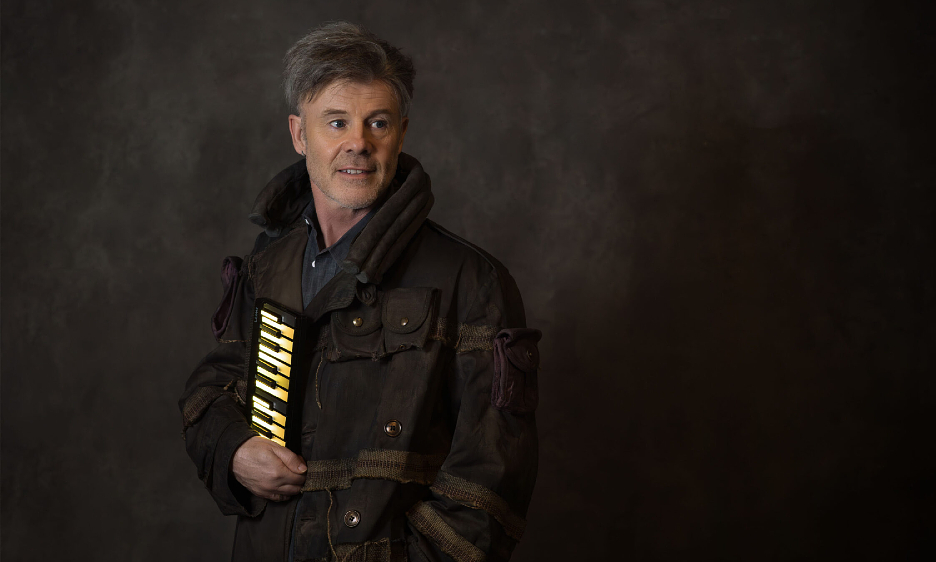
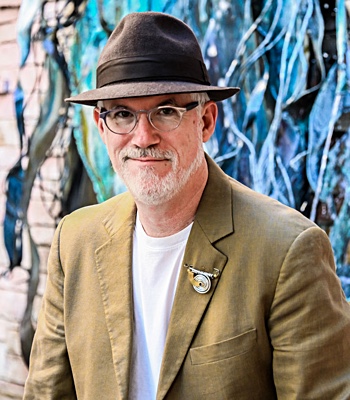
Courtesy Felix Goncalves-Refocus Portrait Studio

When you start to get extended chords and chromatic chord changes and wider harmonies and bigger loops that are getting away from the home scale, that's where I start to connect with music. Some of that happens in jazz and some of it happens in the Romantic and other classical music. Those are really my influences.
All About Jazz: Hi Thomas, thanks so much for taking the time to chat today. We appreciate it.
Thomas Dolby: My pleasure, Kurt. And thank you for the opportunity.
AAJ: When I first heard The Golden Age Of Wireless (Venice in Peril, EMI, 1982), I was instantly drawn in by all of the coloristic effects that you don't really hear very often in popular music. It seemed to me that this has got to be someone who's been listening to some jazz or Bill Evans, because that's what it sounded like to me.
TD: Two things. Number one, I don't know jazz theory. Once you get beyond extended chords, I don't really know what you're talking about, but I found it interesting to read anyway. In a nutshell, a lot of pop music is basically triadic. The most extreme versions of that are country and mariachi music, which is purely triadic and mostly I-IV-V. When you start to get extended chords and chromatic chord changes and wider harmonies and bigger loops that are getting away from the home scale, that's where I start to connect with music. Some of that happens in jazz and some of it happens in the Romantic era and other classical music, as you pointed out with Debussy and Ravel. Those are really my influences. I'm not a hardcore jazzer at all. When you started saying in your piece that these changes are very typical of Herbie Hancock and people like that, I don't relate what I do to any specific jazz players or composers, but I recognize that what I do is wider than the norm. Triadic-sounding music is the easiest for the public to relate to. Some people can't really get beyond that. It's like tasting food: some people prefer more delicate flavors and spices, and others are perfectly happy with relatively bland cheeseburgers. That's what I put it down to. But I can't possibly deny the comparisons that you make, because it's beyond me.
AAJ: What I find really interesting is that when I sat down to transcribe some of these chords, I kept thinking there's no way someone who just dabbles in jazz could simply put their hands on the keyboard and land on these voicings. They feel straight out of the jazz vocabulary. How did you actually discover and develop that harmonic language? I noticed, for example, that one tune on the second Prefab Sprout album Steve McQueen (Kitchenware Epic, 1985) [produced by Dolby] opens with a similar major-seventh chord in third inversion, and I wondered if you were writing around the same time.
TD: Pretty much. I'm basically self-taught, and from the moment I started dabbling on piano, I was drawn to chords that had adjacent seconds and extensions. I've always been into the ambiguity of those types of chords.
AAJ: In quite a few cases, it was actually difficult for me to assign a clear chord symbol because the shapes felt so abstract and open-ended.
TD: Those Budapest [referring to "Budapest by Blimp" from "Aliens Ate My Buick (EMI Manhattan,1988)] ones you got exactly right. It's interesting because sometimes, through playing them live, over time, they evolve. Sometimes things that you wrote sound wrong to me now, and I think, well, he probably wasn't actually wrong. I've evolved to play it slightly differently. For example, in "Budapest by Blimp..." can you hear my keyboard? [Dolby plays the chords to "Budapest by Blimp."] Yeah, okay. You have the sequence. You're exactly right. That's all exactly right. Then the second half of it, I play like this these days. [Plays a variation in the chord changes.] This chord—do you have it playing only one note changing there, which I think is what I did on the record? But when I play it live now, I just go [plays again]. As you get older, those minute changes become very important emotionally. You change one note within the spelling of a chord and it changes the emotional content.
AAJ: So it sounds like the piece is still evolving for you even now, as part of an ongoing, live improvisation.
TD: Yeah. The only other thing you got wrong is the written "SCIENCE!" part. You had it, and it's actually [plays]. It's no big deal. I must have just had it in my head that that's what it sounded like.
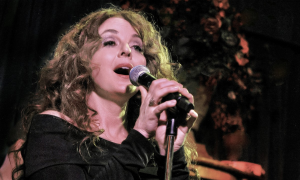
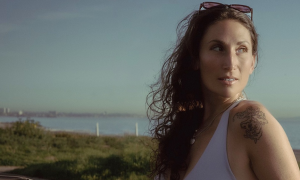
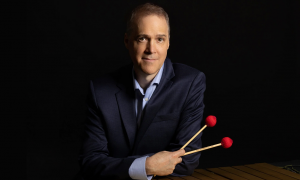
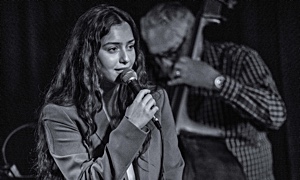
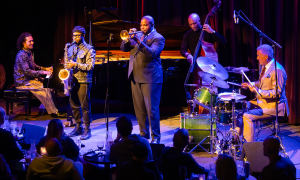
The Jazz Trio Recording of "Budapest by Blimp"
TD: I enjoyed the trio's performance. Hearing them do it was very interesting because a lot of my music has a pedaling note with changing chords or the other way around, some sort of ostinato with the root changing, which some people call "planing" in film music. They were actually taking some of the chords at face value rather than just an inversion with a pedaling root. I've never really thought of those Budapest chords like that. In the B section, they played them with the correct root note. It took the song places I hadn't thought about. It's beautiful when it gets to that chorus. Everything leading up to that, with the voice part over top, really just comes down and gets really settled and then yields toward the ending. Another thing that's evolved is that B section. I'd play it like this now [plays]. Again, that's just evolved. Why is that different? It's a bit more sentimental with the E at the bottom than the F sharp. I've got the E kind of held through that. That E against those three chords sounds really beautiful. But I wouldn't go back to that now. I play it with the parallel sixths.Professor Dolby: Teaching at Peabody and Film Music
AAJ: What does a typical class look like when you're teaching at Peabody?TD: I try to prepare them for the reality of working for clients. The music we do is for film, TV, video games, and virtual reality. There's going to be a client, a boss whose vision you're beholden to. You're the servant of what's going on in front of the camera. You can't go into it with your own agenda. When I was their age, I didn't have those skills. I was lucky enough to get some of those jobs so I didn't really know what I was doing until I'd done it for a few years. I'm trying to pass on the wisdom I learned by trial and error. On the technical side, they can all use Digital Audio Workstations, soft synths and orchestral samples. They're all learning theory, harmony and orchestration in conservatory subjects. But I role-play the director. I take a scene from a movie, take the music out. That's their assignment. I spot it with them and role-play the director who doesn't understand music but is trying to explain emotionally and dramatically what's going on in the scene. Then they ask questions and come back the next week with their version. We play everybody's in class and critique it. Sometimes I'll say, "What if she had gone to the major chord at that point? How would that make us feel?"
They're learning the language of film music as supporting background. Some of them are gamers who want groovy soundtracks for gameplay. Until we started this program there hadn't really been an undergrad program like this at a major US university. The typical thing is to get a music degree then do a master's in film music. The younger generation in COVID were sitting in their rooms thinking how am I going to make a living? They saw TV with orchestral-sounding soundtracks and started experimenting. They want to learn it when they leave high school. We have a recording arts program too and a lot of them are out in the world doing mixing and engineering. In the Hollywood scoring world, the Hans Zimmers have a couple of dozen people working for them. There's a pathway to becoming an A-list composer via interning and gradually working up.
What this really reminds me of is the early days of MTV. The first videos were typical three-camera rock-and-roll shoots, but once the platform was established a bunch of us—myself, Peter Gabriel, Kate Bush, Laurie Anderson—said if you're going to put my video on MTV I want it to be something that actually expresses me. It's a great opportunity to do something different with a new medium and reach a new audience with my music. That's the way I see it with the orchestral circuit.
Dolby's New Symphonic Project
AAJ: Does the new symphonic project have a working title yet? TD: I'm probably not ready to debut the name yet, but there's a working title. Initially, you might think if I'm going to an '80s show I want Footloose and Michael Jackson and Van Halen and Madonna and Prince, but there might be a dozen shows like that and only one of mine. What's special about it is that it's very much through the lens of somebody who was actually there and cropped up in these different places. If I tell the story of Live Aid or playing at the wall with Roger Waters or jamming with Stevie Wonder and Herbie Hancock on the Grammys, it's through my own very personal point of view. Hopefully, that will make it unique. They book a long way out. Before it gets anywhere near an expensive orchestra, I need to workshop the material and the flow. I'm sharing the vocals. I can't cover all the vocals myself. I've got Gail Ann Dorsey and Andrew Lipke guesting. There's a drummer, and the orchestra the audience sees will be a virtual—sampled orchestra and visuals on a video screen. I'm semi-conducting to simulate what the experience will be like with the full orchestra.AAJ: You already incorporate some of those visual and theatrical elements in your current live show, and I thought they worked really well.
TD: There's a real art to it. It's a balance. You don't want to replace people's internal visuals for a song or supplant them and say this is the way you should be viewing it. You need to be a little bit abstract with music visuals and not deprive the audience of their own interpretations. So I wouldn't want to overdo it. Probably a year out. If I'm able to do it sooner with the Peabody Symphony, that would be great. I'd love to do it with my students.
The Synth Solo on "Commercial Breakup"
AAJ: About that synth solo on "Commercial Breakup"—did you play it in a single take, or was it built up through multiple passes and editing?TD: I'm flattered that you thought that was improvised. I don't really improvise because my fingers are always a bar or so behind my brain. I'm have a simplistic technique and I never learned scales or a frame of reference for improvisation. I hear improvised-sounding parts in my mind and I'll figure out what those notes were or sometimes I'll record something, mess it up, listen back and go, I know exactly what I should have done, and edit it with cut and paste and moving notes around the MIDI.
AAJ: It's a great solo. That part in the middle just kind of goes really far out. I thought it was a little like a nod to Thelonious Monk.
TD: I think those influences are there for sure. When I was first learning synth there were people like Chick Corea, Jan Hammer, Joe Zawinul doing guitar-like or horn-like things with a keyboard which hadn't been possible before then, and that influenced me as well.
Dolby's Upcoming Tour
AAJ: Tell us about your upcoming tour—is it related to the new project?TD: Yes. This is the next leg of the prep tour for my symphonic project. Since I've been at Peabody, I leave my office at the end of the day and very often the symphony orchestra is rehearsing, and I go and sit there because it's soothing. One of the things I love about it is that every one of those players has been training all their life. They're now sitting next to each other, and when they play a note, they're responding in microseconds to their own open strings, to the sound of their neighbors, the whole section, the open piano lid, the timpanis, the sound from the back of the hall. When they're really locked in it's like watching a school of fish or a flock of birds. You don't see individual decisions. You just see the collective. That's what happens when great musicians are playing together, and which machines to date lack. I love sitting there, marveling at it and thinking, well, I couldn't program that with the tools we have today. Given the way AI and deep learning are headed, that could become feasible in the next few years. Absent that, the net result of so much exposure to orchestral music is that I think that is really the next frontier for me. It doesn't matter that I skipped music theory lessons and can barely read and write music. I'm just going to dive in and have a go. There's so much to learn about instrumentation and orchestration. It's a whole new realm.
The short of it is that I'm working on a symphony which is going to be my story of the 1980s, told from a first-person perspective with some narration. I'll break it down and do some storytelling at different points, and then with a small band and a full orchestra play the music that was most important to me in that decade, whether my own, or people I worked with, or music that just mattered to me. It becomes a patchwork of different impressions and influences. The quotes come at you thick and fast to the point where you probably give up nudging your neighbor and saying, "Hey, wasn't that The Smiths?" You just let it wash over you.
AAJ: You've done a lot of that in your live show, mashing up different parts of tunes from one album into the other.
TD: On the Totally Tubular tour, I was throwing in chunks of other people's songs. There's the outro to "One of Our Submarines." When I walk up to the mic I have a choice of singing "One of Our Submarines," or "Save a Prayer" by Duran Duran, or "Love Song" by The Cure, "Silent Running" by Mike + The Mechanics, just depending on the mood I'm in that night.
AAJ: I can see the colors of the orchestra really finding a welcome home in your music.
TD: I think it will. It's timely because there's a very strong interest in '80s music at the moment, both for the rewind retro festival kind with headbands and leg warmers, and also for the darker side. If you were living through it with the Cold War and Reagan and Thatcher and corporate greed and general strikes and the Falklands, it felt very dark and disassociated at the time. By today's standards, it was tepid, but it wasn't all pink leg warmers.
AAJ: Have you looked at dates yet? With an orchestra, I assume you would come to a town and rehearse and then perform with the local symphony musicians as if often done.
TD: There is a circuit where local symphonies have half a dozen pops events within their program. They've got people offering them the best of Broadway or Beyoncé meets Beethoven, or Star Wars and Frozen. It helps put bums in seats and brings in a slightly younger audience who may turn into subscribers or donors. Most major cities have a beautiful concert hall and a fine symphony orchestra, but the old way of doing things is dwindling. That audience is getting too old. After COVID, they didn't all come back. Younger people need multiple sources of stimulation. Those symphony halls are an amazing platform for somebody to do something out of the ordinary, not just a tribute, but to create new works that resonate with the times.
AAJ: Where can people find out about your tour dates and everything else related to Thomas Dolby?
TD: You can find it all here. We start in the Northeast on April 14th, running in the US until about the 22nd. I'm doing enough gigs to really break in the new material. In the fall, I did two movements of what will be a five-movement piece. I've added a third, and I'm adding a drummer this time. I'm working toward having it completed by the end of the year and talking to a few different symphonies about where it will be premiered.
AAJ: Great talking to you. I encourage people to check out one of your upcoming shows—your concerts are exciting and fun, but also very personal and intimate.
TD: Thanks a lot. Really appreciate it.
Tags
Interview
Kurt Ellenberger
He Blinded Me With Jazz: The Surprising Jazz DNA in the Music of Thomas Dolby
Bill Evans
Herbie Hancock
Stevie Wonder
Thelonious Monk
Chick Corea
Jan Hammer
Joe Zawinul
Thomas Dolby
Synth Pop
80s music
Jazz influences in popular music
Comments

PREVIOUS / NEXT

Support All About Jazz
 All About Jazz has been a pillar of jazz since 1995, championing it as an art form and, more importantly, supporting the musicians who make it. Our enduring commitment has made "AAJ" one of the most culturally important websites of its kind, read by hundreds of thousands of fans, musicians and industry figures every month.