Home » Jazz Articles » Jazz in Long Form » He Blinded Me With Jazz: The Surprising Jazz DNA in the ...
He Blinded Me With Jazz: The Surprising Jazz DNA in the Music of Thomas Dolby
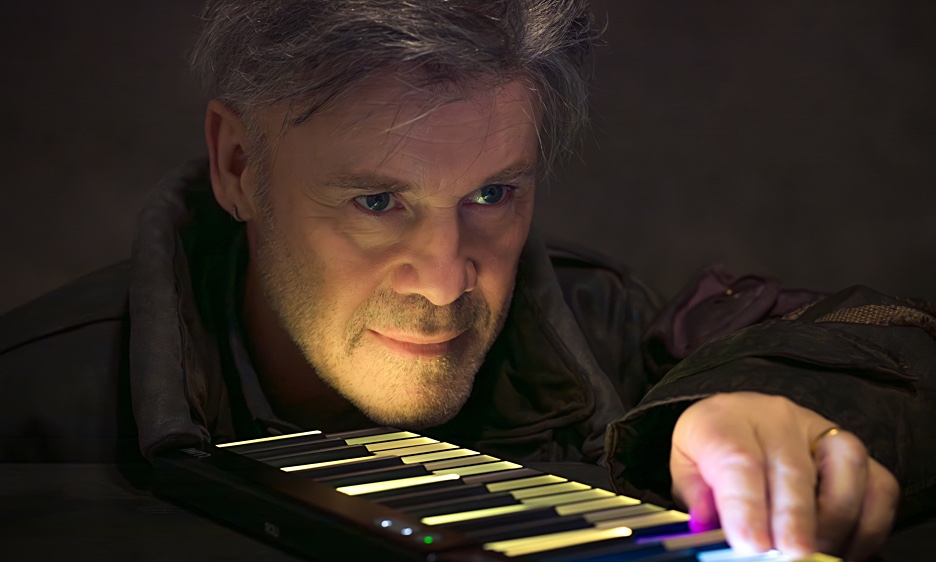
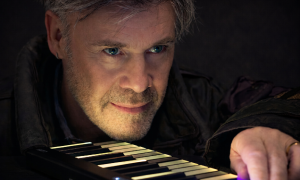
Courtesy Felix Goncalves-Refocus

Dolby incorporates jazz elements in an authentic and creative manner that is so well integrated that we can hardly see it, but...it is there nonetheless.
I. Introduction
Thomas Dolby is one of the most prominent and recognizable synth pop artists of the '80s. His carefully crafted brand as the bookish, bespeckled "mad synthesizer scientist" was perfect for the time period when MTV emerged as a dominant force in the music industry. MTV made the music video an essential part of an artist's success and the primary marketing and branding tool for both the music and the artist.Dolby, like his hero David Bowie before him, was aware of the importance of video and the artist's image from the very beginning of his career. His most successful hit, "She Blinded Me With Science," was carefully crafted to build his image and brand and succeeded marvelously. (Dolby was intimately involved in the production of the video—he wrote the storyboard, which featured many old "scientists" living in a "Home for Deranged Scientists.") The Golden Age of Wireless (EMI-Capitol, 1983) was his first full-length recording and featured "She Blinded Me With Science." It was released in Europe in the spring of 1982. It did not do very well in Europe, but when it was released in the US in early 1983, it moved up the charts quickly and rose to #5. It remained in the top 10 for the remainder of the summer of 1983 and has since become a cultural icon of the '80s, remaining widely known to this day.
He had several other hits, but none that matched the success of "She Blinded Me With Science." These include:
- "Europa and the Pirate Twins" from The Golden Age of Wireless. Notably, this tune relied heavily on the second line rhythm used prominently by the pre-jazz-era brass bands in New Orleans in the 19th Century. It peaked at #37 in the US charts, so it did crack the top 40.
- "Hyperactive" from The Flat Earth (EMI-Capitol, 1984). "Hyperactive" did better in the UK, reaching #17, but not as well in the US, where it topped out at #62.
- "Airhead" from Aliens Ate My Buick (EMI Manhattan, 1988). This irreverent and comical tune is reminiscent of Frank Zappa's "Valley Girl" in its disparagement of a certain female demographic in California."Airhead" had some limited success in Europe, hitting #16 in Italy, and hit #6 on the "Hot Dance Music Club Play/Billboard" list in the US.
II. Encountering Dolby Before "She Blinded Me With Science"
I first heard Thomas Dolby's music in 1982 long before "She Blinded Me With Science" became a big hit the following year. I was in New York City, staying in Queens with a friend, David Bravo,1 a South African musician who was Deodato's keyboard player. David had somewhat of an inside track because of his record company connections from Deodato and had access to all kinds of new music that was not available in the US, except perhaps on college radio stations. One of those recordings was what I assumed to be a bootleg cassette tape copy of The Golden Age of Wireless. I was instantly smitten by it and, against David's explicit instructions, I surreptitiously made a copy of his cassette, which I wore out from listening to it repeatedly before purchasing the album. It was such a refreshing recording in the then-emerging synth-pop/new wave movement. The songs were harmonically rich and interesting, with impeccable production and a sophisticated orchestral approach to the gorgeous synthesizer textures and timbres. And they were all gems of pop music songwriting—not a dog in the bunch! There was also compelling storytelling with some rather serious content ("One of Our Submarines"), and, in the case of "She Blinded Me With Science," it is a cheeky '80s nod to the silent-film era sprinkled with a generous helping of Monty Python absurdity and Benny Hill slapstick looniness.What stood out to me was that there was something in his music that is not generally found in this genre—I heard jazz influences in the melodies and harmonies, which was very satisfying to hear in a genre that does not, by definition, allow for much variation from the standard triadic harmonies and simple melodies. As his career progressed, he regularly leaned into both sides of his musical personality exposed on his first album: Dolby has a delightfully absurd, sometimes irreverent side, but he also has a serious, introspective, and contemplative side. Not surprisingly, it is the former visage that produced the hits, but it is the latter that has earned Dolby a very loyal fanbase that still turns up in large numbers, singing along robustly even with the more obscure songs from his oeuvre.
III. Jazz and Popular Music
The harmonic and melodic language of jazz is certainly present in popular music in varying degrees. Sometimes it is deep in the background, as is the case with Motown, whose session players in bands like the Funk Brothers contributed so much to the music. They were among the finest jazz players in Detroit, providing rhythmic and harmonic subtleties to the Motown hit-making machine. (See my previous five-part article, Ghosts In The Machine, Part 1: Jazz Musicians And Popular Music) Other successful bands, like Chicago, Earth, Wind & Fire, Steely Dan, and Blood, Sweat & Tears, proudly displayed their jazz roots as a defining feature of their unique identities in the popular music genre. We also find advanced harmonies, melodies, and rhythms regularly in progressive rock. Bands like Genesis, Yes, Pink Floyd, U.K., Gentle Giant, and King Crimson masterfully utilized elements from classical and jazz music, so much so that these groups were largely defined by the musical sophistication that resulted from incorporating these art music genres into rock.So, while we can find some jazz DNA in niche genres in popular music, it is much harder to find in the Billboard 100 in the other popular music genres that dominated the charts in the '70s, '80s and to this day. To wit, we would be hard-pressed to identify any jazz influence in disco, punk, yacht rock, folk, new wave, grunge or other popular genres.
This is where Dolby comes in with his first recording and an era-defining smash top 10 hit that is still well-known and popular today. That hit tune, "She Blinded Me With Science" is certainly not jazz, but it does contain harmonic and melodic devices that are generally not found in popular music and are, I think, a significant reason for his initial success and his longevity.
IV. Astronauts and Theoretics: Dolby's "Jazz DNA?"
At the time, I probably couldn't have identified precisely, in music theory terms, what I heard on The Golden Ages of Wireless that sounded "jazzy" to me. Over the ensuing years, as I listened to his music develop from recording to recording, the jazz elements clearly stood out again and again, as Dolby regularly wove them into his music to great effect.In an interview from 2012 and a more recent interview from 2024, Dolby references his jazz background directly:
I sang in a choir when I was 10 or 11, and learned to sightread single lines, but other than that I don't have a formal education. I picked up the guitar initially, playing folk tunes—Dylan—then I graduated to piano when I got interested in jazz, listening to people like Oscar Peterson, Dave Brubeck, Bill Evans, Thelonious Monk, and so on. (Morehead)
There has always been a strong jazz flair in my songs, especially the harmonies. Now you know where it came from! (Potter)
With these statements from Dolby, we will now take a closer look at several of his tunes from different recordings to see exactly how his "strong jazz flair" manifests in his music. We will begin where we would be least likely to find anything from jazz—i.e., in "She Blinded Me With Science," a Top 10 hit from 1983, surrounded by decidedly non-jazzy hits like "Beat It" by Michael Jackson, "Family Man" by Hall and Oates, "She Works Hard for the Money" by Donna Summer, "Flashdance...What a Feeling" by Irene Cara, and "Electric Avenue" by Eddy Grant.
Exhibit #1: "She Blinded Me With Science"
"She Blinded Me With Science" is an 18-measure form,2 shown in Example 1, that resembles the 16-bar blues form, starting with the tonic (I7) for eight measures, and moving to the subdominant (IV7) in measure nine, but that is where the similarity ends:
Example 1: Form of "She Blinded Me With Science"
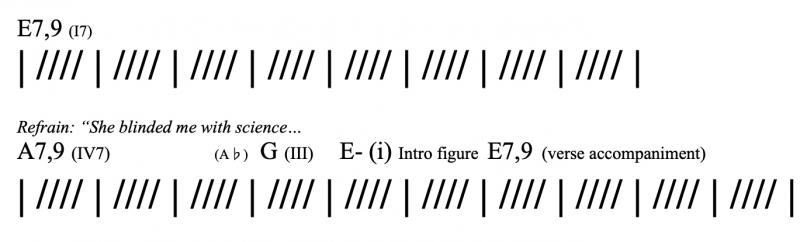
The tune is in mixolydian mode, which means that it is centered on E as the tonic, but uses the key signature of A major. There is some chromaticism, as the A7 moves to G with a passing A♭, and some notable mode mixture at play—most of it is in E mixolydian, but it moves to E dorian after the refrain, where we find the name of the tune in the lyrics. There is also mode mixture in the melody, which is in E dorian, while the chord is E7,9. The accompaniment leans on color tones a bit—the 9th (F#) over E7, and the 9th (B) and 13th (F#) over A7. None of these, by themselves, is unusual, but placed together in such close proximity, they do make for heightened harmonic color and tonal variety. Still, the verse is in E major, while the refrain moves towards E minor which arrives for the first time in measure 13. This creates some tension and ambiguity as the jaunty, comical verse morphs into something more ominous, bringing the form to a close.
Example 2 is the memorable synthesizer melody that opens the piece by itself, and a variation that leads to the Bridge (lyrics: "I don't believe it, there she goes again...") towards the end of the piece at the 3:00 mark.
Example 2: Synthesizer Melody from the Intro and Extended Version Leading to the Bridge
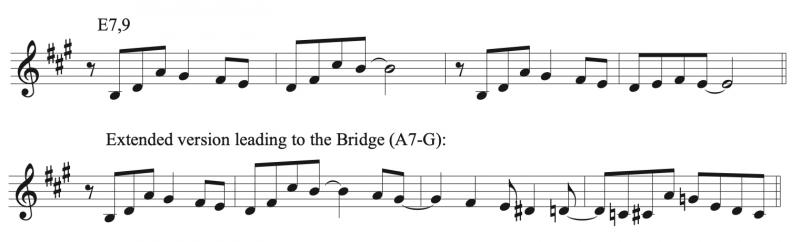
This is where we find some melodic devices common in jazz but uncommon in popular music, at least not referenced so overtly as they are here.
The melodic devices referenced are commonly known as "guide tones" in jazz pedagogy. Basically, guide tones are the third and seventh of each chord, and jazz musicians learn to highlight those pitches by approaching them by step from above and below and in doing so, the single line melody outlines the chord changes—the player therefore sounds like they are "making the changes" and the listener can hear the that the solo and the chords are intimately linked. Highlighting the guide tones is one of the first exercises that young players learn when studying jazz. Jazz theorist Steven Strunk describes them as follows:
Efficient voice leading between chordal thirds and sevenths connects nearly every chord in the progression [of Miles Davis' "Tune Up"]; the notes involved in this voice leading are familiar to many jazz musicians as guide tones." The concept of guide tones originates in jazz pedagogy, where such tones form melodic skeletons called guide-tone lines; guide-tone lines may be used by improvisers to smoothly navigate from one chord to the next. (Smither, par. 0.1)
The guide tone lines stand out as defining features of this synth melody, as shown in Example 3.
Example 3: Guide Tones, Bebop Scale and Surround Tones in the Synth Melody
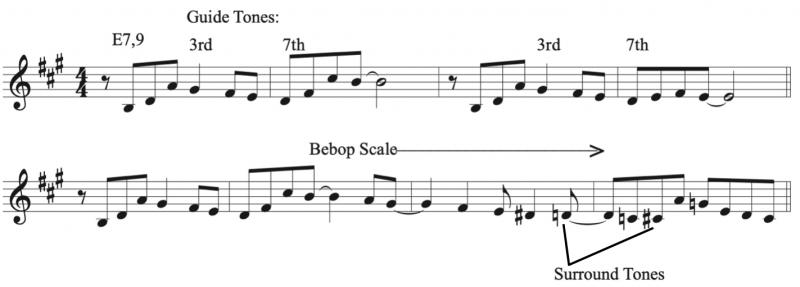
The synth melody highlights the guide tones (thirds and sevenths) by approaching them by step from above or below, and they land on strong beats, than the C# in the last measure which is anticipated by D♮and chromatically encircled by C♮ before landing on the guide tone, C#, the third of A7. This is a chromatic approach to the guide tone that is commonplace in jazz. These are called "surround tones" or "enclosures"—they encircle the goal pitch from above and below before landing on it, and when that is done by half-step as happens here, it introduces a pitch, C♮, that is not in the key. Pitches that are outside of the key are not expected by the listener, so they make the harmonic and melodic landscape more colorful and less predictable.
In the extended version leading to the bridge, we also find another jazz melodic device: the bebop scale. Like the guide tones, the bebop scale is an essential part of the jazz musician's melodic vocabulary and is learned early on as a fundamental scale of jazz.
There is also another melodic device used regularly in jazz in this melody: "octave displacement." The Jazz Piano Site defines octave displacement as follows:
To make our solo more interesting we want to insert a few bigger jumps in-between our smooth lines to create a bit more interest and contrast. This means we want to introduce some jaggedness into our melodic contour... A simple way of doing this is with octave displacement. All this involves is shifting a note in a linear phrase up or down by an octave and continuing the phrase in that new octave. So we are literally displacing a note by an octave. (Walk That Bass)
This technique was likely used to compensate for range restrictions in wind instruments, but it quickly became an essential part of the bebop language, used by instrumentalists and vocalists alike. It provides variety in the melodic line that is more surprising and interesting than running the scale in the same direction. Musician and composer Kevin Sun relays his discussion with trumpeter Brian Lynch:
A couple of years back, I had the chance to hang out a bit with trumpeter Brian Lynch at the Brubeck Summer Jazz Colony... Of the concepts we discussed, one particular point has been on my mind...the use of octave displacement in creating lines and melodic shapes... In a bebop context, octave displacement serves a practical purpose by enabling lines to fit in the range constraints of a given instrument, e.g., saxophone or trumpet. A simple example is dropping the end of a line down an octave when nearing a note that's above an instrument's comfortable range. From what I can remember from speaking with Brian, horn players used O.D. [octave displacement] to adapt lines from pianists like Bud Powell to their instruments. It also gave musicians greater directional flexibility—sort of like wearing cleats and being able to switch directions, ascending or descending, in a moment's notice. (Sun)
The octave displacement occurs in Dolby's synth melody in the second measure, as shown in Example 4. Instead of running the line down the scale, the large leap up to C# is a surprise, and is therefore more interesting and satisfying.
Example 4: Synth Melody With and Without Octave Displacement
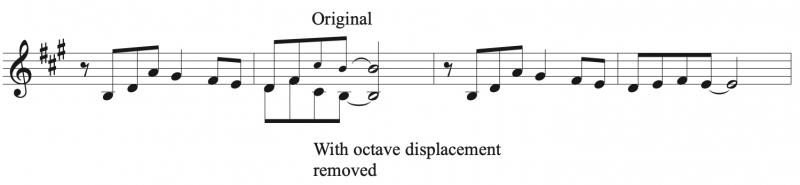
Here is the melody with the octave displacement removed. The melody loses all of its charm as well as its need to be "answered" by the second part of the phrase. Without the octave displacement, the entire phrase is a dead end; with it, it is a pregnant question that makes the answer in the second part satisfying.
This short melody is a catchy, memorable earworm that is an integral part of the song. What makes it so memorable? The use of jazz melodic devices is a large part of why it works so well: the guide tone lines highlight the harmony clearly and pleasingly, the octave displacement links the two parts of the phrase into a satisfying whole, the chromatic surround tone introduces more color, the use of three different modes, and the bebop scale is a direct nod to jazz that, like the surround tones, introduces D#, another pitch that is not in the key.
There is also a remarkable use of yet another mode built on E, shown in Example 5, which enters in the second verse. We have already seen that the tune starts in E mixolydian and ends in E dorian, so it moves from major to minor tonality within only 14 measures. The other mode at play here is a much more provocative mode that is not found in very often in popular music, and certainly not in a top 10 hit song—that mode is the phrygian mode (in this case, again on E). The phrygian mode is commonly used in heavy metal, where its ominous, foreboding character fits perfectly with the genre's darker themes. We find it appearing for the first time in the second verse, where it accompanies the scientist's manic incantation of "Science," which he screams as if it is a talisman that will ward off the evil spirits troubling Mr. Dolby (who is primping and preening luxuriously on the psychiatrist's couch in the video).
Example 5: The Arrival of E Phrygian Mode in the Second Verse ("SCIENCE!")

The phrygian mode brings with it a dramatic mood change that is sinister and grim, taking the E dorian turn another step to the dark side of madness. Technically, the phrygian mode introduces F♮, another new pitch that is not in the key. F♮ is provocative because it is a half-step above the tonic, and the dissonance that results is strong and destabilizing.
Along with the A♭ major passing chord in the verse, we now arrive at a "pitch inventory" that contains 11 of the possible 12 pitches—the only pitch missing is B♭. Jazz and classical music regularly use all 12 pitches, often within a handful of measures. It is, however, far rarer for popular music where songs regularly use only 8-9 of the possible 12 pitches. Viewed numerically, this may seem like an insignificant difference, but in a universe of 12 pitches, eschewing three or four of them limits the pitch and chord variety by 25-33%, which is significant.
Unlike most popular music artists and similar to jazz and classical composers, Dolby is at home in the fully chromatic world, and masterfully incorporates a high level of chromaticism without making it off-putting in the least.
In closing this part of the discussion, it might be helpful to list the harmonic and melodic devices used in jazz that are found in this tune:
- guide tones,
- surrounding tones/enclosures,
- bebop scale,
- octave displacement,
- mixolydian, dorian, and phrygian modes,
- pitch inventory: 11 of the 12 possible pitches in a pop tune under four minutes in length.
Exhibit #2: "Commercial Breakup"
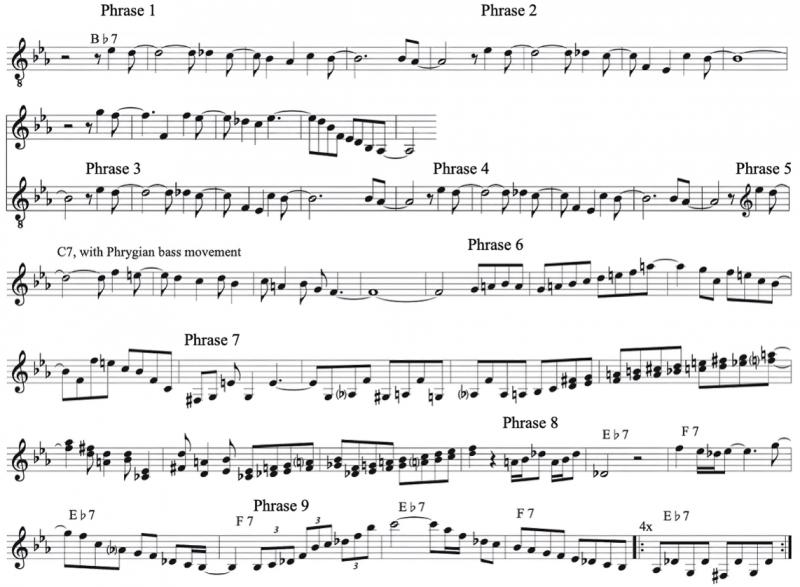
"Commercial Breakup" is another track from The Golden Ages of Wireless and it is somewhat of a unicorn in the genre in that it contains an improvised, or largely improvised, synthesizer solo that accounts for over 25% or the track's length, which is unheard of in this genre.Example 6: Transcription of Thomas Dolby's Synthesizer Solo in "Commercial Breakup"
Analysis:
The solo, as seen in the transcription3 in Example 6, contains nine phrases.Phrase 1
Phrase 1 is a simple descending scale that, as before, highlights the guide tones. It contains the minor third (D♭) as a passing tone, giving it a bit of a bluesy flavor, mimicking the bebop scale.Phrase 2
Phrase 2 is a slight variation on Phrase 1.Phrase 3
Phrase 3 adds a new harmonized line that uses a fragment of the melody from Phrase 1/2 that begins a measure later and then veers off into a descending 8th note phrase that highlights the guide tones once again, but in a more florid manner.Phrase 4
Phrase 4 closes it out with a restatement of Phrase 2 and 3.These first four phrases seem more composed rather than freely improvised. However, they function as jazz improvisation does—they present a motif, and build on it with increasing levels of variation, and then finish with a final unadorned statement.
Phrase 5
Phrase 5 begins with the same notes as the previous four phrases, which makes it sound like it will continue with that motif, but it doesn't—it moves up a step to match the new chord, C7. It then continues on with a descending line that is a variation on the descending line from the previous phrases. It lands on F♮ and stays there for almost eight beats, which is a bit provocative because F is the fourth of the chord, and begs a resolution to the third, but that resolution never arrives. Additionally, while the chord is C7, the bass surrounds the root from above with a D♭, which, as in "She Blinded Me With Science" invokes the phrygian mode, giving Phrases 5 and 6 an edgier tone. (In a bit of comic relief, Bob Barker makes a cameo appearance here, announcing a prize—a telephone—on the popular game show The Price Is Right. This could be an example of some coded "text painting" given that The Price Is Right was nominally a game show, but in practice, it was really just an hour-long commercial— a Commercial Breakup?—for the companies that donated the prizes.)Phrase 6
Phrase 6 introduces new melodic material that is not directly related to the initial motif. It uses the C mixolydian scale, which fits the chord, and again highlights the guide tones, but also includes more jagged shapes that feature the unresolved fourth of the chord, F♮. Dolby is taking it a bit further out as his fealty to the guide tones appears to be waning.Phrase 7
Phrase 7 starts with a hemiola4 figure that begins with the fifth and third of the chord, but then slides up chromatically and hovers there a bit before moving to a rising eighth-note line in thirds. This is where it gets very dissonant for the first time because the thirds are all major thirds, which gives it a strong whole-tone scale flavor. The whole-tone third line is followed by another hemiola that takes it even further out harmonically with dissonant chords (D major, B major, E♭ major) over C7. This a freer improvisational approach that allows for more provocative dissonances that appear to me to be a nod to Thelonious Monk or Cecil Taylor. The phrase ends with another rising line in thirds that finishes on the forever unresolved F♮, as if Dolby is saying "Yeah, I know how the guide tones work, but I can also ignore them if I want to."Phrases 8 and 9
After the increased dissonance and felonious funk from Phrase 7, Dolby brings it back in with some overtly bluesy lines. In the measure before Phrase 9, he juxtaposes F-9 on top of E♭7, quoting a well-known jazz lick, shown in Example 7, that we can find used regularly by Evans, John Coltrane, and many other jazz artists.5Example 7: Commonly Used Jazz Lick Highlighting F minor 9

The solo gets more rhythmically active and varied, with triplets appearing for the first time. The last set of triplets in particular is very telling— Dolby places them slightly behind the beat, which shows an understanding of how jazz players masterfully maneuver around the beat to great emotional effect. This ratchets up the excitement level considerably, as does the melody's move to the highest note in the solo, C♮. Dolby then winds it down and seamlessly morphs into the quasi-montuno figure that is repeated four times before the vocals return.
In one of the interviews referenced earlier, Dolby voices some reservations on embracing a full-blown jazz aesthetic:
I dabbled in jazz and was attracted to the bohemian lifestyle but could never stand the endless self-indulgent solos. (Potter)
This is not an unusual sentiment—there are a lot of musicians and non-musicians who enjoy the genre when it is more restrained, as found in the music of Oscar Peterson, Bill Evans, Chet Baker, Miles Davis in the 1950s, Dave Brubeck, and others whose improvised statements are more contained and compositional than what emerged in the 1960s.
We can see this aesthetic clearly in jazz-inflected popular music, such as Steely Dan, Chicago, Little Feat, and even in progressive rock in groups like U.K. They contain exquisitely crafted improvisations but are highly constrained and subject to a compositional aesthetic that treats improvisation as part of the larger structure, not the reason for it, as in jazz proper. Indeed, this can be a point of tension between musicians, as was the case with Eddie Jobson and John Wetton from the British all-star group, U.K., who bristled at the fact that the powerhouse jazz guitarist in the group, Allan Holdsworth, would not—I would argue could not—reproduce the solos from their recording in live concerts.
In the case of "Commercial Breakup," Dolby has crafted an extended (for the genre) synth solo that has compositional elements (Phrases 1-4) and fully improvised sections (Phrases 5-9). How does this play out in a live setting?
In the video below, we see Dolby's performance of "Commercial Breakup" at the Virginia Arts Recording Studio in 2012. His approach to the solo is interesting and revealing. He performs Phrases 1-4 verbatim as on the recording, and sings the harmonized second line in Phrase 3. He quotes Phrases 5-6 largely verbatim, and then opens it up and improvises freely. As in the recording, Phrase 7 is where he takes it "out" a bit. Nonetheless, he is still using some of the shapes and gestures of the recorded version. We can see clearly that the ghost of the studio recording haunts the live performance, which happens in jazz, too. We can hear the highest level jazz musicians, like Bill Evans,6 Lee Morgan, John Coltrane, and many others using similar gestures and figures in live performances.
In "Commercial Breakup," Dolby delivers an excellent improvisation that shows his fondness for jazz, but it is jazz on his terms: improvisational, yet constrained and concise. As in "She Blinded Me with Science," his solo here exhibits a nuanced understanding of jazz harmony and melody and rhythmically, it is in the pocket. It has tasteful blues references, and idiomatic use of guide tones and bebop scales. It is logically developed through motifs and their variations. It also features strong dissonances that are unheard of in popular music. And finally, the solo builds well—it has a strong arc, reaching its climax near the end, then effortlessly and logically retreating to prepare the transition back to the verse.
Exhibit 3: "Budapest by Blimp"
"She Blinded Me With Science" and "Commercial Breakup" covertly featured many stealth jazz elements, hiding in plain sight, as it were. In contrast, "Budapest by Blimp," from his recording Aliens Ate My Buick, takes the mask off. In this piece, Dolby makes his jazz affinities crystal clear and, in the process, crafts perhaps his most reflective and poignant work.Example 8 is a leadsheet for "Budapest by Blimp."7In it, we find a series of gorgeous chords over a G# pedal in the verse, with similarly rich harmony in the chorus. The use of a pedal with shifting modalities and harmonies above it is common in jazz—we find it used in Coltrane's "Naima," Herbie Hancock's "Dolphin Dance," and many others. At the end of the chorus, the melancholy gives way to anger, in a brief turn towards the darkness of the phrygian mode, which we encountered in the previous two pieces.
Example 8: Leadsheet for "Budapest by Blimp"
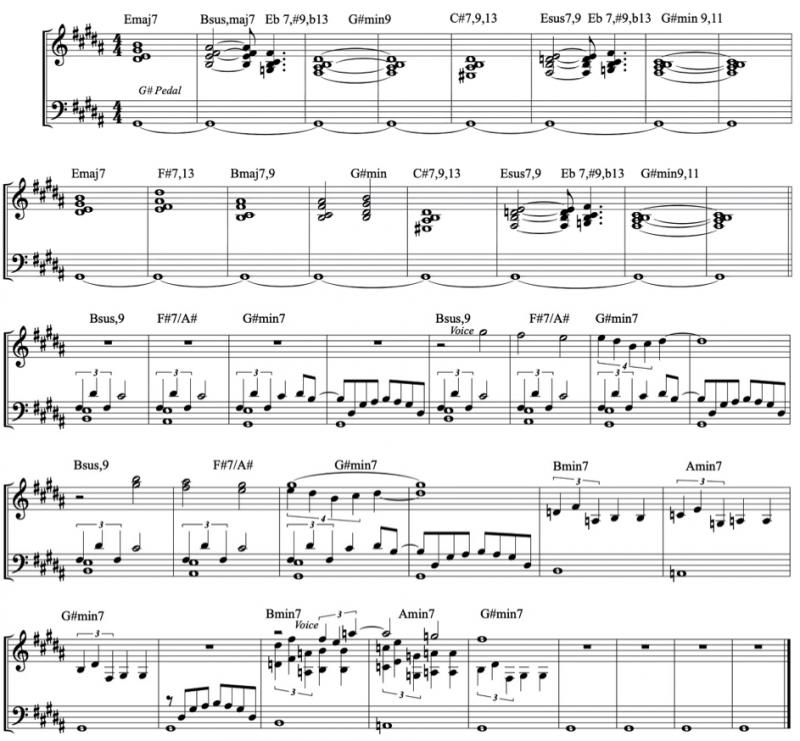
In the previous two pieces, a fair amount of analytical work was required to reveal the jazz components—in this piece, that is hardly required. We can hear instantly that these are jazz harmonies of the highest order. Many of the voicings (Emaj7, C#7, 9, 13, E♭7, #9, ♭13, G#min9, 11) are standard jazz keyboard voicings that we can find abundantly in the music of Bill Evans, Herbie Hancock, Geri Allen, Keith Jarrett, John Taylor, and virtually every jazz pianist working today. Others, however, are not standard voicings at all—they contain intriguing shapes and clusters that help to create a brooding, neo-impressionist mood. These types of harmonies are found in the music of jazz musicians Kenny Wheeler, Maria Schneider, Tomasz Stańko, and others. Interestingly, they are also found in the music of Maurice Ravel, Claude Debussy and many others whose music is awash with rich, autumnal colors, basking unapologetically in deep, reflective introspection.
In Closing
Dolby has done something remarkable as a creative artist in pop music: he has skillfully woven significant elements of jazz into his work in surprising and interesting ways. In lesser talents, this could easily have devolved into kitsch or novelty, as often happens when artists seek inspiration from other genres. There is not a whiff of that here—Dolby incorporated jazz elements in an authentic and creative manner that is so well integrated that we can hardly see it, but, as we have seen, it is there nonetheless. As he said in the 2024 interview, "There has always been a strong jazz flair in my songs, especially the harmonies. Now you know where it came from."Indeed—we certainly do.
Coda
As I was working on this article, I kept wondering what "Budapest by Blimp" would sound like interpreted by a professional jazz group. I contacted my former student, Keaton Royer, who is one of Detroit's finest jazz pianists and accompanists, and asked him to record it with his group. I gave him no indication of tempo or anything else—the only requirement was to play the chords and come up with an arrangement. The only melodies included were the synth "voice" parts and the chorus melody with its striking accompaniment figures. I also told him that if anyone recognized the tune, they should ask them not to divulge the source, so they would not have any bias or preconceived notions about how to play it. Their recording of "Budapest by Blimp" is found in the YouTube video below.Special Thanks:
Dr. David Morgan (aka "The Compass") for excellent feedback and never-waning encouragement and support.Dr. Josiah Boornazian for his excellent editorial suggestions and overall support.
The Keaton Royer Trio: Keaton Royer, piano Brennan Andes, bass Jon Taylor, drums
Engineer: Darrin James
Recorded at Ravine Records, Ann Arbor, Michigan
Endnotes
[1] I met David Bravo the previous year in a touring "vaudeville revival" show featuring Joey Bishop and Jack Jones, directed by the controversial New York promoter, the late Roy Radin. The show toured the East Coast and was led by bassist Gordon Edwards, who was in the all-star '70s fusion band, Stuff.↩[2] The form stretches after the first iteration and the length increases. ↩
[3] I have intentionally left out grace notes, portamento, and other embellishments. ↩
[4] A hemiola is a rhythmic device that imposes a three-beat figure over the 4/4 time signature, which introduces a rhythmic dissonance into the texture. ↩
[5] For examples of this, compare Lee Morgan's solo from Art Blakey and the Jazz Messengers "Moanin'" and live versions—he begins his solo verbatim from the recording. Or, compare Take 2 and Take 3 of Bill Evans' "All of You" from Bill Evans Trio: Sunday At The Village Vanguard & Waltz for Debby that begin with similar melodic and rhythmic gestures. Another example of this is Coltrane's solos on "Giant Steps" in the outtakes, which are similar to each other.↩
[6] This figure highlights F minor 9, and works well over that chord and over B♭7 where the F minor 9 represents 13, 5, and 9. But it is more commonly used over E7, where the F minor 9 becomes #9,♭9, ♭13. ↩
[7] I have presented an "averaged out" version of the tune in leadsheet format without the verse melody because the analysis is mostly focused on the harmony. It differs from the recording, but I hope that it captures the general shape and form nonetheless. ↩
Works Cited
Morehead, James. "Thomas Dolby on Music Education and the Evolution of the Music Industry." OneDublin.org, 14 Apr. 2012.Potter, Jordan. "Thomas Dolby Picks His Favourite Jazz Album." Far Out Magazine, 9 July 2024.
Sean R. Smither. "Guide-Tone Space: Navigating Voice- Leading Syntax in Tonal Jazz." Music Theory Online 25, no. 2, July 2019.
Sun, Kevin. "Octave Displacement: Application and Practice." Kevin Sun Music, 12 July 2012.
Walk That Bass. "Octave Displacement and Pivot Arpeggios." The Jazz Piano Site, accessed 20 March 2026.
Tags
Jazz in Long Form
Kurt Ellenberger
David Bowie
Deodato
oscar peterson
Dave Brubeck
Bill Evans
Thelonious Monk
Cecil Taylor
John Coltrane
Chet Baker
Miles Davis
Alan Holdsworth
lee morgan
Herbie Hancock
Geri Allen
Keith Jarrett
John Taylor
Kenny Wheeler
Maria Schneider
Tomas Stanko
Keaton Royer
Brennan Andes
Jon Taylor
Gordon Edwards
Art Blakey
Comments

PREVIOUS / NEXT


Support All About Jazz
 All About Jazz has been a pillar of jazz since 1995, championing it as an art form and, more importantly, supporting the musicians who make it. Our enduring commitment has made "AAJ" one of the most culturally important websites of its kind, read by hundreds of thousands of fans, musicians and industry figures every month.