Home » Jazz Articles » History of Jazz » That's Club Harlem in West Philly, NOT Club Harlem in At...
That's Club Harlem in West Philly, NOT Club Harlem in Atlantic City

Club Harlem was a product of a city and a society very much in transition. And it is not as if the motives for its establishment were particularly noble: the idea was to make a buck off the burgeoning black population of West Philadelphia in the 1950s, "a grand scramble for Negro attractions," as Billboard Magazine put it in the language of the day, West Philly had previously been an enclave of immigrants, Jews and Italians mostly, in a city in which as recently as 1925, the black population was not much more than ten percent. But this had begun to change in a big way with the Great Migration of black people from the South in the late 1940s. Parts of South and West Philadelphia became the places into which the blacks moved in as Irish-Americans and, to a lesser extent, Italian Americans moved out. And with their growing numbers, there was opportunity.
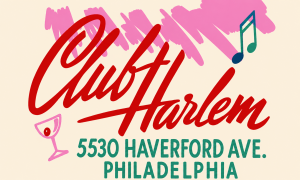
People with backgrounds in clubs with values rooted in vaudeville and live entertainment knew that everyone needed a respite from a day's work: a place where just showing up to see Someone meant you could be Someone in a society in which the established rules had long said that was not possible. As Bon Bon, the singer George Tunnell (1912-1975), who had become familiar to white society as with the Philadelphia-based big band of Jan Savitt in the 1930s put it, "For years now, the question has been asked," When will colored night club patrons have an honest to goodness, first class, modern night club offering the best in entertainment in moderate prices. Well, friends, 'This is it.' The new Club Harlem located at 5530 Haverford Avenue: seating capacity 625; never a cover or a minimum; three bars at different elevations, each about 100 feet long." Tunnell gave this prospectus in 1950. Within a year, the club was up and running. And "there will be no tipping at the checkroom, bar, or table... visibility excellent from all points." Who could resist? When the Club advertised for help in the checkroom or for the souvenir photography, the female employee, in her early 20s, had to be "attractive." Nobody said anything about color. The subject was either obvious or irrelevant.
Realistically, what did seem to concern the business types was the sheer profusion of jazz clubs in West Philadelphia, all of which would ultimately, at least in the short run, be competing for the same dollars. The Powelton Cafe, which was not all that far away, had also gone in for attracting "names" or top talent and had pulled in a big crowd with Sarah Vaughan, who would also subsequently open the Club Harlem with Slam Stewart on October 2, 1950. There was also the Club 421 (still standing today!), where, according to Odean Pope, Charlie Parker "played with strings many times." And, yes, Bird would also be a major attraction at the Club Harlem when he was in town and well enough to play. Then there was the Earle Theater at 11th and Market, downtown, open since 1925 and reopening soon from a hiatus with Dinah Washington, Eddie "Cleanhead" Vinson (who also played the Powelton) and Arnett Cobb. And there were other clubs too in Philadelphia, including the famous Click as well as the original Latin Casino, which would ultimately migrate across the Delaware to New Jersey. As a writer in Billboard Magazine wondered—all too perceptively, it would turn out—"Whether there's enough loot around to satisfy the tills at all the rooms remains to be seen."
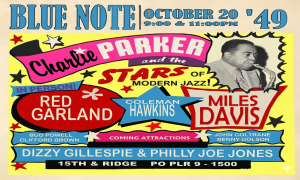
Yet there was another problem, or rather problems, and money alone could not solve it. Like the Blue Note Cafe on Ridge Avenue, the Club Harlem may have been primarily intended for the now-growing black population of Philadelphia, but it welcomed white acts and patrons as well. The Club Harlem would feature Stan Kenton, Buddy DeFranco, Georgie Auld, and, if that was not enough of a signal, former Glenn Miller singer, Ray Eberle, who also showed up in movies, like Orchestra Wives. Nobody would have confused Eberle for what was termed, at the time, a "race" singer, because he was about as plain vanilla as a singer could get. Anyone with a knowledge of the history of Philadelphia in the late twentieth century could tell you that mixed crowds may have been tolerated, but they were hardly encouraged by the city fathers. There were two musicians' unions (in this, Philadelphia was not unique), Local 274, the black local, and the white Local 77, and the black union lasted in Philadelphia until 1971. While the overall process of consolidation took place during the 1960s, it started earlier in some places (Los Angeles) it was far from a happy marriage in Philadelphia. At one point, in 1950, the Atlantic City Club Harlem—much better known then—was reported to be taking over the Click, owned by Frank Palumbo. In the words of one report, "In the face of obstacles laid down by various unions, plus unconfirmed reports that certain people in city government were not too happy about the prospects of a Harlem-styled cabaret in the heart of town (the Click was at 16th and Market, which is basically Ground Zero in Philadelphia), ... fell through." Palumbo must have been looking for a buyer, because the Click closed down soon after, a part of the wave of collapsing swing bands that started right after World War II, for which the Click had been a major venue.
Economics was, no doubt, a big part of the problem. But it was not the only one. In January 1951, the Philadelphia police, always on the lookout for serious corruption, announced a "crack down" on bars "harboring minors" (i.e., drinkers under the age of 21). The police were pretty good at this sort of thing, particularly when it involved mixed-race audiences, which the new police commissioner Thomas Gibbons regarded as an invitation to drug traffic, at least. This was no idle threat. The police raided the Blue Note Cafe and then proceeded to raid the Club Harlem twice in June 1952. Curiously, underage drinkers at the Club Harlem, who had all previously certified they were 21 years of age, were all white and all were released the following day, if it took that long (a couple of Stan Kenton's trombonists, presumably white as well, came along for the ride). The Club Harlem lost its liquor license within days. Like some other clubs, it was already in trouble for unpaid federal taxes amounting to $1071.13—probably withholding—well over $30,000 today, not exactly a trivial sum. If you could not sell alcohol in a nightclub and were liable for back taxes, you were in trouble. By 1953, Club Harlem had vanished.
There had always been rumors, almost from the beginning, that the Club Harlem was operating on a tight margin—for all the reasons to which we have alluded—and at some later point, the club simply closed. While some point to a "labor dispute" as the source of a closing, it is easy to imagine that being unable to pay its bills, wages included, would have been enough. The State Liquor Control Board had already shut down Reynolds Hall, a venue at Broad and Master in North Philly where Bird with Red Rodney had been featured, so, in a way, this was business as usual.
What did these people have against jazz, mixed bands, and mixed audiences? Well, you could have asked that question in a lot of places in the United States in the 1950s. It was a sad fact of life, but there it was. Curiously, other far less famous venues in West Philly featured a jazz policy, although the "names" might have been less celebrated. One of them was a bar named Skippy's, also on Haverford Avenue, but in an Italian American neighborhood where the featured saxophone was Mike Pedicin, Sr. Skippy's was always in trouble with the police, but not for underage drinking. Skippy's augmented its cash flow by a bookmaking/numbers business, which the police repeatedly raided, much to the annoyance of the owners, the Scaperotto family, dating back to 1941. Mrs. Scaperotto, who was actually the licensee, had been arrested 9 times, and her husband, Albert, either jointly or as the sole perp, had racked up 22 arrests between 1941 and 1965. But the Scaperottos were generally handled more gently, occasionally enduring only house arrest.
Albert was suitably outraged, "Every time we turn around, you're [the police] at our heels." Perhaps what made the difference was that West Philly was under the benign gaze of Lt. Frank L. Rizzo, "The Cisco Kid," who was already under fire for allegations of police brutality. Rizzo maintained, "I am not racially prejudiced." Well, whatever, Skippy's never lost its liquor license, and by the late 1960s and early 1970s, had blossomed into a full flown boite de nuite, just as the Club Harlem had been some years earlier. Did race have anything to do with it? Let the reader judge. As for Frank Rizzo, he ended up as the city's very controversial Mayor (1972-1980) after a stint as police commissioner.
Whatever the case, there is a sense of a lost opportunity, a chance to bring together a group of different people who shared a common love of jazz, not to say an occasional drink. Alcohol was the social lubricant and probably the financial engine (maybe with some sketchy finance) that drove the clubs, all of them, both black and white. Jazz was the vehicle. When pianist Ray Bryant moved as house pianist from the shuttered Club Harlem to Billy Krechmer's, Jam Session on Ranstead Street see my Billy Krechmer: A Philadelphia Story he moved from black to white, and from bop to Dixieland. Trumpet player Tommy Simms made a similar move from the Web Club to Krechmer's top soloist. In a country whose latent divisions needed little encouragement to become open warfare, did the Club Harlem, the Blue Note Cafe, or Reynolds Hall deserve their fate? Or did we just leave it to the Frank Rizzos to decide? Look at the results.
Tags
Comments
PREVIOUS / NEXT
Support All About Jazz
 All About Jazz has been a pillar of jazz since 1995, championing it as an art form and, more importantly, supporting the musicians who make it. Our enduring commitment has made "AAJ" one of the most culturally important websites of its kind, read by hundreds of thousands of fans, musicians and industry figures every month.