Home » Jazz Articles » History of Jazz » In Circuses and Carnivals, Sideshows Brought Black Music...
In Circuses and Carnivals, Sideshows Brought Black Music To The Heartland
Courtesy Huntington Digital Library

Good things cometh to he who waiteth as long as he hustleth while he waiteth.
—P.G. Lowery
Trumpeter Lester Bowie, later known for the avant-garde Association for the Advancement of Creative Musicians (AACM), Art Ensemble of Chicago, and Brass Fantasy, joined circus and carnival bands early in his career when he needed any job he could get, he told writer Ted Panken in a series of interviews for WKCR-FM in New York. He also played in small combo R&B rhythm and blues bands, and big bands that backed soul and R&B performers but were populated with such jazz players and arrangers as Kenny Dorham, Blue Mitchell, and Johnny Coles who needed the work too. "To work then, you had to work in that kind of situation," Bowie related. For Bowie it was all an education, yielding a library of technique, style, and sounds from various traditions to draw upon later in free jazz.
By the early 1900s, most circuses had a Black sideshow band and/or minstrel show. These were the days before radio, movies, and television, when circuses and carnivals were entertainment sensations, mesmerizing the way electronic media are now, presenting the exciting, the mysterious, the foreign and strangely glamorous to those in the heartlands.
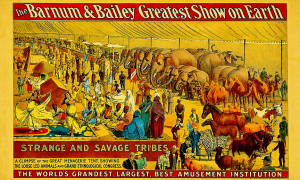
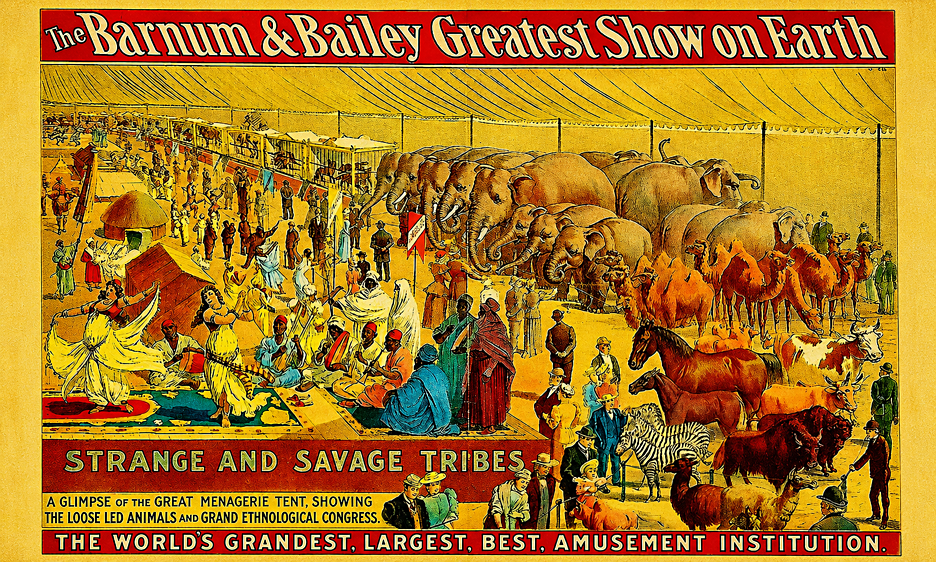
They drew the curious and the mocking, and left them entertained and often confused about their attractions. The circus impresario P.T. Barnum earlier had posed Black musicians as from distant Africa, and positioned them in the sideshow among other curiosities. The bands worked under the prejudices and gaze of segregation, featured attractions on stages of their own even if situated to the margins.
The shows traveled by rail in the days before airlines and highways. The carnival circuit was separate from territory bands and standard revues, which played more formal shows and dances, covered at Blue Highways and Sweet Music: The Territory Bands, Part II. Bowie learned that other musicians who he later met in New York had similar shared experiences. Lester Young, the "Pres" of the tenor saxophone, had started with a family circus band in New Orleans and the Southeast that extended to carnival, theater, and hotel engagements in Oklahoma, Iowa, Minnesota, and North Dakota. Blues singers Bessie Smith and Gertrude "Ma" Rainey played in tent shows. When the Art Ensemble of Chicago went to Europe and had gaps between engagements and residences, Bowie recalled, its members already had experience living in tents and trucks.
Midwest, Harlem, Havana
One of the carnival bands that Lester Bowie joined was Leon Claxton's Harlem in Havana Revue. Set up on a tented sideshow stage, Claxton's floor show of musicians and dancers emulated what had been presented in New York's Cotton Club or stage shows in Havana, when Havana was Las Vegas before there was a Vegas. The show also included variety acts, comedians, and singers. It was a touring ensemble that aspired to be something more than a carnival girlie show and striptease. It featured a mix of swing, Afro-Cuban rhythms, and blues; over time adding R&B, and Doo-Wop, blending Black and Latin musical traditions for a unique carnival sound that also forecast the birth of soul and rock and roll.Singer/composer Joni Mitchell has recalled the carnival that came to her hometown of Saskatoon, Saskatchewan, Canada every summer. "Harlem in Havana" was foreign, high-spirited, and thereby an attraction. In an interview with Jody Denberg on KGSR-FM in Austin, she remembered the cacophony of circus generators alongside the sideshow, driving a Ferris wheel, the Caterpillar ride, a motorcycle globe of death, and the forbidden territory of Harlem in Havana. "Our parents said, Don't let me catch you there," she recalled. "Every hour on the hour, the band would come out onto the bandstand, and it had a good horn section. And it was my first exposure to black music live. And it was way back on the beat and swampy and the source of total fascination for me."
She recalled chorus girls in blue satin capes with silver spangles who came out in front of the sideshow tent, while a barker promoted the show. For Mitchell, the call of this world was irresistible. "When I heard this, I'd go running—to see the band file out—horns in hand—and seat themselves behind the blue and silver music stands. They'd begin to play this brassy, stripper groove—so slow and humid." She recalled a lot of plumage and high kicking and great music.
Mitchell retrieved that memory in the lyric to her song Harlem in Havana from her 1998 album Taming the Tiger" (Reprise, 1998). Contemporary jazz artists Wayne Shorter on tenor saxophone and Brian Blade on drums were in her band for the album. The song was revisited instrumentally by pianist Herbie Hancock on his album River: The Joni Letters (Verve, 2007), again with Wayne Shorter.
"At the far end of the midway, by the double ferris wheel,
There's a band that plays so snakey, You can't help how you feel...
They play "Night Train" so snakey, Black girls dancing, Long and leggy...
Silver spangles, See 'em dangle in the farm boys' eyes,
Hootchie kootchie, Auntie Ruthie would've cried, If she knew we were on the inside."
(Copyright 1968, Joni Mitchell)
The story of the Claxton shows has been preserved in a documentary video by his granddaughter Leslie Cunningham, JIG SHOW: Leon Claxton's Harlem in Havana Revue, a pair of books about the showgirls, and a traveling multimedia exhibit. It intentionally uses the derogatory term "jig" from the Jim Crow era as a descriptor of historical context, recapturing the phrase to override its sting. Less toxic interpretations are offered that the dancers were "jiggling" in their movements, or dancing as in an Irish jig, but the epithet was unfortunately common at that time. Component parts of the documentary stream on YouTube with gateways to other presentations of the history. The full version of almost 90 minutes is available on Vimeo.
Onto The Plains
When circuses and carnivals came to towns, these bands presented a vibrant black culture from the South onto the Great Plains, stated musicologist Roberta Freund Schwartz of the University of Kansas in her review of Clifford Edward Watkins' biography Showman: The Life and Music Of Perry George Lowery (University Press of Mississippi, 2003). These were sounds that had never been heard before on the Plains. What that showman Perry George "P.G." Lowery did was to elevate the standards of musical performance past minstrelsy, with musical inventions that became central to the show.Lowery was born in Kansas in 1869 to parents who had been slaves. He was a contemporary of and friend to ragtime composer Scott Joplin, and promoted and innovated within that style. Joplin dedicated a ragtime piece, "A Breeze From Alabama," in his honor. Lowery started with minstrel and circus shows around 1890, in intensely competitive traveling companies that were massively popular forms of entertainment. His bands' repertoires included a wide range of musical styles, from operatic overtures and marches to popular music.
Lowery had been the first African America graduate of the Boston Conservatory of Music, but did not shun the music he came to play as low-class. He praised circus life for the opportunities it created for African American entertainers, and refused to have his musicians double as roustabouts and common laborers. He educated hundreds of musicians in the "Lowery school" of on-the-job training, bringing them along at their own pace to fill the growing need for musical entertainment. He was entrepreneurial, but patient, with a guiding mantra: "Good things cometh to he who waiteth as long as he hustleth while he waiteth."
A Parallel Universe
The history of black music in circus and carnival environments was unknown even to initial researchers who sought it out. Lynn Abbott was the assistant curator of the Hogan Jazz Archive at Tulane University in New Orleans. With his fellow researcher Doug Seroff, they wrote a trilogy of books on the subject: Out of Sight: The Rise of African American Popular Music (University Press of Mississippi, 2002) and Ragged but Right: Black Traveling Shows and the Dark Pathway to Blues and Jazz (University Press of Mississippi, 2007); and The Original Blues: The Emergence of the Blues in African American Vaudeville (University Press of Mississippi, 2017).Abbott and Seroff unearthed a parallel universe of American music that existed invisibly, only alluded to in standard scholarship, but not known in any depth, Abbott has told the audio and e-zine platform Afropop Worldwide. They began with a curiosity of the sources of how this music came to be at all. Their research took them deep into black newspapers, the Indianapolis Freeman and Chicago Defender, that were important cultural connectors. The Freeman especially served as a bulletin board of job listings for black performers and tracked their movements. Billboard magazine acknowledged in 1920 that it owed a debt of gratitude to the Freeman for directing attention to black performers who had been unacknowledged.
Historian Sakina M. Hughes, associate professor of ethnic studies at Santa Clara University, had a similar encounter when she contacted a major American circus archive to research the history of Black and Indigenous people in the circus and was laughingly told by the archivist that there had been no such people. Hughes theorized that histories had been simply written out of the record, and were unknown even to the archivist. Hughes subsequently has written widely on the cultural impact of Black Americans in circus and carnival music, and of Native Americans in Wild West shows.
Her book Music, Muscle, and Masterful Arts: Black and Indigenous Performers of the Circus Age (Univ. of North Carolina Press, 2025) relates how within a generation at the turn of the Twentieth Century black circus and carnival entertainers developed artistries and a work ethic of excellence that led eventually to prominence in American popular entertainment. Entrepreneurs, artists, and bandleaders introduced America to a culture of black stars, she writes, without which the later Harlem Renaissance, and the paths for persons from Ella Fitzgerald to Louis Armstrong to Beyonce may have been very different. Black performers populated regional entertainment in highly-segregated entertainments, before they became more prominent after World War II in commercial entertainment, popular music, sports, comedy, radio, television, movies and records.
Access To Instruments
In the decades after the Civil War, economic opportunities for African Americans were limited to agriculture and domestic labor. Black musicians had access to brass instruments in regimental military bands, and after the Civil War obtained instruments discarded as armies were disbanded and plantation aristocracies collapsed. Moneyed free people of color in New Orleans created a retail market for instruments, and pawn shops were flooded with instruments that became available after the War. Minstrel music, for all its self-mockery, provided a foundation in playing music and showmanship.Ephraim Williams started his own Black-owned circus in the late 1800s with all black performers that included minstrel music, tap dancing, acrobatics, animal acts, and light dramatic operetta. From a start watering elephants for a white-owned circus, he learned enough to become an elephant trainer, and went to Europe to teach that craft there before returning to the United States. After early success, the pressures of discrimination rendered his shows unwelcome, and he was forced to disband. He was succeeded by the sideshows.
From local and community bands, for musicians an alternative to manual labor was provided in the circus. Circus was a symbol of progress and hope, Hughes writes, a place to challenge prejudices, and promote skill, entrepreneurship, self-help and black culture. Being isolated to the sideshow allowed an autonomy for developing their art in something of their own design. African-Americans saw their work as economic and social uplift as it granted economic freedom and travel opportunities.
P.G. Lowery exuded self-esteem, in photos that projected industry professionalism. His musicians were distinguished by their instruments, wore professional uniforms but, being in circus, altered the boundaries of what was professional and respectable. Hughes writes that circus performers challenged reformist attitudes that portrayed religious morality as the only pathway to stability and middle-class respectability. They broadened the importance of black culture and music with the joy of having a good time, easing the burden of upper class expectations distinguishing between high and low art.
Show And Spectacle
Lowery's bands used fast marches and musical "smears" as devices years earlier than other players, according to historian Betsy Golden Kellem writing for the Windjammers, a hall of fame publication for circus music. "Windjammer" was the circus name for all the air pushed through horns in repeated performances on the sideshow, the midway, and parades. Circus musicians had to be skilled and resilient, for the music itself, and for life on the road. Many circuses and carnivals used the sound and spectacle of their sideshow players atop ornately carved and painted horse-drawn wagons at the front of parades advancing into each visiting town, and later grouped on flatbed trucks, always the spectacle even while segregated.W.C. Handy, the "Father of the Blues," had observed Lowery shadowing a minstrel band Handy led in the late 1800s. Their paths crossed directly at the Trans-Mississippi and International Exposition, the formal name of the 1898 Omaha Exposition, a regional version of a previous World's Fair, the 1893 Chicago Columbian Exposition. Handy, a cornetist himself, reported in his autobiography that Lowery played cornet there so gloriously as to be the right hand man to the Angel Gabriel.
Encouraged by Handy's musicians who were confident in their leader's prowess, the two men engaged in an after-hours "cutting contest" of musical skill, each man seeking to outplay the other. It ended in a friendly draw, but Handy conceded that his greatest ambition remained to outplay Lowery. Handy went on to become famous as a popularizer, composer, and publisher of sheet music orchestrations for band ensembles. Lowery remained dedicated to performance, and educating cadres of black musicians for the circus and carnival medium.
Seeing The World
A later generation from P.G. Lowery was the band that Lester Bowie had played with, Leon Claxton's Harlem in Havana Revue, attached to the Royal American Shows carnival company. Claxton was based in Florida, between New York and Cuba, and within traveling distance from both to sample what was produced in each. Claxton brought singer Mercedes Valdes into his show from Cuba in 1955 with a backing quartet of "Cuban Dancing Dolls." From an ensemble that had included singer Celia Cruz, Valdes had popularized the rhythms of spiritual Santeria folk music into secular Afro-Cuban performances at Havana's leading nightclub, the Tropicana. She had appeared in a Mambo Rumba Festival at New York's Carnegie Hall in 1954 with Puerto Rican timbalero and mambo bandleader Tito Puente; Cuban flautist Gilberto Valdés' 25-piece orchestra playing rumba and mambo; and congueros Cándido Camero and Mongo Santamaría.Harlem in Havana not only entertained segregated audiences but also reshaped images of Black and Latino identity. The show's contribution to spreading Afro-Cuban and African American rhythms across the region further emphasized its cultural significance. For African American audiences during the Jim Crow era, Harlem in Havana became a source of pride and celebration, where they could see their own on stage with this new music. It stood out at carnivals where people of color were welcomed, if only for a day and still segregated, on occasions like "Negro Day" in cities such as Tampa, Florida; Memphis, Tennessee; and Little Rock, Arkansas.
Leon Claxton's programming went through several iterations. His "Hep Cats Revue" featured jitterbugging dance and the culture of swing music. The act had a lineup of "Champion Jitter Bugs" and "Solid Swing Cats," to emulate Harlem nightlife. In 1936, his "Brown Skin Vanities" featured female dancers before evolving into "Harlem in Havana" in the mid-1940s.
Claxton envisioned a show that celebrated Black artistry without apology. Costumes for the dancers were informed by the design sense and sewing skills of the dancers themselves, including the tailoring of an especially creative male dancer who performed in "drag" as part of the show, another early crossover. Dancers were beautiful, barely-dressed, and bronze, alluring and unsettling to whites-only audiences: that gaze in the farmboys' eyes observed in Joni Mitchell's song.
Women whose ancestors just decades before had been subject to predation of slave owners, still within the era of Jim Crow segregation, exhibited themselves largely undressed, dangerously tempting, but also empowering. They were black entrants into burlesque and show business, and were outdrawing the parallel Caucasian acts. There was exotic, shake, and striptease dance in the realm of Black and Latinx burlesque. The Caribbean performers brought the rhythms of rumba, calypso, and the craze for mambo and cha-cha.
Andrea E. Woods Valdés, associate professor and chair of the Duke University dance program, states in the Claxton documentary that the limitations of contemporary sensitivities cannot be imposed onto that particular time period. "It's important to note that the expressivity and liberation of women's bodies at that point and in a dancing context was not only light entertainment or entertainment provided for the male gaze. It also represented a certain type of liberation and self-control. That kind of economic power as well as sexual power and liberation speak to the potential future that comes out of the early performance at that time period: the performance and performers and what they were able to sort of plant along the way."
A tour for Claxton's shows might start in their wintering home of Sarasota, Florida, then visit Miami, Tampa, Pensacola. Wind through the South by way of Birmingham and Mobile, Alabama; Little Rock, Arkansas; Augusta, Georgia. There were the Mississippi State Fair in Jackson, MS, and Louisiana State Fair in Shreveport. Moving northward, Chattanooga, Knoxville, Nashville, Tennessee and the Cotton Carnival in Memphis. Peoria, Illinois; the annual Shrine Jubilee in Davenport, Iowa. St. Louis, Missouri; Topeka, KS, and the Kansas State Fair in Hutchinson; the Minnesota State Fair; the Tri-State Fair in Superior, Wisconsin and the State Fair in Milwaukee; Grand Forks, North Dakota.
Entering Canada, Winnipeg and Brandon, Manitoba; Calgary and Edmonton, Alberta; Regina and Saskatoon, Saskatchewan. Returning eastward: Montreal; Steubenville, Ohio; Pittsburgh; New York. All that travel was by train, in dedicated railcars that into the 1950s and later were "for colored only." They were not allowed to stop in some towns, and were pelted with rocks as they passed through others. P.G. Lowery had a dedicated railcar for his troupe as well, a privilege mandated by prestige but also segregation.
With Fidel Castro's 1959 revolution in Cuba and tensions between the United States and the Soviet Union over the island, Leon Claxton had to remove the name Havana from his show, and the emergence of radio, television, and records rendered circuses and carnivals themselves as sideshows to other media. In 1967, Claxton presented the last version of his show, "The Harlem Revue," with new cast members performing calypso, merengue and other forms of dance from Trinidad, Haiti and Jamaica. Claxton's son, John Cunningham, is a Latin-focused percussionist in San Diego, who as a boy traveling with the show learned his craft from some of the Cuban musicians.
Integration And Inclusivity
In 1920 P.G. Lowery's band marched as part of the Grand Entry to open the Ringling Bros. Barnum & Bailey circus at New York's Madison Square Garden, in recognition of its musical excellence but still promoted as a sideshow attraction. It was the first Black band to play for the main show, but remained otherwise excluded because of segregation.It was not until 1968 that the three-ring Ringling Brothers circus became integrated, with black unicyclists playing basketball. By 1984, Ringling had black clowns, black showgirls, and Satiny, the first black aerial act in the show. In 1998, Jonathan Lee Iverson, who had trained to be an opera singer, became the first black ringmaster for Ringling Bros., and remained until its closing performance in 2017. He is now ringmaster for Circus Vargas, a traveling circus performing under a "big top" tent, like Circus Zoppe, both now with ownerships of international heritage; and president of the board of Omnium Circus, an inclusive show with differently-abled performers. Circus is a strong tradition from Mexico; today, Mexican circuses such as Circo Osorio continue the institution. Academic gymnastics have grown into acrobatic arts, from Cirque du Soleil to numerous regional companies.
The UniverSoul Circus, for more than 30 years black-owned and emphasizing international performers of color, now brings the music of hip-hop with R&B, Latin, jazz, gospel, pop, and world music under its one-ring tent, and returns the experience to urban centers. It becomes an interactive show, with acrobats, clowns, dancers, and stilt-walkers engaging directly with the audience, who are energized as if part of the show. In recent years, it has booked extended weeks-long stays in New Orleans, Houston, Dallas, St. Louis, Chicago, and Detroit. Its tour this year began in April from its base Birmingham, Alabama, then on to Atlanta, Houston again and Newark, New Jersey, with other locales still to be scheduled. Showman P.G. Lowery's wisdom remains: good things come to those who wait.
Tags
History of Jazz
Lester Bowie
Arthur R George
United States
Florida
New York
Kenny Dorham
Blue Mitchell
Johnny Coles
Blue Highways and Sweet Music: The Territory Bands, Part II
Lester Young
Bessie Smith
Gertrude “Ma” Rainey
Joni Mitchell
Wayne Shorter
Brian Blade
Herbie Hancock
New Orleans
Ella Fitzgerald
Louis Armstrong
Beyonce
W.C. Handy
Celia Cruz
Tito Puente
Cándido Camero
Mongo Santamaría
Tampa
Memphis
Little Rock
Miami
Pensacola
Nashville
Milwaukee
Calgary
Edmonton
Montreal
Pittsburgh
San Diego
Houston
Dallas
St. Louis
Chicago
Detroit
Birmingham
Atlanta
Newark

PREVIOUS / NEXT


Support All About Jazz
 All About Jazz has been a pillar of jazz since 1995, championing it as an art form and, more importantly, supporting the musicians who make it. Our enduring commitment has made "AAJ" one of the most culturally important websites of its kind, read by hundreds of thousands of fans, musicians and industry figures every month.