Home » Jazz Articles » Interview » Sonny Rollins: Still a Student
Sonny Rollins: Still a Student
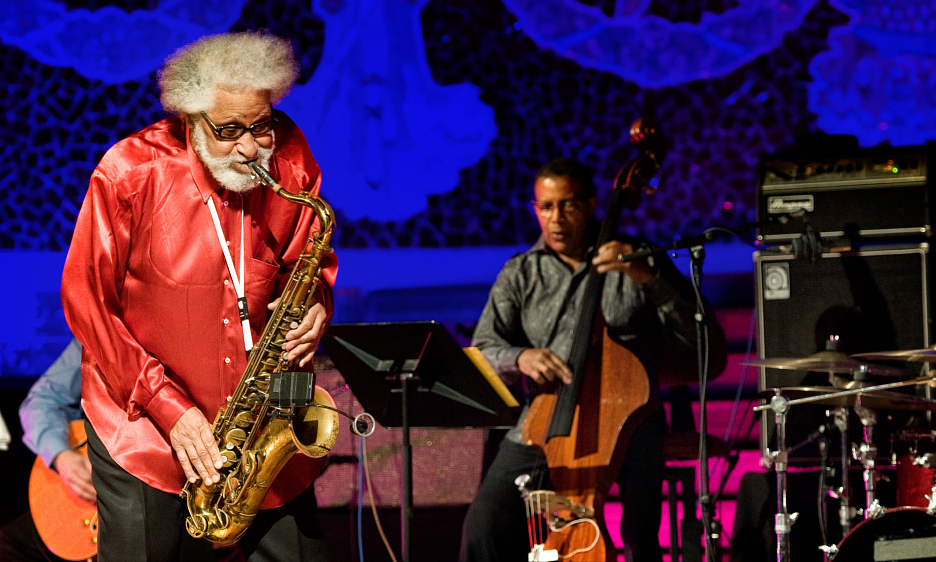
Courtesy Lorenzo Duaso

...music is a thing you never completely master; there's always new things coming up anyway. But this helped me to remain a student all of my life. I consider myself still a student.
Considering his five decades as a fixture among the tenor greats, it's pretty safe to say that in 1999 most jazz fans under the age of sixty have never known a time when saxophonist Theodore "Sonny" Rollins was NOT on the scene.
From the time he emerged on tenor late in the 1940s to his release of Global Warming in early 1999, Rollins has more often than not carried the mantle of jazz greatness (and sometimes seemed to try to shrug it off). Formative years with Bud Powell, Fats Navarro and others led to sessions in the 1950s with Miles Davis, The Clifford Brown-Max Roach Quintet, and Thelonious Monk (including Brilliant Corners). A good example of Rollins' company (and work) from this period is Sonny Rollins With The Modern Jazz Quartet, which also features Davis, Roy Haynes, Art Blakey and Kenny Drew. In sessions with Davis, Sonny introduced his own entries in the jazz canon, including "Oleo" and "Airegin."
Rollins has recorded exclusively as a leader since the late 1950s and has been generally hailed as one of the modern tenor titans, in the company of Coltrane and Coleman, ever since. He has also retired more than once, several times in the late '50s, then again in the late '60s, seeming to return each time with a more expansive musical vision. These sabbaticals may not have helped his commercial visibility, but they did nothing to damage his reputation among musicians, as Rollins performed and recorded throughout the '60s and into the '70s with the likes of Don Cherry, Ron Carter, Herbie Hancock, Elvin Jones and other modern masters. He has recorded for Milestone since 1972 and celebrated a quarter century with the label with the 1996 Silver City compilation, which features his work with, among others, such great drummers as Tony Williams, Jack DeJohnette, and Al Foster.
Talking to Sonny Rollins is a lot like listening to him play a classic pop tune. In the same way he cleverly slips "Oh, Susannah" in and out of "Lucky Day," he laughs a lot and surprises you often. His catalog is among the most extensive in jazz—yet in the course of an hour-long conversation, he mentioned exactly two album titles. You have a fairly good idea of where things will take off from and where they'll eventually land. But, man oh man, the view in between!
All About Jazz: How do you keep finding inspiration after half a century of creativity?
Sonny Rollins: Well, I was lucky because I started out as sort of a person who was self-taught so I've always been sort of learning along the way. I've always found things to learn and study along the way. I didn't really have what you may call a full university music education, and might have felt, "I have the basics and therefore I can do other things." I had to kind of acquire what I would consider the basics along my career. And of course, music is a thing you never completely master; there's always new things coming up anyway. But this helped me to remain a student all of my life. I consider myself still a student.
AAJ: Do you still manage to surprise yourself, in the studio or on the bandstand?
SR: Yeah, I do, and that's always great, you know? When something comes out of me that I go, "Gee, where did that come from?" Of course, you can never find out where it comes from, it's a place in the subconscious. But yeah, I did that yesterday—I was working on a book of my solos and I was recording something in my studio and I came out with something which I had never played before in a certain song. It was great.
AAJ: You're preparing a transcript book of your solos?
SR: Yeah, it's a book of transcripts of my recorded solos, plus with those from the records I'm also adding some current solos. So it's going to be a little different than just a book of my recorded solos; I'm going to add a modern version of what I'm doing right now with the same song. We're trying to get it out this summer, which may be a little bit optimistic, but I would say I want it out this year. This will be published by Hal Leonard, he's done a lot of those books. This would be mainly a book for schools.
AAJ: Do you consider yourself a perfectionist?
SR: Oh yeah, I'm very much a perfectionist. So much so that I hate to listen to myself back, because I hear a lot of things that I think I could have done better. I'm very much a perfectionist, I'm very aware of what I want to do and what I'm not doing.
AAJ: How do you deal with the difficult spot that being your own worst critic puts you in?
SR: Well, of course I never listen to my music—that's one way I deal with it. I never listen to stuff back. The most excruciating period in my life is after I make a recording, having to edit it and listen back to myself playing. Other than those periods, when I HAVE TO listen back to what we do, I avoid listening to myself. Of course, when I'm working and I'm actually on the bandstand, things are happening so fast that the process of listening back to yourself is sort of absorbed. The time reference is so fast that you don't really listen back to yourself, you have no time to listen back. You're really producing.
AAJ: Have you reached the point where you can play anything you can imagine?
SR: To a certain extent that's true, but I still have to practice my rudiments and everything every day, so that I'm able to play something right away that I hear. But on one level, playing an instrument, you have to have a certain rudimentary expertise, so you have to kind of practice the ins and outs of each little phrase. That you have to do, just to keep yourself in shape. But just hearing something, yeah, I could make a stab at anything that I hear. And probably I could get close to it. But to really be able to execute it over and over again, you have to have a little more in-depth study of any particular phrase. I don't know if that's comprehensible. I've never really discussed this question you've asked me, so I'm just trying to explain it.
AAJ: Have you had to change your practice habits as you've matured? Can you put your instrument down for, say, a month, and then knock the rust off within a few days?
SR: Well, it's difficult to do that, put it down for a month. I would never put down my instrument for a month. That's really a long, long time. I try to practice every day when I'm home. Sometimes on the road you can't practice every day, but of course if I'm on the road, I'm performing, which is really the highest form of practice in a way. But when I'm not playing my horn, when I'm not on the road and performing, then I have to keep my chops up.
I try to practice every day. I think putting your horn down that long is difficult. Even the way I have my schedule, which we've been doing for some years now, is to work roughly between March up until November, then we take off the rest of the year. Even that is difficult sometimes, because I'm away from performing for three months. Last year, my last job was in the beginning of November, in Japan, then we came back to work in March. So it was quite a while. That's difficult. You get rusty, and even though I'm practicing at home, it's nothing like really performing, when all your juices are flowing and you're really doing the ultimate practice.
No, I think that's a long time to put your horn down and not perform. I've done it in my career at different times, but I wouldn't recommend that other people do it.
AAJ: That seems very similar to something Herbie Hancock says Miles Davis once told him: Herbie asked Miles when the band practiced, and Miles replied that they practiced on the gig.
SR: You know, Max Roach once told a guy, "Oh, gee, you're not supposed to practice. Practice is like cheating, you know?" A guy quoted what Max said. In a way I understand what that means: that means that you should be able to play things, if you're at a certain level, you should be able to just pull things out of the air. Something like what you asked me before: can I play any phrase I can think of?
However, you have to keep your chops up. So what Miles told Herbie of course is true. As I said, the bandstand is the ultimate place for everything. However, you've got to get on the bandstand prepared, so you have to practice yourself. So Herbie might not practice at Miles' house, but he should practice at his own house and then be ready to go on the bandstand. And then a lot of different things will happen. Yeah, I think what Miles said was correct—with the caveat that it doesn't mean that a musician doesn't have to practice himself.
AAJ: Do you remember why you switched from piano to sax all those years ago?
SR: I always liked piano, but at the time, this was when I was really a kid. My older brother and older sister were more straight-laced people, I would say. It was sort of something which was required in my house, that the kids would get this musical education. Being a rebel, I sort of rebelled against that, so I didn't really practice anything. It wasn't until I really became enamored with jazz—I had always liked music, of course, but it wasn't until I became enamored of jazz and began to identify with some of the great jazz musicians, and I began to identify with the whole movement of jazz—it wasn't until then that I really felt that I wanted to invest that much of my energy into formally trying to do something and really getting that involved. Other than that, the piano thing was somebody making you do something, you know?
AAJ: Did you ever note-for-note memorize other famous solos?
SR: We had a young band, and we used to memorize all the things. Yeah, we did that, because in those days we would listen to the records and try to memorize the records. You know, copy the solos from the records. I guess that memorizing would be part of it, but we would basically be trying to copy the solo so we would sort of have an idea; it was a way of studying music for us, to memorize what other people were doing. A learning phase, I would say.
It was hard to always do that. You could approximate some of these things that Charlie Parker and Coleman Hawkins or these guys played, but you couldn't always get everything right. But the idea was to try to get as much as you could. When I was coming up, I know Coleman Hawkins had this famous song, "Body And Soul," his famous solo, and all the tenor saxophonists used that as a litmus test, to kind of show what you could do. All the saxophonists were trying to play "Body And Soul," just as a way of showing how advanced you were. We tried to copy things, but as I said you couldn't always get everything correct, because we were just learning. But as a method, yes. We did that. I did that. But I wouldn't say that it is required of everybody, because people have different ways of learning.
AAJ: How do you keep track of your ideas when you're away from your instrument—like in a restaurant, just waking up, etc.?
SR: It's hard to keep things in you, because you lose things. So whenever I travel, I keep a manuscript paper with me. It happens all the time. Once you might think, "Oh, gee, I've got this in my mind. When I wake up in the morning, it'll be there." But when you wake up in the morning, it's gone. I mean, this happens. I try to minimize that happening by having manuscript around with me all the time.
Recently, I did that. You still make that mistake. Even as much as I know this to be a fact, I still just recently had something in my mind, it was there and then I didn't write it down and then when I went back to retrieve it, it was gone. You kick yourself the rest of the day, but it's one of those lessons that's hard to learn because when it's in your mind it's right there. Yeah, that's just it, you know that it's there—but if you don't write it down and you think you can come back to it, even in ten minutes you might not be able to. It's a law that you really can't break.
AAJ: Are most of your friends musicians, or non-musicians? Who would your closest musician friends be?
SR: You see, some years ago I stopped going out to jazz clubs because a lot of guys would come up to me, people would come up, which as I look back on it was very flattering. But it was sort of, I couldn't just go out to a club and sit down and listen to the music. People would come up and sort of bother you, you know? And I don't mean that to sound unappreciative. It's flattering that they do, and great, but it still was a pain in a way, because I wanted to go and listen to the music.
So I got out of that habit of going to clubs for a long time. So I very seldom go out to clubs. That kind of forced me to be recluse in a way; even when I'm in New York City I don't go out to clubs because of that. It's hard for me to be in an anonymous way. Now, this may change, and guys may say: "Who's that?" "Sonny Rollins." "Oh, who cares." I mean, that may happen too. Then I might say, "Gee, I wish guys would come around me." Who knows?
Anyway, I got out of the habit of going to clubs and listening to guys. So in a way I became sort of a person that was reclusive. We live in the country and I don't...I used to have some people and some friends that I would talk to. But as I've gotten older I've gotten to the point where I don't want to waste energy. And sometimes I find that you can waste a lot of energy, just gossiping and talking and all this stuff—it's sort of a waste of energy in a way. My time is short now and I want to try to concentrate on those things which are important to me, which is my music, I have a certain consciousness as a citizen of the planet, and these things are important to me. So I think in many ways that I am a reclusive person. It's not something alien to my character. I'm sort of there now. I'm kind of content within myself actually, that's really the way I would like to put it. There are a lot of things that are important to me that I want to work out, not the least of which is my music and other things like that. I'm perfectly content to live the kind of existence that I have, which in many ways is not a gregarious one.
AAJ: Is there one particular musician that you feel has been critically unappreciated or overlooked?
SR: No, there's no one musician, but there are musicians. There's no one person that I could name. Because in the first place, jazz is a tremendously under-appreciated art form. You're beginning below the line already, because a lot of people just don't appreciate you, especially in America. So there's a lot of people who aren't appreciated; the ones that are, are probably under-appreciated anyway. No, I wouldn't say that there's any one person that I feel has been aggrieved. However, I think that there's a lot of musicians who have been inspirations to other people along the way whose names will probably never be known. Usually, in these days of excessive media, any person that's halfway good, what media there is in the jazz world will pounce on him, give him perhaps more praise than he might have gotten in an earlier era. That this guy should be more "Talent Deserving Wider Recognition" and all that stuff. There's no one who really stands out, but I'm sure there are people who are doing yeoman's jobs who are not appreciated. It's safe to say that.
AAJ: If you could go see any musical act, living or dead, who would it be?
SR: There are several people I would love to see again. I could say Louis Armstrong, I could say Fats Waller, I could say Art Tatum, I could say Coltrane—I'd like to see what Coltrane is doing today. Probably I could say Charlie Parker. But when you get into that, you get into, "Would you want to see them at certain periods of their life, or later in their career?" It gets quite complicated. But I would say that those people, Ben Webster—here's a lot of people I would love to hear again. Those people would be some of the people that I would use.
AAJ: Are there particular vocalists who greatly influenced your saxophone style?
SR: They always say that the greatest instrument is the human voice, I'm sure you've heard that said before. I love singers. I like Louis Armstrong, I like Bing Crosby, I like Nat King Cole, I like Billie Holiday, who I think is nonpareil. I like Dinah Washington, who I think was really great. I like some of the stuff that Frank Sinatra used to do when he first came out in the Dorsey era.
AAJ: What transpired for you to end up on The Rolling Stones' "Waiting On A Friend?"
SR: There was a friend of mine, an English guy that I had done a documentary for. He and Mick Jagger are good friends. I was working down at a club in New York, I think it was The Bottom Line, and he brought him down and they were there and everything. I didn't talk to them, but later on he called and said, "Mick Jagger would really like to have you on their album." To me it was sort of strange, because I didn't really know too much about the Stones. I'd heard about The Rolling Stones, of course.
But anyway, I was sort of convinced: My wife liked The Rolling Stones a lot, and I thought it may be an interesting experiment to see if I can express myself in that kind of environment. It was sort of an experiment for me. It was simply that. I wasn't billed on the record or anything. It was just an experiment for me. It was something that I didn't approach in a commercial way, I wasn't thinking of it in that way. There's very few things I do in life that I do for commercial reasons. That's why I'm a poor jazz musician. It was just sort of an experiment to see how it would work out.
AAJ: Do you consider the experiment a success?
SR: That's for people to say. Other people have told me that they liked that particular album by them. It was not incongruous, what I did with them. I felt it was OK. I was able to do what I do, so the experiment worked out as far as I was concerned. After the record came out and it was a successful record for them, they wanted me to tour with them. But it wasn't something that I did to get into that world or to become successful in the commercial way, so of course I wasn't interested in that. It was just something for that one experiment.
AAJ: Some of your music, like Monk's for just one example, seems to irresistibly rock. Do you like to dance?
SR: Yeah, I like to dance. I haven't danced in years. But yeah, as a teenager and all that, I liked to dance. There used to be a dance we used to do called the Apple Jack, which was sort of a dance which guys would do by yourself to the music. A lot of it was done to jazz. Yeah, I like to dance. I've danced with people.
A lot of critics can't reconcile, they have a very narrow view—an imperfect, actually, view —of a lot of music. You mention Monk: I don't know if you've ever seen Monk perform, but Monk would dance up onstage. Monk would start dancing and a lot of these straight-laced jazz critics would be there and they didn't know what to say: "Wait a minute, this is such profound, deep music—and there he is dancing!" They couldn't reconcile the two things. It's rhythmic music, and dance in my view is very much a part of music. It's part of the music that we play, it's got that animation to it for certain players. I certainly love to dance and some of the music I play has even been profiled as dance music, some of the Caribbean stuff I play. People can't see it as being part of the whole canon so they sort of characterize it as dance music. But I love dance music and I love dancing. I think it's an integral part of what I'm doing, the way I play and things that I find attractive about music.
AAJ: Have you noticed the influence of the Caribbean on other jazz musicians?
SR: Other people have used it, but I've probably been the one who has popularized it or incorporated it into my playing more than others. There's people who have used it, but it's probably been a more integral part of what I've done. So I would say I've been more prominent doing that music than anyone at this time.
AAJ: What's the biggest difference between twenty year old musicians today, and when you were twenty yourself?
SR: That's difficult to say. The milieu that we came up in was so different in those days, the nightclub thing with all the downfalls and dangers of being in nightclubs. And then they had good parts of being in the club, you're playing in close contact with people. But that was all there was in those days. It was quite a different thing. Today there's so much more exposure that these guys can have, the records and different venues they can play in. I shouldn't speak too much on that because some musicians may say they don't have enough work.
But it seems like there are more opportunities, there are schools, there are more festivals, more and more places where jazz musicians can make a mark for themselves. In our day, there was just the clubs, and you had to live in that nightlife atmosphere netherworld of jazz. It's quite different. I think jazz is a very basic form of music, and it's still there in the genes of a lot of people. It's such a really integral part of this country's music that it's always there. Even though some of the outward places to play have changed, but the young guys coming up are still, if they have a chance to play, it's there in the blood. I think it will always be there.
AAJ: Considering the themes of Global Warming, do you consider yourself a political person?
SR: I would consider myself a political person. I did the Freedom Suite a long time ago, which was a political statement back in the '50s, I think it was '58 that I did that, which was sort of a political statement for a jazz group to make at that point in time. Yeah, I think you can't help but be a political person in the United States. I'm cast in that, being a minority person in the United States, naturally you become political whether you want to or not. Now I say, rather than being looked at as political, I'm a pro-active person about everything. Yes, I'm pro-actively political. I don't think there's any way you could not be political, being a minority in this country. But I'm pro-actively political through that album, and prior to that an African thing and "Airegin" some years prior to that. So, yes, I would consider myself a political person. I think that's sort of confining, to use the word "political." It fits in some ways.
I guess to some people, Global Warming is political. But it's also spiritual. As long as that light is cast on Global Warming and the environmental problems—which really is not a separate issue, because the environment is part of everything we do. It's so much a part of the way we live, the way we treat other people, it's not like a special area of politics. It's very much a part of our life. I feel the environment is a very important thing for everybody. It's not just an environmental issue, it's political, it's also a spiritual issue. It's what's going to either give our children a chance or not give our children a chance. Sometimes on my concerts I say a couple of words about the environment because of my new CD, but I don't go on about it too much because I don't want to preach to people. I'm there for music, so I just say a couple of words about it. I think it's a very important issue, and something that everybody should try to find something to do about it. I have done a couple of shows on it, in Japan when I've talked about it.
People will say, "Gee, what can I do?" My answer is always, it's not up to me. I'm not a environmentalist to that extent. I'm just telling you what I perceive as the problem. Everybody has to do what they can do about it. Find out about it yourself. This is America—we still have the opportunity to find out things. The libraries are still open. There are still books being produced. Nobody's banning books or burning books. We can find out things ourselves. I'm not telling people what to do or anything like that, I'm not going to cast myself as that kind of person. I don't want to preach to people, especially when we're doing a concert. The answer to that is: Everybody just find out what you can do. It's got to be a grassroots thing, like anything else. The people have got to find out that we're creating so much garbage that we're not going to have a clean river, just these basic things. But the clock is ticking. And we have to work. So that's why I did the album, because I think it's important that I make my statement. If ten people get something out of it, doesn't matter; I want to make my statement about something which I feel is very spiritually important, politically important, people important, everything. The whole thing.
AAJ: What do you like to do when you're not playing your music?
SR: Well, at the moment we have a Japanese dog, and we have a lot of cats. We let a couple cats in the house, and we have a lot of visiting cats that we end up taking care of in some way—we don't let them in the house, but on our property they come around. We had a hard winter this year, so we ended up feeding them in the winter. We have a small farm—we don't have time to farm it, but there are a lot of animals that come by, a lot of deer, every kind of animal that might be in the wild comes by at one time or another. I would say we're mostly involved with visiting cats. In the house we have the dog, we used to have German Shepherds, but my last group passed away.
AAJ: Any regrets—a musician maybe you wanted to work with before he or she passed away, an idea you never got to execute?
SR: At this stage in my life I am so grateful that I still have an opportunity to reach for the things that I've always wanted to reach for that I haven't acquired yet, that I don't have any time to be regretful. Of course, as life goes on and you get older, it gets more difficult to physically do things that you were able to do when I was 20 years old. But I am very grateful that I still have the opportunity to do it, to play my horn and to try and pursue these musical dreams that I have. So really, there's no space right now for regret.
And in a way, that's sort of sacrilegious, to regret things. Our creator has given us, each day, an opportunity to try again. And I think this is something very important: Each day we have an opportunity to try again. So in a way, it's sort of regressive to think about "What could I have done?" I don't have any time for that. It's probably six o'clock in the evening for me now, so I've got to try to use the time that I have to continue to pursue, until I sort of get closer, hopefully, to my musical dreams. No, I don't have any regrets. I don't even think like that. That's for other people. And in fact, someone was telling me about something that somebody was writing about me in a concert leaflet, something like, "If Sonny had not gone away, he would have been this, and if he didn't take his sabbaticals he could have done that." This stuff is for other people, really, to speculate on.
No, I did everything in my life basically like I wanted to do it. Of course, I made mistakes. I'm not saying that. Everybody does. But I mean that I've tried to pursue things that I thought were important to me at that time. I've done things against the grain, and all this stuff which people wouldn't have done —people wouldn't have taken sabbaticals, they would have been afraid to get away from the instrument or get away from the music scene, a lot of things. So like Frank Sinatra, I've done it my way.
No, I have no real regrets because there's still time for me to do something. I'm still healthy enough to try to pursue what I've been trying to pursue all my life. This would not be the time. If I couldn't do anything anymore, with some kind of condition where I couldn't play, I couldn't do anything, then I might say, "I wish I had spent more time playing Bach" or something. But at this point, no. There's no time for that. That would take up a lot of time and space which I really need to devote to what I've done all my life. Like I said, I feel it would be sacrilegious to regret things when we're waking up every day with a new chance. I'm a spiritual person that feels there is a great spirit out there and we have to pay attention to that as well as everything happening here on the planet. We're all out here on this planet together, so we all have to interact in more ways than one.
Tags

PREVIOUS / NEXT


Support All About Jazz
 All About Jazz has been a pillar of jazz since 1995, championing it as an art form and, more importantly, supporting the musicians who make it. Our enduring commitment has made "AAJ" one of the most culturally important websites of its kind, read by hundreds of thousands of fans, musicians and industry figures every month.