Home » Jazz Articles » Interview » Roswell Rudd: Where Improvisation Lives
Roswell Rudd: Where Improvisation Lives
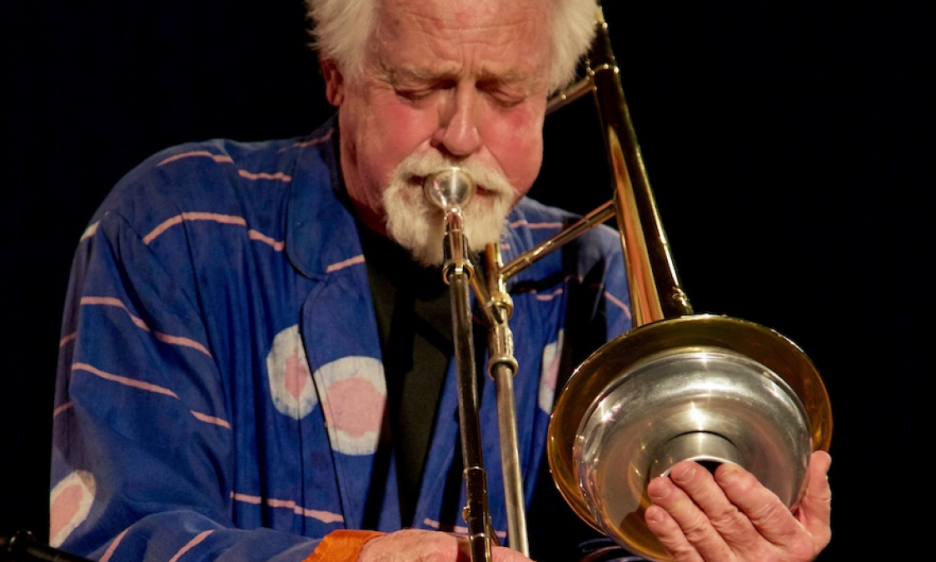
Courtesy Verna Gillis

All About Jazz met with trombonist and arranger Roswell Rudd in Manhattan to discuss his recent activities and his forthcoming weeklong residency with Steve Lacy at Iridium. Rudd also spoke of his affiliations with Albert Ayler and the still very much alive bassist Lewis Worrell, as well as some of his future projects, including sessions done with Mali musicians and sideman work with Glen Hall and Bobby Sanabria. Rudd spoke of his heroes, "Paul Bunyans" as he referred to them, from Pee Wee Russell, Jimmy Giuffre, and Clark Terry (a "real spirit" he has always loved), to Milford Graves (a percussionist with "no lack of inspiration"), and the unfortunate recent illness of a fellow trombonist that Rudd holds in the highest regard—Slide Hampton.
All About Jazz: J.J. Johnson's passing was a big blow to jazz, especially because the timing of it with Ken Burns' Jazz in which J.J. was nowhere to be found.
Roswell Rudd: Well, you have to consider that Sun Ra was nowhere to be found, Roland Kirk was nowhere to be found, Eric Dolphy was nowhere to be found, there's 20 years that was nowhere to be found! And that was sort of my 20 years. From '58 to '76, I was really here, you know, and I thought all hell was breaking loose musically. Just to have that be documented as a gap was "hmmm... " Those guys are the "Paul Bunyans" of the music. I often think that they were larger than life, and what they had to do to literally carve out a face for this music was a super-human kind of effort
AAJ: For the most part, they seem to be more unfortunately appreciated posthumously.
RR: Yeah, it would have to be for me because I don't come along until 1935 anyway. King Oliver was still alive, Kid Ory, Zutty Singleton, then Bunk Johnson. In 1940, I was five years old. I picked up on it a little later, though. I started listening more in depth, and remembering names, and starting to associate names with sounds when I got to be about 10, but before that I was just dancing around and singing along to it.
AAJ: You came up in Dixieland, similar to Lacy's background.
RR: My parents were mainly into that. The Duke, Louis Armstrong, Benny Goodman, Eddie Condon bands, and so forth... The collective improvisation was the thing that was common both to Dixieland music and the so-called avant-garde music of the '60s, and so that's where I was able to fit myself in, really not so much as a soloist, but as an accompanist. One thing you learn very early on the trombone is how to accompany, that's been the traditional role of the instrument, and of course it's since become a solo instrument and probably always has been! But traditionally, the emphasis has been on accompaniment or support, and the trombone for a long time was a supporting instrument for singers... I hooked up with a lot of the older players who had not only a tremendous repertoire of Dixieland numbers, but they also knew the trombone parts or they had interpreted a trombone part each in his own way for these various songs. I educated myself from one player to another about the role of the trombone in the Dixieland texture, of how it should be. So, I carried that experience over into the music of the '60s with Archie Shepp, Albert Ayler, and so forth. Even though it was in a different harmonic timbre and energy context, there was still the space in there, in that texture, for me to play a part in it. Because of that preparation in Dixieland, which is about horns and drums and improvising basically, we were dealing with pretty much the same instrumentation. I found places in there for me to play a part and that was mainly my connection between those two worlds.
AAJ: And who were your early trombone influences?
RR: Well, all of the people associated with those bands [speaking of Armstrong, Goodman, Condon, etc.]. [Jack] Teagarden, Bill Harris, J.C. Higginbotham. I was able to connect with those guys because they were still alive when I came here... with those older guys, I've always been at least 10 or 20 years behind in the music because I started with the older guys in my teens and I really didn't pick up on Bird's syntax until I was 20 years old or so. A lot of my friends were playing like Bud Powell and Bird when they were 15 or 16, but I was still trying to figure out what Billy Strayhorn was doing!
AAJ: At that point Charlie Parker had passed in '55-as you were getting into him that was his last year.
RR: Exactly.
AAJ: With Steve Lacy, would you say that's your longest musical association to the present day?
RR: I really think so... Yeah, Lacy would be around 1960 or so. I started rehearsing with Archie Shepp about that time, but it really didn't open until '66, you know later on. It opened for Steve and I a little earlier. I was able to do some things with him. We used to play in Dixieland bands before I was even living down here. He's the oldest association I have, [we've] really stayed connected over the years.
AAJ: Were there any trombone-soprano sax frontlines that influenced you? Other than Sidney Bechet and the trombonists that he played with, I can't think especially of a piano-less group, with trombone and soprano, bass and drums. Even today it's not a real common grouping of musicians and instruments.
RR: Let me give you an example. I call a rehearsal for a rhythm section and a vocalist and myself. But it turns out that everybody in the rhythm section they all have to cancel that date, so it's just me and the singer working on something. And we work on this without the other guys, and it sounds so good, we say we're going to do this as a duet. Perfect. And then we bring out the other guys at the end or something. The way that things happen in this music you can say by accident, pre-destination, by chance. And you get something called a profound situation or a profound ensemble. It just happened that way. You could say that because Steve and I, we really love Thelonious a lot, we just had to play his stuff and we found out that just the two of us playing it was fantastic. It just worked out that way. All the orchestration, the material, everything was so clear and kind of universal... It just turned out that his pieces have the essence where you could extrapolate for any kind of instrumentation, or orchestration if you wanted.
AAJ: That group, for a time at least, exclusively played Monk's repertoire. How did that come about?
RR: We started out and played a bunch of things that we both liked. I had some scores with Kurt Weill tunes I liked, some Strayhorn, and a couple of Cecil Taylor's pieces. But while we were doing these other things, we kept on adding another piece by Monk every week or two weeks or so, according on how long it took us to decode. The process was to follow Monk around and listen to the little changes he would make from one live performance to another and his interpretations of his own music and then we had the recordings. And between those two things, we kind of put [together] these versions, and made these arrangements... It was such a great learning experience for us doing this that I think that's why we gravitated this way. Every time we did another one of his pieces, it was like opening up another window on the musical universe. So we were just enriching ourselves so much by our involvement with his music that eventually the other stuff kind of slid into the background, and Monk's pieces became the focus.
AAJ: What was his reaction? Did either of you ever just go to him, and say "We're getting to a point where we want to just play your music," or did he ever give you a response, any feedback, either positive or negative?
RR: Well, there was that classic phone call. I remember calling him up a number of times when we were rehearsing to find out at a certain point in a song whether we had the configurations right. And then he would go to the piano and hold the phone up to the piano and we'd hear it. And he would say, "God damnit, Roswell, you're right!" In this instance we called Thelonious to let him know that we were playing someplace and would he please come down and be our guest. And his answer was, "If I am supposed to, I'll be there." [laughs] We never did see him, but I thought that was such a great answer, "If I am supposed to, I'll be there"! Who knows, [it was] Thelonious! In fact, I think you can answer pretty cosmic questions using the titles of Monk's compositions if you want.
AAJ: So for a time, it gravitated towards [only] Monk's works. How long did that last?
RR: Yeah, it ended up being a reportorial thing... The thing that really brought us together, or kept us together was the fact that within Monk's compositions there was really a soprano and trombone component. Not that there are hundreds of other components in there, too, but our component was in there. What we could do on these horns resonated with his music. I think that's what really kept the association going. There was so much for both us in there. It lasted until about '63 I would say, and then Steve was really getting fed up with New York. He was devoting his energies to projecting himself out of here. I meanwhile had taken up with Milford Graves and John Tchicai and we were working on free playing, and out of that time, compositional things... So, there was a transition, an overlap for me at that point of these two different groups. Steve went off to Europe, and it was a struggle for him for a long time over there, but eventually, and particularly now, he's got it to a point where he's working as much as he wants to which he could never do here.
AAJ: That was one of the few bands that I can think of where, as short-lived as it might have been, the music was dedicated to a musician who was still alive, let alone a living legend. Later was the Old & New Dreams, Ornette obviously still around, the group with Don Cherry, Dewey Redman, Charlie Haden, and Blackwell-the Ornette alums. But it's a rare instance.
RR: A very good observation on your part. Monk was very much alive, and it was great that his model was there.
AAJ: Did you have a name for the band? I've heard people call it the "School Days Quartet." Was that just because of the album that came out?
RR: I think it was "Steve Lacy Quartet" for the longest time, now it's Steve Lacy-Roswell Rudd. But if it was "School Days," it would have to have been after that album came out, and I'm not sure that we ever used that. I think that since we got back together, it's been Steve Lacy-Roswell Rudd, but "School Days" is a nice sounding thing. Let's say that that's the alternate title in parentheses underneath—very good.
AAJ: Can you recall when you and Lacy did first meet? Did one of you come to hear the other?
RR: I think it was just in one of those pick-up Dixieland bands. Buell Neidlinger was rooming with Lacy at the time on Bleeker Street. I knew Buell first, and then coming down and doing things with Buell overlapped with Steve. And it kind of began that way; began down here in pick-up bands.
AAJ: I hear that Steve Lacy, who has been outside of the States for around 35 years, is finally moving back?
RR: He will be here permanently for at least a year starting this Fall, teaching at New England Conservatory. He'll be on the faculty there. I hope that things will go well and that he'll be able to stay here for a while. He certainly has a great deal to teach.
AAJ: America has lost so many greats to expatriation, Lacy certainly being one of them. If jazz is such an American institution, why the lack of appreciation here? Why is it so under-appreciated in this country, or, better yet, why is it more appreciated in other countries?
RR: That's a good question that I've pondered a lot, and I think it boils down to the exotic factor. In America, much of what is being played is just so much a part of the American soundscape that it's taken for granted. If it isn't here tomorrow, something else is. When you take something out of its generic context, and you put into another cultural context, it really stands out in a way that it doesn't stand out on its own. I think that's one of the reasons. Another reason is that improvisation in popular music sort of reached a peak in the '40s and it got so good really that it became more and more of an underground kind of an event... and if you look in other areas of the world, you see that the heavy improvisers are pretty much in a corner by themselves. They have a certain following [though] not necessarily a mass following. You always have to bear in mind that all music starts with improvisation. So, if you didn't have the improvisers, you wouldn't have the rest of it. What's down below holding up the superstructure sometime does not appear above the surface all the time. What's happening on the surface depends on what's down below, and draws on what's down below. So from time to time improvisation breaks through or certain improvisers break through—it never goes away, because if it did, we wouldn't have anything. We'd have a bunch of records, and that would be it—a bunch of documents, [but] we wouldn't have any live carriers of the seed.
AAJ: Have you guys ever done, or if not considered doing, a duet recording with just the two of you (referring to Rudd with Lacy)?
RR: We did. In fact, we did a short tour in Canada back around '80 or '81, where it was just the two of us. I think only one track is available on some kind of a Hathut anthology, but there are 3 full recorded concerts of us playing, mainly the Monk repertory, just soprano and trombone... and I think they're great... I think that it would be great to put that stuff out. In fact, I'm going to talk to Steve about this because if those masters still exist, he might even be the one who has them. Obviously he is [actually], because he selected one for the Hatart people. So, that's something to think about.
AAJ: There's something real special about duets
RR: For sure.
AAJ: It certainly takes a lot of confidence. Obviously, you're a lot more vulnerable. You don't have the rhythm section to fall back on, and when I saw you and Duck Baker at Tonic last year, I was just numbed by what you guys were doing up there—it was just amazing. I wanted to ask if you could talk about, especially with you and Duck Baker, how you organize your sets because I spoke to Duck afterwards about it, and he showed me how you choose either people, or places, and you have all these tunes, 100s of these names of tunes, and you hop from one to another as you please with quotes which serve as springboards for your improvisation.
RR: Well, I think you pretty much described it as well as it could be described. I said, "How do you feel about this?" Then kind of demonstrated what I was doing for him, and he said, "I don't know, but I'll try." So, we worked on it for over a year sporadically and it got down to where you were talking about trying to fit masses of material into categories somehow so that we would be able to focus ourselves somewhat. Because if we just threw the whole thing out there, it would probably, well we did do it that way, it seemed to need more cohesion somehow. And the reason I was using these known themes, these playing songs, was because that would give me a certain cohesion with the audience, hoping... that the audience would extrapolate all this other accompaniment and context that went along with these tunes. So we did have these categories, and maybe in each category there would be 25, 50 titles, actually more than what we were dealing with before but we kind of restricted ourselves, and just focused on those. Maybe we did or did not use all of those. At times, I was going out of category, going back into the vault further to retrieve stuff.
AAJ: An incredible knowledge, too, not only to be familiar with a title of a tune, but in a second to go right into [its] catchy melody.
RR: Duck said this is what his problem was, and it was my problem too at the beginning. This particular challenge really helped me grow musically in a technical way. That is, when you learn songs usually you learn them in a particular key, a particular starting note on your instrument. Normally when you play "A Night in Tunisia" with people, it starts out on an E flat 9th chord, then goes to D minor. There's this key that's associated with a song, that most everybody plays it in, and that's true of all these other songs that we knew. Each of us had a key that we knew these things in, sometimes they were identical, sometimes they weren't. The fact is when you're improvising, and you suddenly decide how you feel, one of these melodies falling into the space where you are may not be that starting note that you always used for that song, and yet you hear that melody at that point. And what it amounts to is being able to play these melodies from any starting point, not just the one that you learned originally, but from wherever you are. You see, that was the challenge. It was very helpful to me musically in a technical sense, because it draws on your capacity for transposition, instantaneous transposition. When I teach people transposition I say here's a note, it starts here, goes down a little bit, repeats, it goes up a little bit, it holds, then it rests, and whatever the line or plan is for this melody, the same plan can be moved in total space up and down in an integral way, the whole thing, without losing its relationships, it can be moved around. That's one of the great facilities of the chromatic system. Anything that you play in any register is going to have the same intervallic relationships, so this was something that not only myself but students, people who are studying music, can learn and it wasn't really pushed to this point with myself. I remember somebody telling me when I was coming up, "You really need to play the blues in all the different keys." But I never took that concept to, "I should be playing everything I know." So, it was a way of taking that initial thing as step further and it was very helpful because I started to incorporate a facility into myself, I opened up—sleeping neurons came out, and I developed some new pathways which is what we do out here in self-help land (laughs).
AAJ: And are there any plans of a recording with you and Duck?
RR: We haven't gone into a studio and done anything officially. We did lay down a lot of footage as a result from collaborating at Tonic, and we have other things now. There will be a recording eventually. I think things need to pick up a little more, before I can venture out into the recording world again. The tragedy of 9-11 kind of upset the plans that we had at the time, and projected maybe for two years down the road from that time. We're into rescheduling now, re-evaluating, and trying to put things in some kind of a logical sequence. With Duck, I wouldn't call it a vanity record, but it would be a very personal kind of a statement for me. This is very intimate what we did. I don't know if I could depend on a lot of people to support it. And so what I'm doing right now is more acceptable to a larger audience, and then when I can get that on track, then I can think about doing personal favors.
AAJ: I think that it might even be the best of both worlds. I think that would be a very accessible project, and obviously a very fulfilling project for yourself.
RR: Well, it was. Playing with Duck has been very fulfilling. He himself is such a body of information musically. And I've learned a great deal from him. So eventually, there will be something out there by us...
AAJ: Have you ever done a solo trombone record?
RR: Well, it was supposed to be. As soon as I got into it, I found myself over-dubbing, asking for people to bring instruments for me to play so I could accompany myself. It ended up being more of a one-man band than a solo trombone record. And that was something that I did in '78, '79. I like it! I think it's one of my best efforts, but it's just not a solo trombone record, (though) some of it is. I have fallen into this mold of practicing 3 or 4 years ago, and I think it was because I was practicing so much by myself. I felt I needed accompaniment, but there wasn't any. So, I decided to fall back on music that I knew as accompanied music. In other words, traditional repertory, great classic jazz performances, classic performances of show music, folk music, (and) gospel music. And as long as I played these themes and had an awareness in my mind, in my played these segments. And it started to really feel good. I felt that, even though I was practicing alone for long periods of time, I had tremendous support somehow, a cast of thousands if you will. To take that kind of momentum, I thought, to take the spirit of this into solo performance in front of an audience and see if it carries over, see if the feeling you have in your body is something that you can communicate to the audience just through what you do on the horn, there's something else communicated: singers, drummers, strings, a pianist... [to] ghost these other things into your playing in a way that suggests to the listener that there's something larger going on than just the trombone process... It was an interesting process, and I often still go on practicing this way from time to time. It was a phase in my development, a recent phase in my development that I felt very strongly about. I have a solo repertory—I can improvise for hours by myself, and I've even compiled CDs of myself doing solo. The thing is if you are going to put a record out there, it should sell. I want to be sure that I can back it up. But, it's definitely in the works.
AAJ: There's only a few trombonists who come to mind that have done it, let alone carry it off, Albert Mangelsdorff being one of them.
RR: Yeah, well he is the ideal... the most interesting trombone solo act that I have ever heard! Do you know who the first person was to do this on a horn, a solo concert on a horn? Everybody had their accompaniment, you know. As far as I know it's Jimmy Giuffre, and he did this in 1964 in Helsinki. The only reason that I know this is because when I was doing notes for Herbie Nichols, excuse me the date was 1962, not '64. '62! When I was doing the research on one of the Nichols re-issues, his father, Herbie's father Joel gave me a newspaper clipping from a newspaper in Helsinki at that time, that talked about this Helsinki Youth Festival in 1962 that quite a few American musicians participated in. Little known was the fact that Herbie Nichols participated in this festival. Herbie did kind of a solo thing. In the article, Giuffre declares that this is the first time that he's ever done a solo concert, and this is the time, and this is the place. And as far as I know that may have been the first solo horn concert in jazz for a large audience.
AAJ: Certainly predating Braxton.
RR: After that time, after '62, you know Giuffre did this quite a bit. And then he had this marvelous trio of Jim Hall and Bob Brookmeyer. Giuffre really knew about the strength in small numbers.
AAJ: You know of the group Slide Ride [with trombonists Ray Anderson, Craig Harris, Gary Valente, and George Lewis]? What's the likelihood of you in a rhythm section-less trombone summit you may be involved in, or have you been involved with something like that before, with just a group of trombonists and no accompaniment?
RR: This is something that I have to do down the road, and something that I've done, just never documented unfortunately. Always great possibilities with trombone!
AAJ: Are there any differences that you notice between American trombonists and Europeans? There seems to be, at least recently, a resurgence of interest in folks like Albert Mangelsdorff and Paul Rutherford. Because it's kind of a free context... [and] you went from Dixie to free, you didn't really go through a be-bop phase. Not that the trombone really lent itself [to bebop]... [But] do you think there's a reason why European trombonists are somehow related to the whole so-called avant-garde—the free aspect of jazz trombone playing in that environment?
RR: You know, as far as I know, European trombonists are aware of the older American jazz and when I was still in my college years, I was over in Europe, and I was hearing these so-called "trad" [i.e. traditional) bands, European players who were recreating recordings note for note in a blueprint kind of way. And I could not believe the accuracy and the commitment that they had to recreating the recordings of Louis Armstrong, and Kid Ory, and so forth from the '20s. I was just amazed. I know that even somebody like Paul Rutherford is rooted in a way to the early American stuff. It's not something that he doesn't know about, something that he's experienced maybe perhaps not first-hand, but in a way studied it. So there is that influence of the old American music there. But there's also another thing in European music, and that is the classical tradition of now. You could say it began maybe 30 years ago, maybe 40 years ago, with modern classical composers in Europe who demanded for instance that horn players sing, producing certain unconventional tones on the trombone or whatever instrument it was, that they sing through their instruments, or that they blow air through their instruments, that they make vocal sounds through their instruments without making the conventional sound. Amplifying their voices, these approaches to instrumentation began 40 years ago as far as I can tell in symphonic music in Europe. And not long after that, it started here too. So, this was an aspect of their own culture that they contained in their playing, the influences there, their own symphonic music. Now, one thing I want to stress here is the fact that improvised music started to go underground in the 16th Century. When American improvisers started going to Europe in the '20s and '30s, all those European improvisers who were underground, or in that tradition of improvisation, because the same guys who went underground in the 16th Century weren't around in 1925, but I mean the tradition kept going. As I said, it always has to, because without that, you don't have the other. So the improvisers were there, had gone underground a few centuries earlier, and the Classic and Romantic periods of so-called European music had thrived on great scripted performances. So, those improvisers, when Bechet, the great trumpet player Bill Coleman, American improvisers, jazz musicians went to Europe in the '20s and '30s and surrounded themselves with European improvisers who were there, [and] had been there all along. And the European improvisers got into this music that has brought them here, and some great things happened in Europe... There's great improvisation in Europe which had been underground for a couple of centuries... They have tremendous musical resources as individuals. They are like other improvisers. They have developed their own systems... musical system. And infinite resources to develop it.
AAJ: In another two years, it'll be the 40th Anniversary of the October Revolution which you participated in... What role did the event itself play during that time period? It really seems to represent that time period.
RR: It was the starting point of something called the Jazz Composers Guild, which was a loose association of people who had participated in the October Revolution. And it actually managed to create a series of concerts in the same building where the Village Vanguard is. A series of weekly concerts went on well into the spring or summer of 1965. The "Revolution" was almost like a springboard for this series of concerts that went on, for all the people and others who had participated and were able to come out and play in any configuration they wanted to, and it was great. Somebody like Sun Ra's Arkestra performing there every week for six months!
AAJ: Is there something that you can relate it to today, an equivalent, or is that something that the jazz community today needs?
RR: (points to a copy of the first AAJ-NY issue which "happens" to be left on the couch in front of him with the Vision Festival as the cover) This gentleman here, (William) Parker started something called the Vision Festival—that would be the same idea. Bringing the forces together and getting power. Having everybody spread out, put everybody together and through the power of unified numbers, do something representative. I think that this is part of the same idea... You know we had some folks who were really outstanding that weren't involved, but we did have a bunch of good people who were involved. It was enough to get that thing going, to get that idea out there. I'm sure it will happen again in the future.
AAJ: The Vision is a wonderful gathering.
RR: It's a wonderful thing. We were never really able to really do it again, you know make it an annual thing, have an anniversary, because we pretty much went off in different directions after that, and on top of that geographically.
AAJ: Well, maybe since it's two years down the road, it's time to think about all getting together for a 40th anniversary!
RR: Great idea (laughs)! You have a great idea there. I wish that we were all still here, but for those of us who are, I think we should do it.
Tags
Interview
Roswell Rudd
AAJ Staff
Steve Lacy
Lewis Worrell
Bobby Sanabria
Pee Wee Russell
Jimmy Giuffre
Clark Terry
Milford Graves
King Oliver
Kid Ory
Zutty Singleton
Bunk Johnson
Louis Armstrong
Benny Goodman
Eddie Condon
Bud Powell
Billy Strayhorn
Charlie Parker
Slide Hampton
J.J. Johnson

PREVIOUS / NEXT

Support All About Jazz
 All About Jazz has been a pillar of jazz since 1995, championing it as an art form and, more importantly, supporting the musicians who make it. Our enduring commitment has made "AAJ" one of the most culturally important websites of its kind, read by hundreds of thousands of fans, musicians and industry figures every month.