Home » Jazz Articles » Book Review » Listen to Prestige Now, Think Later
Listen to Prestige Now, Think Later

Recordings took an evanescent music based on improvisation, spontaneous interpersonal chemistry, and (sometimes) sheer chance, and froze it into reproducible, saleable chunks that could spread six, then 10, then 40 minutes of musical inspiration to listeners across the world.
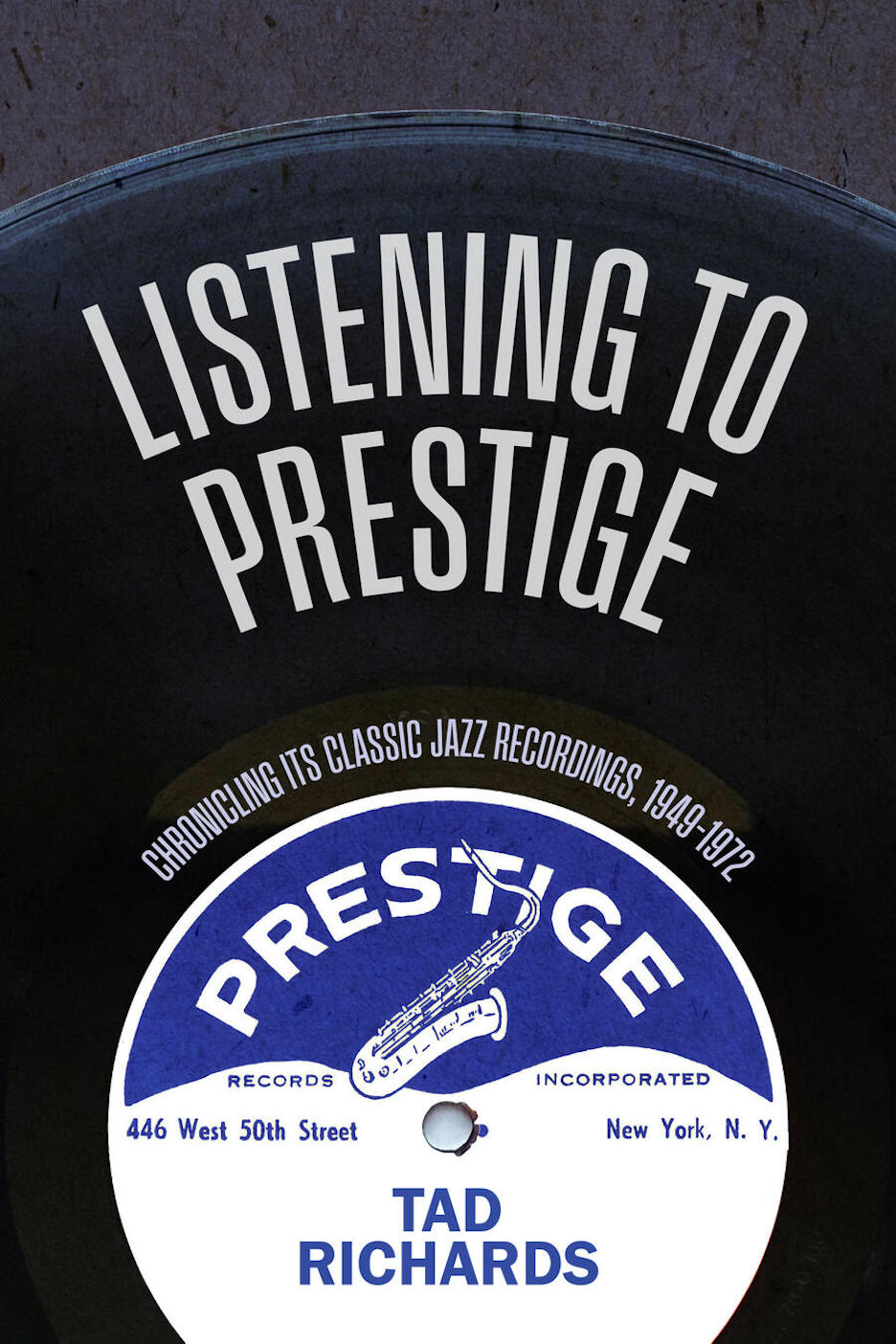 Listening to Prestige: Chronicling its Classic Jazz Records, 1949-1972
 Tad Richards
250 Pages
ISBN: 979-8-8558-0495-9
State University of New York Press
2025 Most jazz histories end up focusing on individual musicians, understandably enough. Talk about movements in jazz all you want: dixieland, swing, be-bop, hard-bop. You will end up talking about Louis Armstrong and Sidney Bechet, Count Basie and Duke Ellington, Charlie Parker and Dizzy Gillespie, Horace Silver and Art Blakey. A few towering figures create, or at least define, a new approach. The rest, in the best of circumstances, find their own identities within the rough boundaries outlined by the pioneers.
The biographical approach makes good sense. For the majority of their most productive years, jazz musicians learned how to play through apprenticeships with role models and jazz history was literally passed on person-to-person. But one can imagine another way of approaching the story of jazz—a supplemental approach that looks at the institutions supporting, spreading, and to some degree shaping jazz practice, at least before the academy took things over.
Record labels would be crucial protagonists in such an institutional history. Recordings took an evanescent music based on improvisation, spontaneous interpersonal chemistry, and (sometimes) sheer chance, and froze it into reproducible, saleable chunks that could spread six, then 10, then 40 minutes of musical inspiration to listeners across the world—and to aspiring players who weren't able to sit in with their idols in person.
It is difficult, if not impossible, to imagine jazz spreading and growing as it did without recordings to capture unique performances. It is almost as difficult to imagine the music thriving as much as it did without the structural support of record labels willing to invest the money necessary to fund those recordings, recordings that would disseminate the musical messages an Armstrong, Ellington, or Parker wished to deliver.
Record labels' involvement with jazz tended to follow a pattern. Independent labels, low budget operations dependent on their owner's taste and willingness to take risks, threw the dice on new artists and hoped a couple of their gambles caught enough public interest to provide the funds for another round of recording dates. The small-label finds who made the biggest impact then got snatched up by major labels, operations with bigger money, better studios, larger distribution networks, and chunkier advertising budgets. The major labels began to exploit (and, though rarely to their full capacity, remunerate) the most promising artists on a whole new scale.
One can certainly imagine a fascinating history being written about, say, Columbia's jazz division—its ups, downs, bloodlettings, and eventual dissolution. But hard-core jazz fans tend to obsess more about the small independents scouting up and coming artists who ended up pivotal to the jazz story. You cannot tell the story of be-bop without Charlie Parker, but where would our understanding of Bird's career be without Dial and Savoy? Can you cover the history of cool jazz without discussing Contemporary and Pacific? Would cool jazz even exist as we know it without those West Coast-based labels capturing it on the fly and, in their choice of which artists to record and which to ignore, to some degree defining the sounds we now associate with the movement?
These questions hover at the periphery of Tad Richards' enjoyable and readable book, Listening to Prestige: Chronicling its Classic Jazz Records, 1949-1972. In 250 easy-going pages, Richards touches on the high points of the label's jazz output, discussing some of its most famous artists—Sonny Rollins, Miles Davis, John Coltrane—in depth, along with a few of the label's most notorious encounters. Once again the age-old question is raised: did Miles Davis and Thelonious Monk almost come to blows at the infamous Bags Groove sessions?
Long time fans already know the answer to that, just as they know that Bag's Groove is one of Miles Davis' immortal early sessions. But they may not have heard that label owner Bob Weinstock claims he put the dates together because the three headlining participants—Monk, Davis, and Milt Jackson, had all hit him up for extra cash to buy Christmas presents for their kids. Sublime, meet mundane.
Listening to Prestige draws from the author's blog of the same name, in which he listened to Prestige's issued recordings session by session and commented briefly on each one. The digital incarnation is not fully digested in its book manifestation. Short blurbs on crucial releases are somewhat baldly interpolated into the book's text. Each is headlined "Listening to Prestige: [insert session name here]" and presented in a gray box with a font that, in my review copy at least, is oddly blurry. Here, Richards offers his personal evaluation of the session at hand, pointing readers less familiar with the label's voluminous output to some personal favorites.
The nuggets are enjoyable enough to read, if perhaps a little cut-and-paste-y. For an old hand, the book as a whole is a pleasant ride down memory lane—one more chance to murmur contentedly about the classic Coltrane and Rollins sessions, for instance, released by the label. And for all but exhaustive completists, lesser-known sessions will get mentioned that pique the interest (is it finally time to give Mose Allison's debut a listen? Maybe that session with Rollins and Art Farmer? Or anything by Moondog?). Newcomers will leave the text better oriented to '50's hard bop. It will be especially illuminating to readers only familiar with Davis' or Coltrane's major label excursions.
All that said, a book titled "Thinking About Prestige" instead of "Listening to Prestige" might have had more fresh insights to offer. Richards acknowledges that label owner Weinstock was controversial but notes that he shouldn't be regarded as an "archetype of exploitation." We do learn tidbits about Weinstock as the book progresses: his dislike of rehearsals, his recognition that good artwork helped sell good recordings, his use of major label promotion to sell his independent label recordings of the same artist made before the artist jumped ship. Such a polarizing figure, however, would have benefited from deeper analysis. Such a book would have Weinstock as the protagonist, or at least a through-line to hang its observations upon.
A book that focused on positive and the negative things Weinstock did for the music during his career running Prestige might have more to offer the reader than this pleasant survey of the label's many memorable releases, a survey that necessarily ends up reciting stories well known to long-time fans. Such a book would have to look at the label as an institution and Weinstock as an important, if flawed actor, who both exploited artists (Prestige was known, among other things, as "the junkie's label") and allowed those artists to reach a public that, back in those pre-internet days, would have been inaccessible without some structure in place to record and disseminate their creations.
Certainly more could have been said about Prestige's current reputation with jazz listeners. A more sustained comparison with jazz-fan darling Blue Note would have been useful. Blue Note's output was more consistent, but in terms of masterpieces, an argument could be made that Prestige is at least competitive with the better-loved label. A careful look at how much Blue Note's aura has to do with its superior art department, or its more powerful current corporate parent, versus its pure musical output, would be sure to raise a few eyebrows.
That kind of history may be near impossible to create in the current climate, when much of what passes for historical thought seems to be determining whether an individual gets thrown on the "good" or "bad" pile, and treating any nuance in the discussion as the next best thing to murder. But the labels' role in jazz remains worth thinking about. For all the harm labels did, all the shortsighted decisions they made, and all the misbegotten projects they engendered (Count Basie's Beatles Bag anyone?) it's not so clear that the post-label world which jazz exists in at present is quite the paradise we imagined it would be. A book that explored just what the old label system did right, as well as wrong, for jazz might be particularly useful at this moment in time.
Listening to Prestige is not that book, nor does it pretend to be. Taken on its own terms, it's an informative if necessarily shallow trawl through the riches of a perhaps underestimated chronicler of classic jazz. But the story of Prestige the label—the facilitator though not creator of much deathless music—remains to be written.
Tags
Book Review
Patrick Burnette
State University Of New York Press
Louis Armstrong
Sidney Bechet
Count Basie
duke ellington
Charlie Parker
Dizzy Gillespie
Horace Silver
Art Blakey
Sonny Rollins
Miles Davis
John Coltrane
Thelonious Monk
Milt Jackson
Mose Allison
Art Farmer
Moondog
Comments
PREVIOUS / NEXT


Support All About Jazz
 All About Jazz has been a pillar of jazz since 1995, championing it as an art form and, more importantly, supporting the musicians who make it. Our enduring commitment has made "AAJ" one of the most culturally important websites of its kind, read by hundreds of thousands of fans, musicians and industry figures every month.