Home » Jazz Articles » The Jazz Life » Les McCann and Me: Laughter, love, and the friendship th...
Les McCann and Me: Laughter, love, and the friendship that changed my life
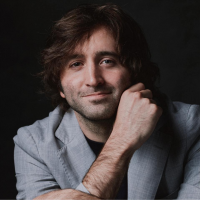
During COVID, when my hair was especially long he'd call me "Tarzan" and, lovingly, "Jungle Jew." He'd poke fun at my love for brisket and sandwiches, sometimes calling me the "briskid," sometimes "brisket junkie," and sometimes "Joe Alterman: sandwich-eating motherfucker."
One time I told him I had to go meet a bunch of friends, to which he responded, "By bunch do you mean both?" Another time I was getting off the phone and told him that I had to go meet a friend, but that I was glad we got to talk. Les' response: "I'm glad you have a friend."
I loved Les poking fun at me. When I moved back to Atlanta from New York, Les asked me for my new mailing address. A few days later an autographed Les McCann diaper arrived.
He called me every Mother's Day with the same message: "Happy Mother's Day motherfucker!" and he gave me advice to "never call your own mother a motherfucker," although being called a motherfucker by Les is one hell of an honor. "I only call people motherfucker that I love," he told me, before continuing:
"Motherfucker is the most flexible word in the English language."
And to illustrate this point he said the following sentence:
"This motherfucker came by my motherfucking house the other day, and I told this motherfucker, 'What motherfucker do you think you are, motherfucker? Just pay me my motherfucking money, and I'll stop bothering with your motherfucking ass. Okay?'"
I loved the relationship he formed with my parents, especially my Dad—with whom he liked to trade silly jokes—and my wife, Stephanie.
One time he told my Dad, "I want to congratulate you on a job well done raising Joe."
To which my 81 year-old Dad jokingly responded, "We're not done yet!"
To which Les asked, "You're having more kids?!"
In 2015, Les was given an honorary doctorate by the University of Kentucky, which is in Lexington. I'll never forget a few of our phone calls leading up to that.
"Lexington, Kentucky's going to name a street after me," he told me all excited, then: "I want it to be called 'Les McCann's Motherfucking Street.'"
He left me a voicemail talking in the voice of Amos from Amos 'n' Andy just a day before heading to Lexington: "Hello Joe. This is Amos. I'm here with Bueller and we all getting ready to go down to the courthouse, fight some battles we have to do. Andy will go meet us down there later, but I've been thinking about you a lot lately since I'm about to become a doctor. Now, I can't talk like this no more; mom and them don't like that very much. So I'm leaving town tomorrow to go home to Kentucky and get my degree, and from now on call me 'Doctor.' Don't you forget that. Doctor Les McCann. Woah!"
After he got back, Les told me about going around Lexington and seeing some of the places he hadn't seen in years. As a kid, he said, "I never was around a real piano. I just would get on any kind of instrument that was there and jam. There was a real bad piano up on stage at the community center" that he often played on as a kid. Then, laughing, he told me that when he went back all those years later, the same community center from when he was a kid was still there, and "they still had the same raggedy ass piano up on the fucking stage."
One of Les' big dreams in his final years was to rewrite the state song of his beloved Kentucky; "My Old Kentucky Home" could certainly use an update. Bedridden and unable to play piano, Les would often call me when a new melody came to him. One night he phoned all excited: "I got it," he told me.
Then he sang me the melody.
When he finished, he said, "Now put your thing on it."
That was Les' way of asking me to add chords, shape the harmony, maybe bend the melody a little. I worked hard on it, called him back a few days later, proud and excited to share to play him what I'd come up with—ready to celebrate our new anthem.
Les' first words after I finished playing: "This definitely won't be the next state song of Kentucky, but let's let it be what it is: it's a beautiful ballad."
He asked me to give it a title and immediately I thought of the greeting on his voicemail before he went into the hospital: "Hi, this is Les. Give me time to get to the phone—but don't forget to love yourself."
That line became the title of our song, "Don't Forget to Love Yourself." To this day, it's hard for me to play it without tearing up. Here's a version you can hear if you'd like.
Les really wanted to officiate our wedding, adding that he'd happily become Rabbi Les McCannstein just for the occasion. While he was bedridden and couldn't make it, the last thing Stephanie and I did before our ceremony—just a few minutes prior—was FaceTiming Les. He gave us the most loving and wonderful congratulatory pep-talk; it was a truly beautiful moment.
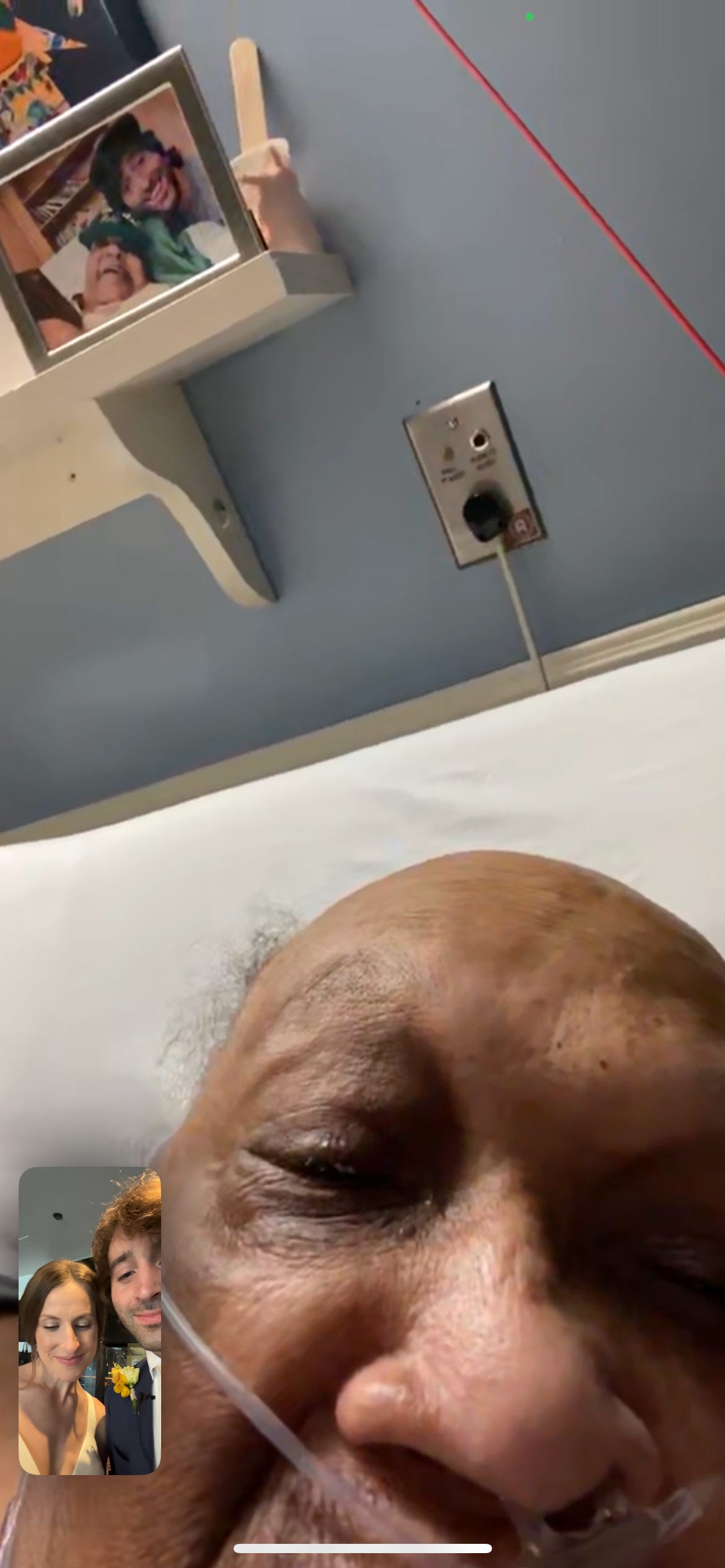
Stephanie and I FaceTiming with Les just a few minutes before our wedding ceremony.
Both Les and I knew that Les' transition would inevitably come, and Les did his best to prepare me for that day.
"Don't ever worry about me," he told me. "I've lived a wonderful life. I've done everything I could've done and more."
"I want it so that when you come home, I want the fucking crowd to be as big as my crowd will be."
"When I die, don't let them say it's because of some physical ailment. Say that I died with a loving heart. Period."
"I want to tell you something very serious. When I get outta here, if anybody asks you what was Les' most important thing, always refer to something related to God, okay?"
Les: "I've been wanting to talk to you. I want you to know that I love you dearly."
Me: "I love you dearly too. I want you know."
Les: "That is not about me anymore. I know, but I want you to know."
Les: I luh you.
Joe: I love you too.
Les: No Joe, Luh.
Me: "It's been a beautiful few days of weather. Lots of blue skies. I've been thinking of you."
Les: "Whenever you look up and see a blue sky I'm giving you a hug wrapped in my arms."
After Ahmad Jamal passed away, Les was reminiscing about how Ahmad would be remembered, and joked about how he'd be remembered, too:
"When people think of Ahmad Jamal they think 'Poinciana.'"
Then he paused for a second and jokingly said:
"When people think of me they'll think 'Symphony in D minor.'"
In his final days, I got a call from Les' dear friend Dean. Les was in the hospital with pneumonia, on a respirator, basically unconscious and definitely unable to speak. Dean held the phone to Les' ear so I could talk to him. Fighting tears, I tried humor—the only thing I thought might get through. "No more rock and roll!" I teased.
No response.
But if Les heard me, I know he smiled inside.
Then I sat down at the piano and instead of playing something slow and heavy, I chose swing and joy. I played "Almost Like Being in Love" in my best Erroll Garner style—the same tune Les had sung on The Ed Sullivan Show, the same song he had dreamed of re-recording as his final song. If this was the last bit of music Les was going to hear in this life, I wanted those final sounds to be swinging, playful and full of light—just like Les.
The weeks after losing Les were brutal. I tried to cling to his teaching; he'd shared these words with me—"When your death comes, that is the most glorious moment of this life because you've graduated from the school and returned home, where you know you're whole and complete"—but grief outweighed celebration.
Two weeks later, Stephanie and I left for our long-scheduled honeymoon in Costa Rica. One afternoon I stood under a waterfall, convinced no one was nearby. Suddenly a woman appeared, smiling at me. Looking up at the waterfall and the trees around us, she exclaimed, "How lucky are we?"
I remember thinking: Les, is that you?
That was the first hint of what began to increase steadily over the next few months: feeling less like Les was gone and more like he's always here.
That sense grew stronger.
After the 2024 election, waking to the shock of Donald Trump's re-election, Stephanie and I went for a walk along the beach in Monterey, trying to shake off the heaviness. The sadness wouldn't lift. As we climbed a small hill, I stopped at a bus stop to tie my shoe. When I stood back up, I found myself face to face with Les.
Literally.
His smiling face filled an ad for the Monterey Jazz Festival plastered on the bus stop, beaming straight at me. The sight hit me like a wave. I broke down in tears.
It felt like Les was right there, reminding me of the words he had repeated to me so many times: "There's only two things in this life: love and fear. Everything we do is a challenge to one or the other. Choose love, Joe. Always choose love."
Over the last few years of his life, Les had called me to say goodbye at least five times—each time I thought it might be the last. But his very first farewell will always feel like the truest:
"Call me tomorrow or the next day, but if I'm not here anymore, I want to thank you for all of your love."
"And I want to thank you for all of yours," I said.
There was a pause.
Then Les, in his most Les way, replied:
"Motherfucker."
Click.
Tags
Comments

PREVIOUS / NEXT

Support All About Jazz
 All About Jazz has been a pillar of jazz since 1995, championing it as an art form and, more importantly, supporting the musicians who make it. Our enduring commitment has made "AAJ" one of the most culturally important websites of its kind, read by hundreds of thousands of fans, musicians and industry figures every month.