Home » Jazz Articles » The Jazz Life » Les McCann and Me: Laughter, love, and the friendship th...
Les McCann and Me: Laughter, love, and the friendship that changed my life
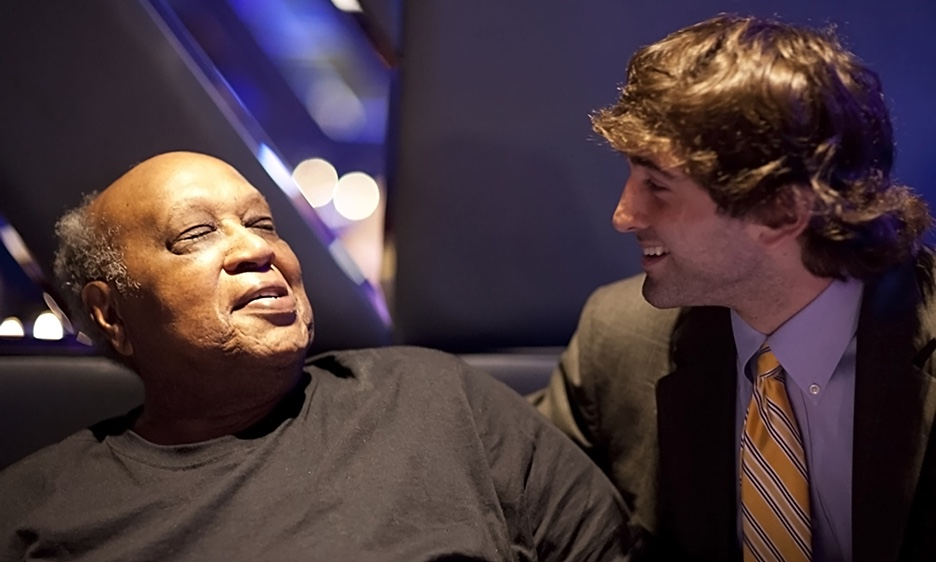
Two hours earlier, we'd been chatting by FaceTime in my hotel room when I told Les that I had to go because it was time for me to take a shower so that I could make it to the gig on time.
"How are you going to play funky if you take a shower?"
We both laughed.
Now, post-shower and just a few minutes before showtime, Les was beaming, totally thrilled, when I told him the show was sold out. (You can watch the show here)
"Joe," he said. "You da man."
"No, Les," I responded. "You da man."
To which Les exclaimed, "We da man!"
Then his face softened.
"I wish I could be there with you tonight."
"Me too," I said. "But I'll be thinking of you and playing your music."
"Our music," he quickly corrected me. "Our music," he repeated, more seriously this time. "We're a team. Say it."
"Our music," I said back to him.
"Amen," he said.
And that was Les: my piano hero turned mentor, soul brother, and best buddy who, despite being nearly sixty years older than me—and a bona fide music legend—would always go out of his way to make sure that I knew that he felt that our journeys are deeply intertwined and connected.
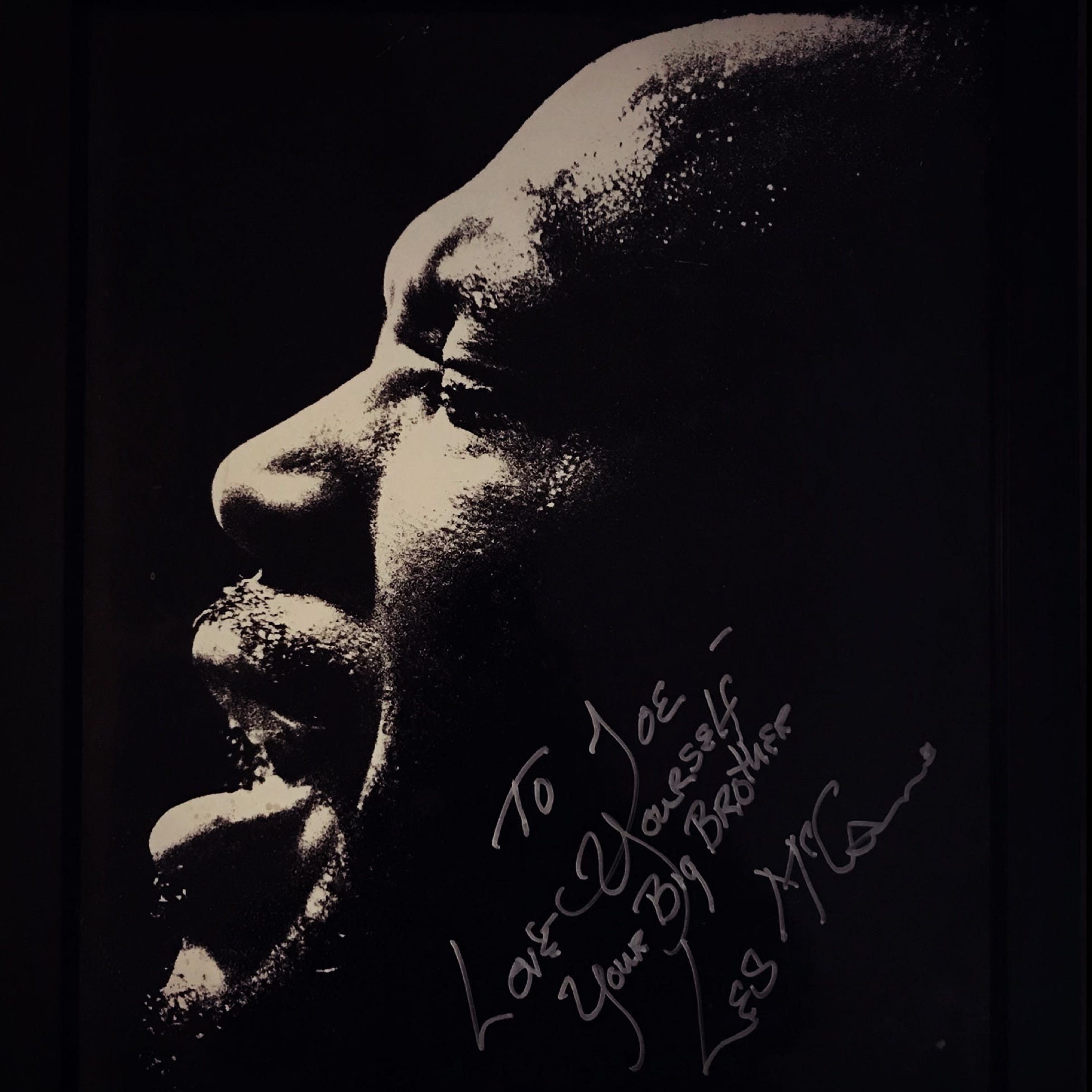
Once we were doing an interview together and were asked about when and how we first met.
I told the interviewer all about that day at the Blue Note in 2012 when a 23-year-old me got to open for Les. He approached the piano and in lieu of a greeting told me to "play me some blues, boy." While I was worried about what I, a white, Jewish millennial, could offer Les, one of the greatest blues players ever, I did my best, trying not to let fear enter my mind. After a minute or two, Les said, "Amen," and I breathed a sigh of relief. When I finished playing, Les asked my name.
"Joe Alterman," I replied.
"Alterman," he said, before asking, "You a rabbi?"
"No," I told him, through my laughter, "but I am a..."
"Hebrew?" he interrupted.
Through my laughter again: "Yeah."
"Well, from now on, you're my He-bro."
And that, I told the interviewer, was the start of our beautiful friendship.
But that wasn't all I remember from that first night.
After the show, Les had me sit with him at a table while he said goodbye to nearly like audience member in the room. Nearly every time a woman came up, he'd ask, "Are you Joe's girl?" Most of them had no idea who Joe was, which only made it funnier. "Well, you should be," he'd say. "Even if it's just for tonight." And in between all that, one woman came up to say hello and Les guessed her birthday on the spot. One guess. I remember thinking that even on the very first night, this man had one of the most unusual minds I'd ever encountered.
Les, however, told the interviewer that the two of us had met in a previous life, recognized each other that day at the Blue Note, and were now back together. He also predicted that in one of our future lives we'll be hanging out listening to music and something will come on that will catch our attention and we'll look at each other and say, "Damn, who is Joe Alterman and Les McCann?"
Ever since that day in 2012 when we connected in this life, barely a day passed in which we didn't speak. Just like the deep resonance I grew up feeling to his music, I resonated just as deeply to the person behind it. It was like having the most beautiful big brother. I was "Little Joe," Les was "Big Mo," and we shared everything with one another—from the ordinary to the extraordinary, the deeply spiritual to the hilarious—both silly and raunchy, sometimes all at the same time.
Thanks for reading! Subscribe for free to receive new posts and support my work.
I remember shortly after meeting he asked me how often I practiced.
"Six hours a day," I told him, almost bragging—very proud of that fact at the time.
His response: "Way too much!"
That caught me off guard; you don't expect your piano hero to tell you you're practicing too much. He explained:
"You need to go out and live more so that you have something to sing about when you get to the piano."
He continued:
"And when you practice don't just practice songs all the time. Practice how you're going to play a song. Practice why you're going to play a song. I don't mean to make it intellectual, but it's about teaching your fingers and your heart to work together. The mind is just trying to be in control of everything, but music, and especially people who love their music, it comes from the heart."
To me, Les was both a wise old man and the most playful child all in one. In fact, I occasionally told him that he reminded me of how I saw the Dalai Lama: an enlightened being who never lost his childlike wonder and enthusiasm.
"I like that," Les said.
One time I was sitting with Les in Santa Barbara and a woman told him how much she loved both his music and his painting, complimenting him for being "multi-talented."
"No," Les said. "Everyone is. The only difference is I actually did some shit about it."
That was very Les.
And over time I came to understand that all of Les' talk about heart, love, fear, really knowing who you are, and even the extraordinary way he seemed able to direct his own mind, came out of a long inner search of his own.
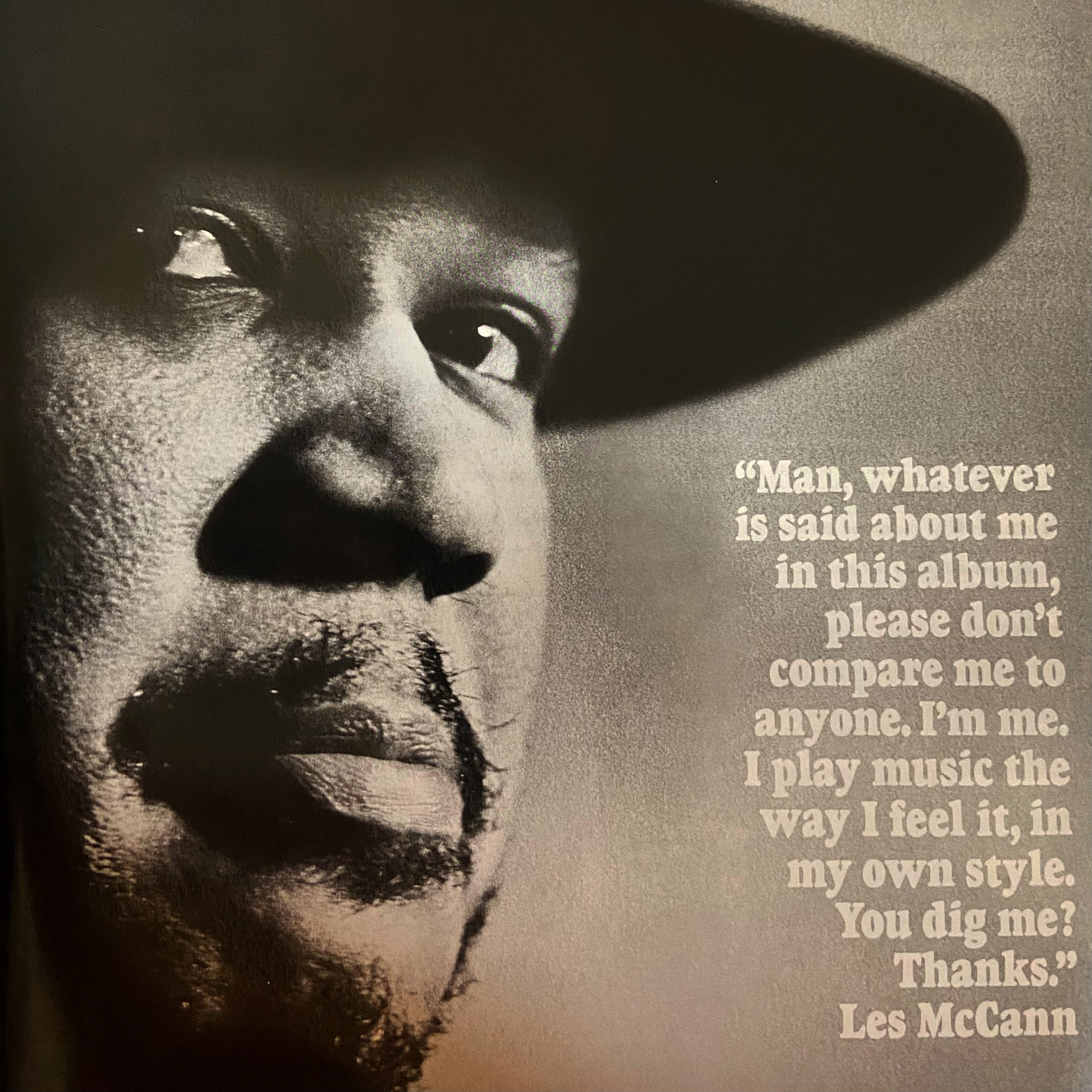
One of my favorite quotes of Les' is in the booklet to his great album, But Not Really, and it reads: "Man, whatever is said about me in this album, please don't compare me to anyone. I'm me. I play music the way I feel it, in my own style. You dig me? Thanks."
What gets me now is that he later told me that even then he was still in what he called his "everybody liked me but me" phase. That really shocked me. He always seemed so confident to me, and so fully himself.
Around the same time Bill Evans had told him: "You're a funky dude, baby. The blues you play is it."
Erroll Garner loved him too, and Les told me that Erroll recommended him for some gigs, including a TV job Les didn't even know had come from him until Erroll later asked, "How did you like that TV show I got you?" (The show was Police Woman, starring Angie Dickinson; Les comes in with the band at around 1:35—watch the episode here.)
And even more, Erroll had been a hero of his from way back. As Les later told Ben Sidran:
"I joined the Navy, and when I went in, I was marching in strict formation. I heard this music coming out of the PX—it was 'Lullaby of Birdland' by Erroll Garner. The company went that way, and I went that way. I got into a little trouble, but I followed the music. That was truly when I decided to play the piano for real."
Les told me that early on some of the critics really went after him. In a 1960 DownBeat review of Les McCann's album The Truth, Ira Gitler didn't just dislike the record; he practically treated the whole thing as a fraud. He accused Les of bringing "a brand of homogenized funk into the lounge," called his music "phony funk," said it was "not creative Jazz, by any means," and even argued that Les sounded like "a one-dimensional player" who "doesn't run very deep in that dimension, either." He mocked the very title of the record: "If this is the truth, then Orwell's 1984 is already here." He also sneered that people seemed to want "ersatz rather than the real thing," then ended by telling readers that if they really wanted jazz piano, they should go listen to Hank Jones, Ray Bryant, Horace Silver, Tommy Flanagan, Monk, Bill Evans, and Wynton Kelly. But Les being Les, he answered the review with humor. As John Tynan wrote in DownBeat later that year, Les joked, "I wish to give many thanks to Ira Gitler for increasing my record sales," and started calling original tunes things like "My Man Ira," "Ira, If You Only Knew," and "Ira Gitler's Homogenized Funk."
Les told me about Lenny Bruce, who, after reading that review, asked Les to open for him at the Village Vanguard. Les told me that one night Ira came to one of the shows and Les overheard him asking Lenny why he had "this motherfucker" on the bill. Lenny's response was simple: "Because I love his music." Then he turned around and introduced Ira to Les right there.
And yet, after telling me stories like those—stories about musicians he loved and respected him—Les said a sentence that I never forgot: "So everybody liked me, but me."
I was shocked, and I asked him: So when did you start to like you?
And in his telling, a huge part of that search began with the one great regret of his life: saying no to Miles Davis.
Miles already liked Les's playing, which is part of what made the whole thing sting so much, but one night in Boston, Les had a bad cold but went out anyway to hear Miles at Paul's Mall. When Miles spotted him in the crowd, he said, "Come on up and play with me, man."
Les told me that he was sweating and coughing, but more than anything he was nervous. So he said no and blamed it on the cold.
Miles shot back: "Fuck you."
"That was it," Les said. "The one regret."
Back at the hotel that night, Les realized that he had let fear win. And that really stayed with him.
Les used to tell me all the time that there were only two things in this life: love and fear. Everything else, he said, fell under one or the other, and he encouraged to always choose love.
He believed that we're all angels having a human experience, that the body is just a suit, and that Earth is where we come to learn how to love.
Most of the time I was fully with him, but occasionally, after a two-hour-plus phone call in the middle of the night, I'd get tired and would tell Les so, to which he'd spend the next twenty minutes explaining how angels don't need to sleep. "Your costume is tired," he said. "You're not. You think you're the suit. But you're not the suit. You're the light inside the suit. The skin is tight, and we think it's real. But it's just a costume." I'd laugh and he'd keep going. Eventually, I'd make it to bed.
He also didn't call himself my mentor. He preferred the word "reminder." As he told me: "You knew all this at birth. I'm just here to remind you of it and help you tap into it."
That same way of thinking shaped so much of what he told me about music. Regarding the piano, he said:
"The piano is just a tool. Without that piano, without those fingers, you would still be hearing music. You've got to hear what's in you! And by the way, you already know this stuff."
To illustrate his point, shortly after we met, he, understanding that I wanted him to be my mentor, asked me to write a song a day for a month, with just one catch: none of the songs could be written at the piano. As he later explained:
"When you sit at the piano to compose, the first thing your mind thinks is 'what can my fingers do?' But when you're not at the instrument, you're writing what you truly hear in your heart."
Les would point to Jobim and others: "All these guys—great lovers. It's about sex. It's about love, about the air, about touch. Not the mind, the heart. Music is love."
He believed the mind was just a storage closet. The heart was where truth and love lived. "Right now, this very moment is all that counts. That's what jazz is."
And he really lived that way. Les was bedridden and living in a physical rehab center with a rotating cast of roommate characters—some of them pretty wild—for at least five of the twelve years I knew him. We spoke around six hours each week during all of those years, and he complained maybe three times total. In fact, I can only think of a handful of times he didn't say things were either "beautiful" or "just a touch above perfect" when I'd ask how he was doing, despite his being bedridden, unable to play the piano, and living in a rehab center where he shared his room with a variety of interesting characters. Les certainly made the best of a bad situation; he used his time in bed to train his mind to focus on that which he wanted to think about.
Not unlike an enlightened being such as the Dalai Lama, Les is the only person I've ever met who really had control of his mind and could think about what he wanted to think about when he wanted to think about it. He had a beautiful philosophy about the meaning of life and he loved to share it with me often, and he always saw the bright side in everything.
Once, when I visited him in the rehab center and had to use the restroom, I got lost in the halls of the facility trying to find it. When I finally made it back to Les, I told him what had happened and he just started laughing. "Hah! You have to find a bathroom when you need to go! I just go."
We had a lot of fun together. Les would regale me with incredible stories from his amazing career, and I'd ask him advice and tell him all about my gigs and escapades. Although we both knew that Les would probably never get out of his bed again, we used to make plans for our one-day duo show together, which he suggested calling A Hebrew and a Halfbrew. We'd create set lists, I'd make lyric books, mail them to Les, and we'd rehearse over the phone. One time, Les had a particularly funny idea for the show: "You do the work, I'll take the bows."
Via FaceTime, I'd take Les on hikes with me and walks around the various cities I'd visit, alternating the direction of the screen between my face and the scenery—and whenever I'd turn the camera back towards my face, he'd always make some hilarious comment about how painful that transition was.
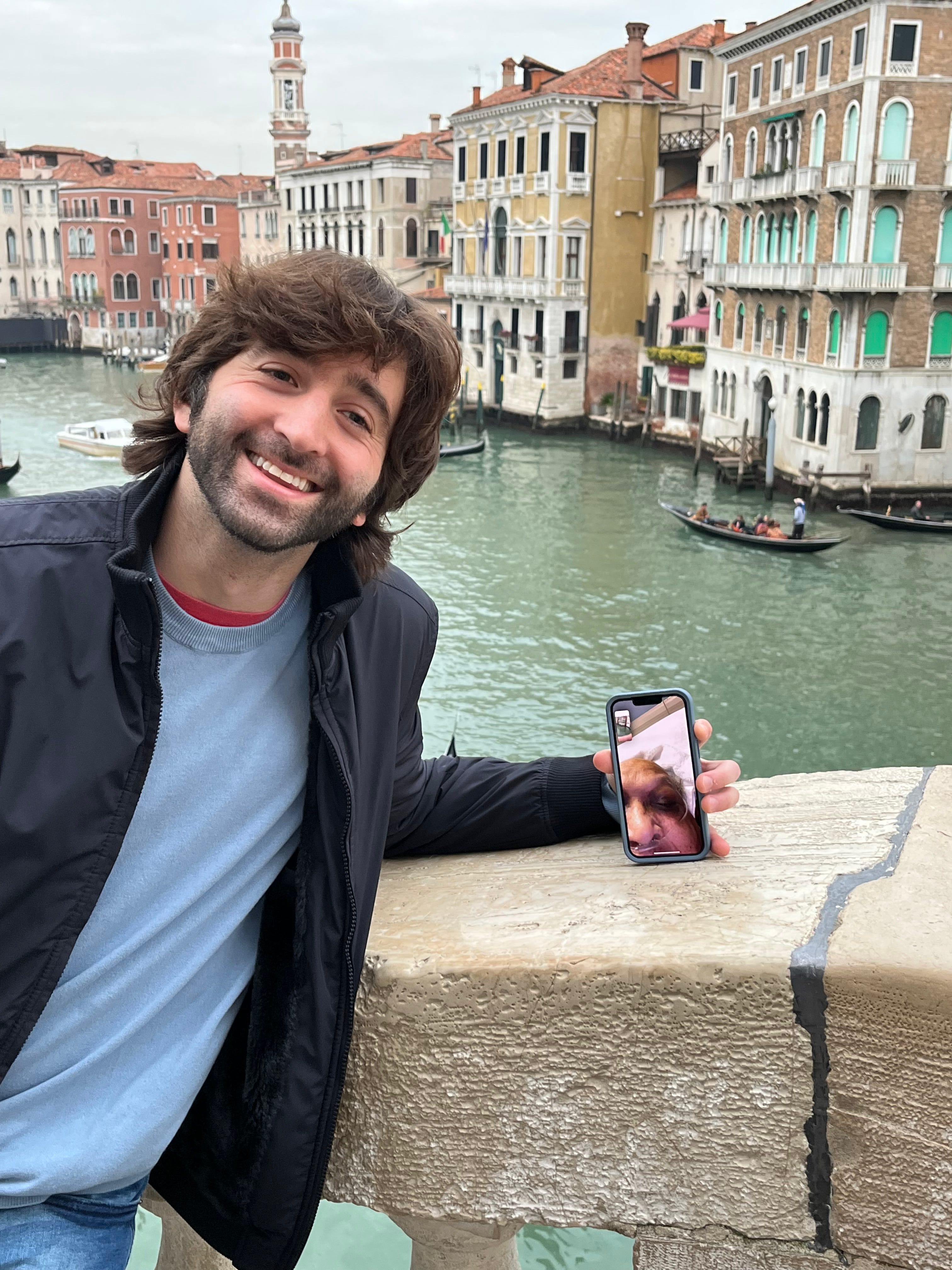
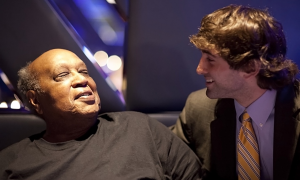
Les and I in Venice
We'd make plans for Les' dream restaurant; "Give Me Some Skin," he wanted to call it—and it would only serve meat skins. "Fish skin, chicken skin sandwiches, vegetable skins, pig skins," he'd tell me, often adding, "and skim milk."
We had a ball getting on FaceTime, and me surprising someone by handing them the phone and saying, "Meet Les McCann." Catching big fans of Les' off-guard was always a hilarious interaction for me and the ever-playful Les, and I always appreciated the times when those funny moments would turn into something deep, reminding me of the fun, yet deeply serious nature of this music I feel honored to play and share a love for with Les.
One time I was FaceTiming with Les and introduced him to two musicians whom I was playing that night. Both my necktie and that of one of the musicians were tied tightly, but one musician's tie was very loose. Les looked at him and said, "You look like you just got home from work and are ready to crack open a beer. You've got to fix your tie and show some respect for this music. People have died for this music."
He often told me that, "Jazz is not about entertaining an audience. It's about expressing who you are on a very deep level. It's like what Reggie Workman said, 'Jazz is a matter of life and death.'"
And he'd often remind me: "You don't do this because it's fun, although it is. You do this because it's you."
Sometimes I'd bring him on stage with me by FaceTiming him and laying the phone next to the piano. He'd always be smiling and cheering me on, and it was always so special and fun to look over and see the joy he felt in watching and listening to me—which meant so much to me.
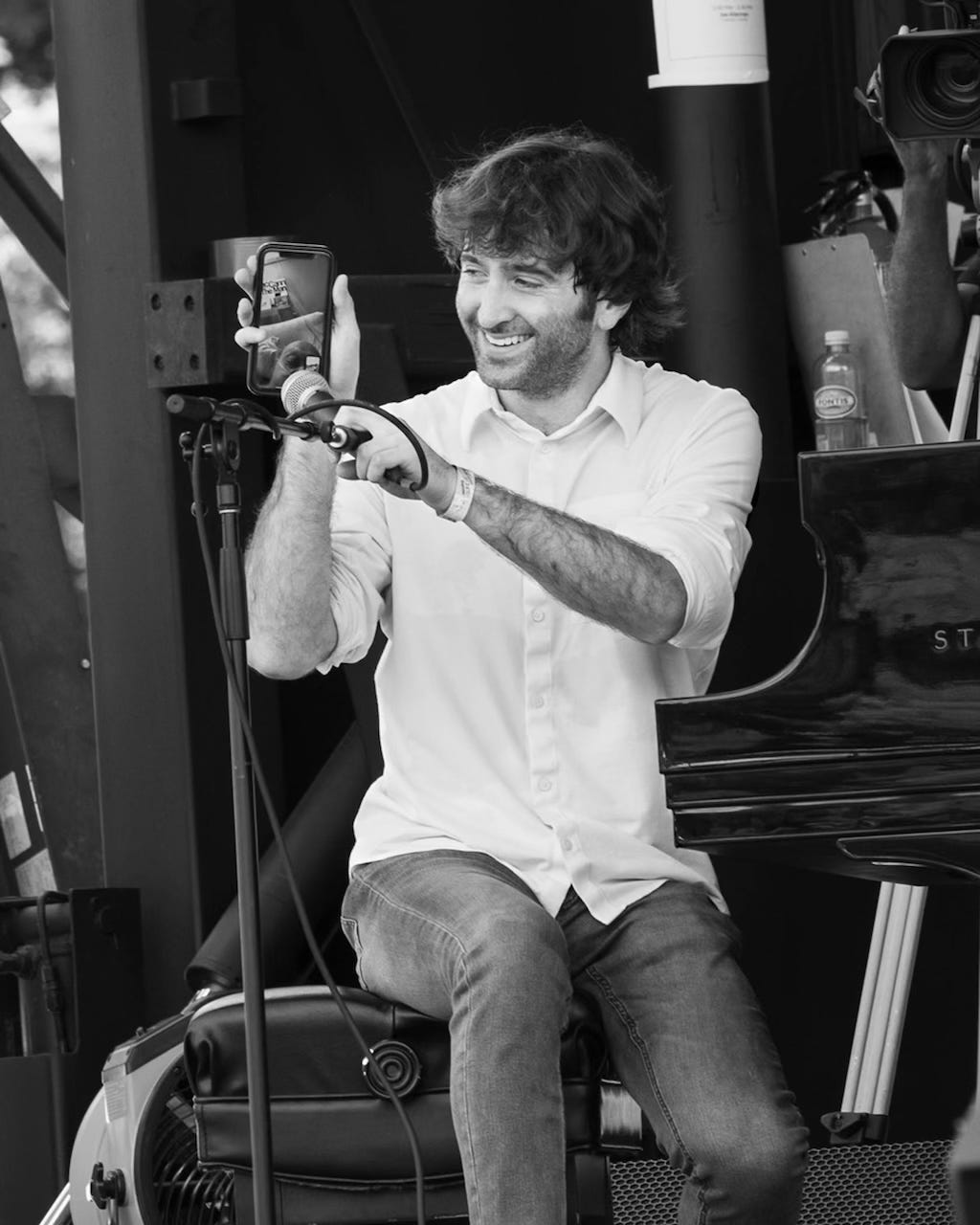
Les greeting the crowd at the 2022 Atlanta Jazz Festival. They loved it! So did he.
When I first discovered Les' music as a teen, my life was changed forever. I was a big blues and bluegrass fan who happened to fall in love with jazz piano, and there was something in Les' Kentucky-influenced, country-tinged sound that hit me hard and resonated deeply. An incredibly exciting, inspiring, and refreshing moment in my life, for that reason and also because, at the time, there were a lot of things I was being told not to do on the piano, but Les was doing nearly all of them and he sounded so good! In being true to himself, Les gave me the confidence to be true to myself.
"Don't believe all your well-meaning teachers," he once told me. "They forgot too much."
"Take your time. Work your way. People will be questioning you, doubting you, and you got to remind them that they have the same abilities. 'Leave me the fuck alone. Don't tell me what to do.' You're like a train: the train might go off the track, but the ride is still on. You'll find a way to get back on. You can't throw the trip back home away; you're going to definitely die."
While I was at first excited that we met so that I could learn to play like him, Les quickly made me realize that trying to sound like him was missing the point—as was everyone telling me not to do all of those things on the piano that Les sounded so good doing!
"There's always going to be the naysayers," he said. "But what you've got to do is say, 'I hear you, but this is my story, my movie, not yours. This ain't about you.'"
One time I was confiding in Les about some negative comments I'd just learned some musicians were saying about me behind my back. Les, who was used to the kind of hate I was then first-experiencing, told me: "When you get haters, that's a good sign. It means you're on to big things soon."
A few days later he called me all excited to share that he'd just remembered one of the worst reviews he got, and he couldn't stop laughing as he told it to me: "Les McCann sounds like a fireman trying to burn down a building."
Shortly after we first met, I was working on an assignment in school where I was supposed to write a melody over a given set of chord changes. The melody I heard in my head clashed theoretically with one of the chords and, knowing I'd get a bad grade if I turned it in as I heard it, I called Les.
His immediate response was: "You need to go work on a farm for a little while."
Shortly before we met, I was opening for Hiromi at the Blue Note in New York. Another hero pianist, Ahmad Jamal, was in the audience, and it was the first time I'd performed for one of my heroes. It was exciting that he was there, listening intently to my set, but I spent nearly the entire performance in a state of crippling anxiety. For much of the weeks that followed, I felt embarrassed, shattered, and confused. I had let—or, more accurately, I hadn't been able to keep—my fear from getting in the way of the music, which had, in my eyes, ruined the evening's performance.
I eventually shared that story with Les and he told me that he had a similar story he wanted to share with me. He was about the same age that I had been at the time, and he was about to walk on stage for his first big Chicago gig at the London House, when Oscar Peterson walked in and took a seat—which gave Les nerves very similar to the ones that I felt playing in front of Jamal.
He told me:
"I went over to say hello to him and I sat down for a second to talk to him and I told him, 'I love you, Oscar, but I don't know if I can play in front of you. I'm so nervous, I can't believe it.' Oscar looked at me and said something that changed my life. He said, 'I didn't come here to hear me. I came here to hear you.' He was telling me to be myself and that calmed me for the rest of my life. It was a moment of saying that I never have to fear what I do myself again. Without that experience, I'd have probably been fearful for some time longer. I'd have had to learn that anyway, eventually, but that's what I learned on that spot and at that moment. I never looked back after that, either."
And after hearing that story, neither did I.
Another time, on Oscar, he told me: "Oscar Peterson and Art Tatum? I can't do that. But I don't want to do that. That's not me."
And another time he joked, "I always wondered where Oscar got a piano that could do all that."
One time I told Les that the way he plays the melody on his 1961 recording of "Them That's Got" (alongside Ben Webster and Richard "Groove" Holmes —listen below) is the most difficult thing I've ever tried to learn on the piano. It had an incredible "winding up the piano" sound I'd never heard before; he laughed. "Well," he said. "When you grow up with a thing that only looks like a piano, you end up doing things that aren't on a piano."
He told me that the family piano didn't really function as one. "It was really just a place to hang pictures," he said. "But me, not knowing that it wasn't a real piano, I would sit there for hours banging on it and playing it, trying to get sounds out of it. I was fascinated by music."
As a kid in Lexington, Kentucky, Les said that "every Saturday my mother would listen to the famous opera show on the radio that came from New York, every Saturday—and she would try to sing like them. We thought something was wrong with her. 'Mom, what is that shit?'"
He told me that in those days "the local radio stations where I grew up was all country music," which his father loved, and on Sundays it'd be church music. "Not gospel music," Les clarified. "Church music."
He explored the sousaphone in school as well and, in the process, discovered another one of his gifts.
"I figured out how to make sounds come from an instrument and I started making my own music. I would use the sousaphone as a cheerleading instrument, because we didn't have cheerleaders. We had Les McCann on the field with the football team and the big horn, and that'd get the crowd going. I learned I had an effect on people with the little bit I knew."
Les eventually joined the Navy and won an annual talent contest. The prize was going on tour and appearing on The Ed Sullivan Show.
Thankfully, the clip survived, and Les was easily able to find it among the thousands of Ed Sullivan shows because of it being one night Kirk Douglas hosted.
The clip itself is hilarious—maybe more so to me than to Les. For all the things he had on me, this was the one thing I could always give it back to him for, playfully of course. Watch it below.
In all our years together, Les had so much material to give me shit with. But I had one card I could always play: "No more Rock N' Roll!" And I had a lot of fun with it.
That said, despite his Ed Sullivan routine, Les was and is the funniest person I've ever met. I love listening to recordings of Les live not only for the music, but also for the spontaneous moments when he talks to the crowd.
On one recording I have, just after the audience finishes applauding one song, Les says to the crowd,
"Thank you to everyone who clapped."
Pause.
"To everyone who didn't clap,"
—longer pause—
"we wish you severe chest pains."
Or another: "It's so nice to be back in beautiful...what is this place?"
And one more: "Is everybody here black or is it just the lights are out?"
I also love this exchange from an interview I once heard:
Interviewer: When do you first recall hearing music that really influenced you?
Les: My mother was breastfeeding me one time and I heard her singing this tune by Charlie Parker. I looked up and milk got all in my eyes and everything, and I said, "Gee Mom, did you write that?" She said, "Naw, Bird..."
He always encouraged me to continue the search for my true self through music.
He'd often say things like this:
"Represent all those people you like, because they're all pulling for you."
Or
"History's cool and all but at some point you just gotta say 'fuck history' and play how you want to play."
Michaelangelo said that "The sculpture is already complete within the marble block, before I start my work. It is already there, I just have to chisel away the superfluous material."
Les McCann said that "Your greatness is already there. It's already in you. You've just got to get to it."
He told me amazing stories about so many greats:
Mose Allison, who got mad at Les when a group of musicians visited the Pope at the Vatican and Les greeted the Pope with, "What's happening, baby?"
Coleman Hawkins, who was sick of playing his hit song "Body And Soul" and instructed Les to say he didn't know the tune when anyone requested it—after an irate fan called Les a "motherfucking liar" when Les said he didn't know the tune, Coleman took a pitcher and hit the man over his head, knocking him out ("Coleman was old school," Les told me. "He came from the day when everybody carried a switchblade and didn't take shit off nobody.")
Miles Davis, who interrupted a recording session to ask Les to speak with his son. "Sure," Les said, and Miles pulled out $500, about to hand it to Les. Confused, Les asked "Where's your son?" "In St. Louis. Let's go," Miles told him—to which Les said, "Motherfucker, I am not going to St. Louis."
Herbie Mann, who stopped a record date to ask Les if he could "play like a regular pianist," to which Les asked him to clarify what that meant. When Herbie said to "just lay the chords down," Les asked Herbie if he knew any pianists who could play like that, to which Herbie said yes. Les said, "Well hire them. I'm leaving," and he did.
Oscar Peterson, whose left hand was severely impaired by a stroke, and called Les after a stroke severely impaired Les' right hand and said "Let's go on the road together as one good pianist."
Bassist Leroy Vinnegar, who corrected the Rabbi giving the eulogy at the funeral for original Lighthouse Cafe owner John Levine; the Rabbi kept saying "John Le-vyne," and Leroy yelled out from the back of the sanctuary, "It's 'Leveen' motherfucker!"
Drummer Philly Joe Jones, who Les said playing with "makes you feel like you're playing in the middle of a thunder storm. You cannot fall. All you gotta do is ride the wave."
Pianist Carl Perkins, of whom Les said, "When Carl Perkins played a ballad you felt like you were standing under a waterfall."
Pianist Phineas Newborn, Jr., of whom he said, "had a look in his eye like something went wrong a long time ago. Almost like in another life he got killed. Music was his lifesaver. Played his ass off."
Saxophonist Houston Person. He told me that "One time I saw Houston Person in the bathroom. I asked, 'Are you Houston Person?' He said, 'No, I'm washing my hands.'"
Pianist Horace Silver, who called Les "Les McNasty" and unsuccessfully tried to get Les to sing two songs he wrote for him called "Ophelia Butt" and "Who Cut The Cheese?"
Count Basie and Ray Charles, who Les was so thrilled to have shared a triple bill with on his first concert in France (where, both because Les wasn't well-known at the time and because "Les" means "The" in French, some were confused when Les and his trio walked onstage; apparently, some were expecting a dance troupe called "The McCanns").
Jackie Onassis, who he spent an afternoon with at the home of his good friend Doris Duke. "When she was leaving, I had the gardener cut the biggest bunch of flowers from Doris's gardens, enough to fill the back seat of Jackie's convertible. When she saw that she grabbed me and gave me the biggest kiss."
Organist Richard "Groove" Holmes, who had this hilarious first-meeting story to share: "I go to meet him at this little restaurant up the hill in Pittsburgh called The Silver Pig. I walk in and see him at a table big enough for a football team—covered in food, piles of it, like a feast for twelve. Just as I get close, Groove calls the waitress over. With all that food sitting in front of him, he says, 'Oh, by the way, dear—would you please bring me a Diet Coke?' I fell on the floor laughing."
Ramsey Lewis, who Les told this bizarre story about: "We played a gig in Birmingham where the only person in the audience was the waiter. He sat there clapping for us all night. When we finished, the emcee got up and said, 'Ladies and gentlemen, let's hear it for the great Ramsey Lewis.' What?!"
I could go on and on. I learned so much from him, and I'll forever miss his teachings and his never-ending plethora of incredible stories, but I miss the fun we had most.
Just a few months before he passed we were chatting about one of the songs I included on my tribute album to Les, "Samia," to which Les remarked, "Ah, Samia. I loved her and never got to tell her." I inquired who she was and he told me that she was a lady who worked at Atlantic Records while he was on the label, and that she left the company before he got to express his feelings. He told me her real name and that, if she was still around, she would be around 80 and he thought that she lived in Brooklyn. So I typed her name, "80, Brooklyn" into Google and a bunch of phone numbers came up.
"Let's call 'em!," Les said.
And we spent the night calling them.
While we never found the Kathy Moore that he was looking for, Les did get to have a field day when one of the Kathy Moores answered the phone drunk and responded, "I get fucked up," when Les asked what she did for a living.
He called me one Christmas singing, "I'm dreaming of a white... woman."
And one Passover: "This Passover, they should rename all freeways 'passovers.' It gets really busy during the five o'clock Rush Hashanah."
Regarding Stone Mountain—the mountain just outside Atlanta with Confederate generals etched into its face—Les had a brilliant idea: swap the generals for Georgia-born greats Ray Charles, James Brown, and Otis Redding, with one condition: it could no longer be called Stone Mountain, only Stoned Mountain.
One time, one of my musician friends had a question about Les' song "Gus Gus," which was written for one of his best friends, Gus Perdakikis. Here's how the exchange went down:
Friend: Les, is your song "Gus Gus" named after the mouse in Cinderella?
Les: How old are you?
Friend: 33
Les: What the fuck are you doing watching Cinderella?
Occasionally Les would lose his teeth after taking them out, putting them on his chest and falling asleep, and he'd always have fun with the nurses who tried to help him find them. Here's a favorite interaction that happened while we were on the phone:
Les, to me, laughing: Joe! I lost my teeth!
Les (talking to his nurse who's looking for his teeth as we're talking): Y'all got any extra teeth?
Nurse: We don't have extra teeth...
Les (fake crying): Where's my teethies?
Nurse (as she's searching): We'll find them, don't worry. Did the other nurses feed you yet?
Les (still fake crying): No, they didn't.
Nurse: They didn't?
Les (still fake crying): It's because I'm Black...
Les would leave me hilarious voicemails, often speaking in a British accent and pretending to be different people, most frequently—and I have no idea why—Amos from Amos & Andy.
Les definitely had his own way of talking about things, and his own way of moving through the world. He often called Carnegie Hall "Carnegro Hall," and after getting his honorary doctorate in Kentucky, happily referred to himself as "edumacated." All of that was very Les. He wasn't especially interested in other people's rules about how he was supposed to think or talk.
One time I told Les about the campaign to rename jazz "Black American Music," thinking he'd surely be into the idea. In some ways, I assumed it would line up with so much of who he was and what he had lived through. But Les saw it differently. He didn't want music reduced to what he called "human shit." To him, music came from someplace higher. He felt that making it about race pulled something godlike down into something merely human. Coming from Les McCann—whose life and music were deeply shaped by Black life in America, and whose "Compared to What" became an anthem of its time—that really struck me. It was such a Les answer: surprising, deep, a little maddening, and completely his own.
"Making things about race is beneath an angel," he told me. "Most humans neglect their angelhood. They get caught up in human shit other humans made up. We've got to strive for more."
Regarding "bad words," Les insisted, "They're just sounds humans made up. There are no bad words. It's just sounds that humans label bad to instill fear."
Tags
Comments

PREVIOUS / NEXT


Support All About Jazz
 All About Jazz has been a pillar of jazz since 1995, championing it as an art form and, more importantly, supporting the musicians who make it. Our enduring commitment has made "AAJ" one of the most culturally important websites of its kind, read by hundreds of thousands of fans, musicians and industry figures every month.