Home » Jazz Articles » Interview » John Bishop: A Multi-Dimensional Journey in Jazz
John Bishop: A Multi-Dimensional Journey in Jazz

JB: I didn't go chasing after the trio as a thing. I think it just kind of fell in my lap—New Stories was probably what really got that going, just because we created a group sound and we were all sidemen also, for other people. So it helped to make sense for people who wanted to have a really cohesive band. They could come in and just hire us, and then you had this sound. So it kind of worked on that, that experience doing that for 25 years kind of threw us out into the world way more than just having a band or just doing our own thing alone. I think that's probably where the whole trio thing seemed to make really good sense as a form. It's true for the bassist as well. Certainly, because you don't have five or six or seven sounds when you're sitting in the audience, coming at you when it's whittled down to three.
AAJ: A little more exposure, there's a little more vulnerability, that's what makes it intriguing for the listener.
JB: But the other thing about New Stories was that it was collective, so we all had equal say, and what our sound was coming out like, and what tunes we were doing, and how we put that together was a collective effort. And so then getting the gig with Hal, it was exactly the same. I mean, he definitely had a mind to what tunes he wanted to do. But as far as what came out, there was no role playing. It was a collective thing. I think for myself, it's easier to have a collective when you have three people than when you have six.
AAJ: The Galper trio was revolutionary in that it worked out of a rubato concept. The trio had an advanced concept of time, employing an elasticity to time and space. Galper described this as being in "the zone." He told me that he was playing with Jeff Johnson and toyed with the concept, but that it really snapped into place with your arrival. That's quite a compliment. Tell us how this happened and how you never spoke of it again.
JB: Hal had heard some stuff that Jeff and I were recording with John Stowell, as he was working, hanging out at his house and working on some things for a few years after he disbanded his trio. He was just kind of hanging out, playing and doing stuff. And I think he heard something where it seemed like an easy step into doing his next step—he could hook back up with Jeff Johnson. Then I happened to be there, so it's ready-made. So he flew out, and we played in my living room. We started playing a tune, and about 15 seconds into it, he said, "Let's try it without worrying about time—rubato, let's just don't worry about bar links or playing time. So we started doing that and then did it for another hour on a few different tunes. The next day, we went in and recorded the first record, Furious Rubato (Origin, 2006). Basically, once the concept was set, we didn't really need to have a discussion again about what we were doing or what we were trying to do. It was just, here's a new tune, and then we would just attack it coming from that space of you're sitting, you're not counting off the tune, you're just sitting, and then sound starts, and that you all three happen to be playing something, It's all about just creating momentum and movement and a collective sound.
AAJ: It's always been my contention that the Galper Trio has not received the notoriety it deserves historically. The conception of time employed had never really been fully broached in that fashion. The trio's overall work deserves to be mentioned in the same breath as the trio work of Bud Powell, Bill Evans, Keith Jarrett and the other innovators of the form.
JB: I mean to me, when we were playing it, each one of us is like connecting to our past and everything that we've been taking in musically. I don't feel like I'm doing anything new or anything like that. It's a result of everybody else's influence on me and all the collective experience of playing with different people, but at the same time anything else in life?
Well, exactly that's the thing. I suppose you say the same thing about John Coltrane when he's playing "A Love Supreme." That was him playing r&b gigs, that was him going through Miles, that was him doing self-reflection, and then you end up with "A Love Supreme." I'm not comparing us to Coltrane, or anything like that, but just that, the creative process, you know, it's magic in the end. As far as deserving anything, the accolades and the critical acclaim for any particular thing is all based on what the ecosystem of the press and radio and writers and how they perceive it.
It can, but I think we're in such a weird space now, where there's no city hall, there's no community center—I mean, you have Downbeat magazine and you've got a thousand Substacks and blogs and things like that. There are very few—you don't have the New York Times, Wall Street Journal, Downbeat, Jazz Times. You don't have this collection of really powerful voices going, Ah, this, yes, this is worth looking at. I think again, with the label, getting back to that and trying to build a thing that can get into the right hands, so that you can build at least something—it won't be that overwhelming word on the street that this is good. It would be more of an underground collective thought within all of these radio people and writers and musicians that what's been created here has some value. It's got a position in the world. Is it going to be written about in the New York Times or anything? Maybe something will. But that story probably won't be told in a big enough way to really affect your career and your life and all that. But at least within our realm of, you know, a few thousand people, there's this nice little thing—this is a worthwhile thing you've done.
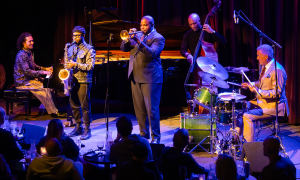
AAJ: You currently play in a chordless quartet featuring trumpeter Thomas Marriott, saxophonist Rick Mandyck and bassist Jeff Johnson. The band is aptly called Free Fall, because of the band's liberated sense of melodic freedom. The group has been strictly a live phenomenon only, and to some degree, Seattle's best kept secret. Are there any plans for Free Fall to hit the studio?
JB: Yeah, we just discussed that last night for a second. Tom was bringing it up, and I brought up that we did go in and record a thing, just for the sport of it, and I finally listened to it many months later.
AAJ: When was that?
JB: I don't even remember, years ago or maybe a year ago? It was at this little studio, just kind of a thrown-together thing, but yeah, it sounds like us.
AAJ: The band seems like it is a constant state of reinventing itself over the course of an evening's performance. You can tangibly feel the connection between the band and the audience, especially in the right venue.
JB: I think we'll probably do something like that. I mean, that's the idea.
AAJ: You know a guy with a record label. Will that be an Origin thing, or an OA2 thing?
Tags
Interview
John Bishop
Paul Rauch
United States
Washington
Seattle
San Antonio
Eugene
san francisco
Cedar Walton
Billy Higgins
Charlie Rouse
Jazz Alley
Dexter Gordon
Chuck Deardorf
Mark Seales
Dave Peterson
wynton marsalis
Art Blakey
Rick Mandyck
Michael Bizio
Steve Gadd
Billy Cobham
New Stories
Marc Seales
Doug Miller
Jeff Leonard
Hans Teuber
Chad McCulloch
John Stowell
Jeff Johnson
John Coltrane
Comments

PREVIOUS / NEXT

Support All About Jazz
 All About Jazz has been a pillar of jazz since 1995, championing it as an art form and, more importantly, supporting the musicians who make it. Our enduring commitment has made "AAJ" one of the most culturally important websites of its kind, read by hundreds of thousands of fans, musicians and industry figures every month.