Home » Jazz Articles » Live Review » Brilliant Corners 2026
Brilliant Corners 2026
Courtesy Marcin Wikowski

Brilliant Corners is a reassuring celebration of fiercely creative and wholly personal music making.
Few events signpost the time of year quite like a city's flagship contemporary music festival. For one week every March, as winter gradually recedes, Belfast's aptly named Brilliant Corners illuminates jazz—and jazz-adjacent music—in many of its myriad forms. Inevitably, some of the more outré music ignites the old 'but is it jazz?' debate, but for most of the faithful who attend year upon year, musical labels are of less concern than the quality of the music on show.
In this regard, Brilliant Corners nearly always delivers. Since its first edition in 2013, you could count the number of underwhelming gigs on the fingers of one hand. In tennis parlance, the festival's promoter Moving On Music: Literal Magic is getting 95% of its first serves in—with many an ace to provoke the oohs and aahs.
As the first queue into the Black Box assembled on Friday night, it hardly seemed like a year since Brilliant Corners 2025. Is the Earth spinning faster? Certainly, events on the ground seem to be, and that is also true of music. But while AI invades the music industry—like every other corner of our lives—Brilliant Corners is a reassuring celebration of fiercely creative and wholly personal music making. The 2026 edition was no exception.
Anthony Joseph Quartet
Within seconds of British/Trinidadian poet Anthony Joseph's quartet kicking out the jams on "Satellite," the tables and chairs in the Black Box felt like a ball and chain. Electric bassist Andrew John and drummer David Bitan's wicked funk-laced grooves provided the spring, saxophonist Jason Yarde's riffing, spiraling chatter the pistons, and Joseph's rapid-fire spoken-sung poetry the fuel.Like a cross between Gil Scott-Heron and Ted Joans—by way of Benjamin Zephania—Joseph riffed on the cosmos: slavery and Black identity, diaspora and belonging, Afro-futurism and ancestry. There was a tip of the hat to drummer Tony Allen on "Tony," one of several powerful compositions from Rowing Up the River to Get Our Names Back (Heavenly Sweetness, 2025). Joseph jammed with the Afrobeat progenitor in Paris in 2011, and that experience, like Allen's music, seemed deeply embedded as the singer threw joyous shapes, pogoing and gyrating as Yarde worked up his own steam.
Trinidadian Baptist rhythms ("the root of funk") fueled "Buddah"—a journey into the spirit world, forged in magic realism and images of more earthbound design. Yarde switched between flute and honking saxophone, as Joseph blew a whistle over driving beats.
The contrast between the uber-funky "James," and the aching introspection of the dubstep "Jubba for Janet" was striking—the former celebratory and booty shaking, the latter brooding and pain-filled. Epic, the title track of the upcoming album The Ark (Heavenly Sweetness, 2026), with Joseph namechecking the passengers—a starry cast of Black artists and activists—in a free-flowing torrent of acknowledgement.
Th Black Box crowd demanded an encore. Joseph and crew duly delivered "Milwaukee and Ashford," a salutary tale of mental fragility and renaissance. Yarde brought the fire, as he had done all set, Bitan and John the deep-pocket groove, and Joseph, with a poetry at once piercing and empathetic, the history of the Black diaspora and the human condition. Stonkingly good.
Zak Irvine Quintet
Bangor-born, Belfast-based pianist Zak Irvine is one of the leading lights of the up-and-coming generation of young jazz musicians in Northern Ireland. With headline gigs at Belfast's Bert's Jazz Bar and Scott's Jazz Club under his belt, his career is building momentum nicely. Yet he still has time to give those coming behind him a leg-up, working with David Lyttle's Jazzlife Alliance mentorship program for 18-25s.For this Saturday afternoon gig, Irvine delivered a highly polished program of mostly covers that showcased the individual talents of Tom Wall on trumpet, Michael McDowell on tenor saxophone, Phil Acheson on bass and Ben Watson on drums.
Back in February 2025, Irvine was part of the Dakiz Quartet—steered by drummer Steve Davis—that paid homage to the music of Wayne Shorter. It was with Shorter's "Infant Eyes" that the Zak Irvine Quintet kicked off its set, its driving hip-hop rhythms a nod to Butcher Brown's version.
A brace of melodically bright Irvine originals featuring short but sweet solos from Wall and McDowell also leaned towards the contemporary rhythmic milieu of Butcher Brown, Robert Glasper et al. Sandwiched between those two tunes was Glasper's "Rise and Shine," where scurrying drum-and—bass lines and sharply defined unison brass paved the way for impressive individual turns from Acheson, Wall and the leader.
Neo-soul vibes and jazz-funk grooves followed with Nate Smith's "Magic Two: Transit"—a jam from the Festival International de Jazz de Montreal 2023, that aligned the drummer with Kiefer and Carttoons. In a set dominated by busy rhythms, Herbie Hancock's languid "Butterfly" brought a welcome change of pace and mood where dreamy atmosphere and virtuosity combined to handsome effect.
Two tunes by Kenny Garrett, "Sing A Song" and the joyously infectious, solo-peppered "Happy People," struck the perfect closing note to an engaging performance. In tilling the overlapping ground between past and present, Irvine is sowing the seeds of a bright future indeed.
Ibelisse Guardia Ferragutti & Frank Rosaly 'MESTIZX'
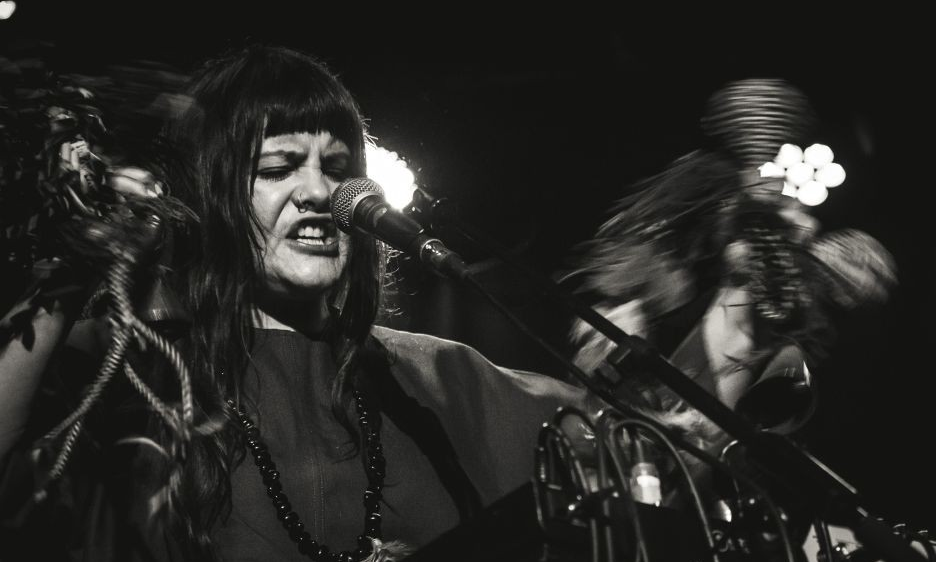
A minute is a long time in the musical universe of Ibelisse Guardia Ferragutti & Frank Rosaly, whose paradigm-shifting performance captivated the Black Box audience on Saturday night. The clue was in the name; 'mestizx' is a reference to Guardia Ferraguti's Bolivian-Brazilian, and Rosaly's Puerto Rican-American identities, rich dualities that only began to hint at the musical cross-pollination on show.From the gentle reverie of mbira-cum-unison-vocals to free-jazz-cum-synthesizer noise, and from melodic song to roaring vocal release, the transitions were as stark as they were thrilling. Synthesizers abounded; the main weapon of Lida Brouskari, synthesizers also kept bassist Uldis Vitrols, trumpeter James McClure and Guardia Ferragutti equally busy.
The balance between electronics and organic textures, however, was finely wrought, resulting in music both boldly contemporary and traditionally rooted. Latin rhythms, marching band groove, pervasive percussive colors and woozy psychedelia swirled intoxicatingly. Prowling and dancing, Guardia Ferragutti cut a shaman-like figure, shaking percussion instruments with impassioned intensity as she released soul-deep howls and soaring cries.
The songs, four years in the making, and delivered mainly in Spanish, spoke of ancestry, post-colonialism and, above all, of the navigation of identity. Not for nothing did Guardia Ferragutti and Rosaly's hypnotic musical offering feel so personal.
At one extreme, enveloping swells of synthesizer combined with potent rhythmic and vocal mantras; at the other, washing cymbals like the whispering wind merged with banshee-like flute, mbira pulse and witchy spoken word. Not one for the jazz police, perhaps, but an invigorating celebration of music in all its possibilities, and of life itself. The late Hermeto Pascoal, you feel, would have approved.
Christian Marien Quartet
In any jazz festival promoting various styles—and Brilliant Corners is nothing if not diverse—there is usually one gig that stands out, and against which all the others are measured. At Brilliant Corners 2026, the Christian Marien Quartet won that gong for its fearless, dynamic performance on Sunday afternoon.The quintet was performing music from the album Christian Marien Quartett: Beyond the Fingertips MarMade Records, 2025). The through-composed element at the music's core was most evident in melodic unison passages and in the choreography of sharp shifts in tempi. But these signposts aside, there was no obvious roadmap to follow. It was a case of hanging on for the ride as the musicians threw everything into the collective ring—tenor saxophonist Tobias Delius' sheets of skronk, Jasper Stadhouders' spiky guitar runs, and broiling rhythms cooked by double bassist Antonio Borghini and Marien.
A guitar-cum-drums summit produced an exchange at once abstract and bone-shakingly visceral. When it petered out to almost nothing, walking bass stepped up, Borghini ushering in a bluesy swing groove, laced with deliciously angular guitar work, that could have come straight out of the Sun Ra Arkestra's playbook.
From vamp-based grooves and simmering minimalism to post-bop charge and blistering free-jazz release, an animated Marien steered the quartet through musical terrain of vastly contrasting contours. That only Borghini and tenor saxophonist Delius—who doubled on clarinet—sported sheet music seemed symbolic of the quartet's form-meets-freedom duality. Smiles abounded between the players, who reveled like children in a playground—tickled by their harmonious creativity and thrilled by the frisson of joyful anarchy. The post-gig audience buzz spoke volumes.
David Lyttle
Dock Street Jazz Club got in on the Brilliant Corners act with a surprise gig on Sunday evening. With DSJC's curator, drummer David Lyttle the only name on the bill, you had to turn up to find out who the guest musicians were. Not many took a punt—the crowd was one of the smallest since the venue began hosting Sunday-night jazz gigs in September 2025. That was a surprise, given the high quality of musicians who perform each Sunday.As it turned out, Lyttle was joined by guitarist Phil Robson and double bassist Dan Bodwell. An off-the-cuff set served up time—honored standards peppered with a few original tunes. Robson took the lead on "Alone Together" and Chick Corea's "Windows," his playing a combination of elegant articulation and unfettered flow. In truth, the same applied to Bodwell and Lyttle, who despite playing more supporting roles, brought inescapable forward momentum to the music.
The drummer and bassist go back some way together, with Bodwell appearing on Lyttle's debut album, True Story (Lyte Records, 2007). From that album "Septembertime" was a logical next choice, with Lyttle and Robson also having rearranged this slice of bitter-sweet nostalgia for their duo album IN2(Lyte Records, 2023). To the accompaniment of gently lilting bass and soft brushes, Robson's lyricism cast a quiet spell.
The guitarist was in more expansive mood on Vernon Duke and Ira Gershwin's "I Can't Get Started," where fluidity and emotive depth were inextricably linked. A breezy take on another standard, "I Hear a Rhapsody" closed the first set on an upbeat note, with sparkling solos from all.
The second set followed in the same vein—standards and originals, punctuated by Lyttle's deadpan humor. "This next one is also from my first album. The last time I played "Happy Easter" was probably somewhere like the Cork Jazz Festival, back in 2007... we haven't played it since."
But the tumbling, slip-sliding years made no odds. The trio were on it this night, and highly attuned, both to the beauty of standards nearly a century old—a gorgeous rendition of "Blame It on My Youth" will linger—and to more recently minted tunes. The originals were cut from a not-dissimilar cloth to the standards—melodically appealing, rhythmically lithe and open to endless interpretive possibilities. Straight-ahead jazz at its most persuasive.
Florian Arbenz & Greg Osby
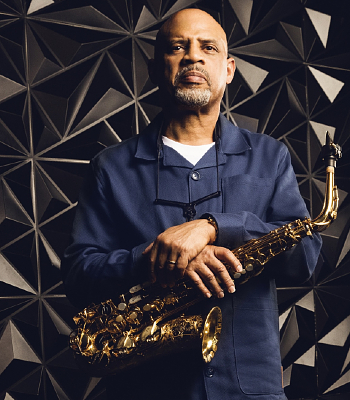
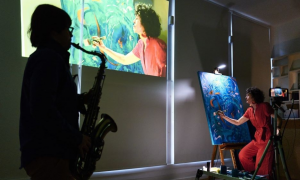
Drummer-percussionist Florian Arbenz and saxophonist Greg Osby are old sparring partners, having first collaborated in 1998. Their first duo recording took a while to arrive, Reflections of the Eternal Line surfacing on Osby's Inner Circle Music in 2020. The concept was inspired by the paintings of Swiss artist Stephan Spicher, who developed the program together with Arbenz and Osby—painter and musicians creating simultaneously.It took just a few short bars of opener "Please Stand By" to underline the close-knit symmetry of the musicians' probing exchanges. A resonator box and a kalimba gave "Wooden Lines" its personal sonic stamp, with Arbenz working these, and the rest of his kit, with mallets, sticks and hands in a blur of movement—his industry replicated by Osby. In the most intense passage of drumming Osby all but laid out, providing the subtlest of accompaniment.
The set featured several tunes from other sources. Notable among these was the spare miniature "Jaunt," which seemed to align with Spicher's guiding star of 'spiritual minimalism,' and "Old Shaman" from The Alpine Session (Hammer Recordings, 2025)—Arbenz' recording with twin brother Michael and bassist Ron Carter. On the latter, feisty improvisation was bookended by ethereal mini-xylophone ripples.
Though the variety of musical textures and tempi made for an immersive experience not unlike an unfolding exhibition, the excitement lay in the meatier exchanges—particularly on a fiery reading of Ornette Coleman's "Mop Chop" with its restless exploration and pulse-quickening rhythms.
Throughout the gig Arbenz alone made brief introductions to a few of the tunes while Osby remained silent. Only at the end, when the applause had wrung itself out did Osby take to the mic, giving thanks with the same elegance, sincerity and authority that had characterized this duo's performance.
Dark Days Trio
Given the political instability in the world, the rise (again) of the far right, and the fractious, tribal nature of national politics in many countries, it is surprising that more musicians do not use the unique platform they possess to speak out. Bassist Neil Charles is an exception. To mark the centenary of civil rights activist James Baldwin in 2024, Charles created Dark Days with pianist Pat Thomas, drummer Mark Sanders and vocalist Cleveland Watkiss. The quartet's performance at London's Café Oto resulted in the live album Neil Charles Quartet: Dark Days (Jazz Now, 2025).Unfortunately, for this Belfast gig, pianist Pat Thomas was absent due to illness—a significant loss that could not be overcome. That said, Charles, Sanders and Watkiss still delivered a memorable performance, searing at times in its intensity.
Charles began with a short poetic discourse, emphasizing that all humans are born as blank canvases and that all of our behaviors are learned. For the next hour, throbbing bass, restless drums and electronic-filtered vocals conjured a wall of sound, representing the activist spirit of Baldwin and the anger and injustice of Black America faced with systematic racism.
Between delivering fragments of Badlwin's words, Watkiss improvised in his inimitable style—a mixture of traditional scat, non-syllabic percussive plosions, babble, echoing cries and melodic lines. As a unit the trio veered from straight-ahead swing to free-jazz improvisation, with pockets of looped vocal—sans drum and bass—creating sonic divergence. Like the segments of a suite, the music was divided into compositional frames with clear points of departure and arrival.
Tempest gave way to haunting, vocal-led chant, where soft brushes and slow-pulse bass played a supporting role. Individual solo spots featured sparingly, though mighty efforts from Charles and later Sanders broke up the prevailing trio pattern in incendiary style. Appropriately, Baldwin had the final say, Watkiss relaying his words, penned nearly half a century ago, and still resonating strongly today, that spoke of a child's loss of innocence in Jim Crow America.
Risk is the currency of improvised music, and although the exchanges did not always pay dividends, the most flowing passages of the Dark Days trio were potent indeed. More thrills than spills.
BAN BAM @Handmade Music
Under the banner of Handmade Music, the Accidental Theatre hosts monthly experimental and improvised music performances by the students of Queens University's Sonic Art Research Centre (SARC). For several years Handmade Music has partnered with Brilliant Corners, bringing more outré music into the festival program. Laptops, loop stations and pedal boards usually abound.First up was violist Joanna Mattrey's quartet, which featured Nick Roth on saxophone, Larissa O'Grady on violin, and Barry O'Halpin on electric guitar. Mattrey's 25-minute "Battle Ready II" oscillated between composed and improvised music and spoken word recital. A video projection behind the musicians alluded to the music's guiding themes of conflict, displacement and identity.
This was contemporary chamber music with a dissonant underbelly. Strings-led rhythmic structures morphed into pulseless, edgy drone passages. Unaccompanied viola of distinct lyricism suddenly went rogue, Mattrey pulling every manner of harshness from her strings. Free-roaming saxophone and jagged guitar gradually acquired coherent shape, dovetailing with the strings in through-composed sections whose beauty was fleeting—shattered by collective dissonance.
The piece finished with four-way spoken-word recital of obvious gravitas, though the interweaving voices, slightly out of sync, did not aid comprehension. Still, a stirring performance that won the audience's approval.
Upstairs in the smaller room of the Accidental Theatre, guitarist Orion Courtney Lee and electronic musician Leo Waterfield employed open-source computer software, loops, delay and echo to fashion a sonic world that fell somewhere between sci-fi abstraction and industrial noise.
Orrin put his whole being into the performance, his gyrations merely extensions of his beautiful distortions and wild projections—a dance in every sense. Yet for all the brutal intensity, it was striking how much space the guitarist embraced, letting small, silent pools form. Together, the musicians manipulated the contours of their narrative in more subtle ways as well, with a circling guitar arpeggio and undulating drone combining to meditative effect. A soundtrack to the encroaching dystopia.
Downstairs once more for the evening's final act. Singer Christine Tobin's work 'Pseudologia Fantastica' was written for Improvised Music Company's BAN BAM Commission & Development Award. Without naming names, Tobin explained how the series of piece were her response to the normalization of barefaced lying, disinformation and fake news in politics and the mainstream media, and also the rise of the far-right in a worrying geo-political landscape. Joining Tobin in this multi-media performance, which also featured pre-recorded piano, spoken-word text and video projection, were cellist Kate Shortt and guitarist Phil Robson.
Tobin toggled between wordless vocals and lyric recitals on the theme of the stripping of meaning from words. A light dusting of electronic effects created intermittent atmospheric halos, but the most affecting music came with cello drone and Tobin's wordless incantations. Hip-hop rhythms accompanied Tobin as she riffed on the dislocation of the truth and the advent of gaslighting, malware, AI, datamining, firehosing, conspiracy theories, toxic masculinity, scapegoating, and social-media manipulation. "Who let the dogs out? Who let the dogs in?" she cried.
From the back of the stage, Robson's guitar effects—creaking and scratching—proved to be largely ineffectual. This did not feel like his bag at all. Perhaps an electronic musician would have brought more pronounced textures to the mix, freeing Tobin from her knob-twiddling duties that felt a little clunky at times. An extended video extract from the prophetic black comedy Network (1976) underlined that the crass, exploitative and manipulative television networks depicted as satire half a century ago are dangerously close to our present reality.
Musically, 'Pseudologia Fantastica' offered little, but Tobin deserves recognition for speaking out when many do not, for speaking up for women's rights when those rights are being trampled upon. She offered no solutions but called for resistance, unity and common sense—commodities all in short supply in the world today.
Laura Jurd: 'Rites and Revelations'
Making her third appearance at Brilliant Corners, and her first since the 2020 edition, trumpeter-composer Laura Jurd was presenting music from her 2025 album Rites and Revelations on the aptly titled New Soil label.With the inimitable Ruth Goller on electric bass, Ultan O'Brien on viola, Martin Green on accordion and the ever-present Corrie Dick on drums, Jurd's quintet rocked the Black Box with its potent brew of folk-inflected jazz. Strains of Celtic folk from all corners colored arrangements that veered from yearning melancholy to thumping celebration.
What a treat to see the multi-faceted Green in his element, headbanging as he worked his bellows with something akin to joyous fury on the rollicking "What are you running Towards?" So too, Goller's post-Jimi Hendrix invention on an unaccompanied solo spot that bled out of the rootsy opener. Her fierce pedal—skewed noise in turn gave way to the somber "Praying Mantis," a vehicle for Jurd's mighty chops.
Jig melted into free-jazz blow-out on "Lighter and Brighter," with Dick's industry fanning the flames of Jurd's improvisation. Miles Davis once said that there was nothing anyone could play on a trumpet that had not already been played by Louis Armstrong and Jurd paid homage to jazz's first great trumpeter with "St. James Infirmary," the quintet's brooding interpretation very much of this day and age.
A trumpet-and-drums duet blurred the lines between composed and improvised lines, but Dick's and Jurd's energy raised the bar for the episodic, swirling finale that was "What are you running Towards?"—a headbanger's delight. Brilliant, heady stuff.
Trish Clowes 'My Iris'
It was a fairly quick return to Ireland for saxophonist-composer Trish Clowes following her appearance with Dave Douglas at Bray Jazz Festival in 2024. Once again Clowes was heading My Iris, her main vehicle since 2014. The deep levels of understanding Clowes has developed with guitarist Chris Montague, pianist-organist Ross Stanley, and more recent arrival drummer Joel Barford, was keenly felt from the opening salvos of "Walking"—a post-bop burner which brought barnstorming solos from all.Clowes was showcasing music from My Iris' spring-release album Try Me (Stoney Lane Records, 2026), music inspired, she related, by a walk along London's Thames pathway and field recordings made en route. There was a sly, tango-ish gait to "For the Darklings," sustained group intensity on "Whisky" and an arresting transition from meditative to rhapsodic on the title track.
Whether ripping it up at medium-fast tempi on contrafacts or steering a ballad, the Shropshire-born saxophonist played with notable authority and melodic invention. Not for nothing is she widely considered as one of the UK's best jazz musicians.
Clowes turned back the clock with "Free to Fall" from Ninety Degrees Gravity (Basho Records, 2019), the quartet hitching tempestuous interplay to mellifluous flow. On the tunes extended wind-down Clowes eschewed the softly spun vocals of the studio version for an instrumental soft landing.
My Iris signed off with a gently bluesy ballad; with Barford on brushes, Clowes, Montague and Stanley each stepped up to beguile one final time.
In a 2019 interview with All About Jazz Clowes said: "The feeling with the band, the way we are growing, it feels more and more special as we build on things... " Seven years and a few excellent recordings further on, Clowes must feel like the cat who got the cream.
Fixity
Saturday evening saw the final slot of Brilliant Corners 2026 fall to five-piece outfit Fixity. Led by multi-instrumentalist Dan Walsh, Fixity grew out of Cork's improvised music scene in 2015. Since then, the group, featuring a rotating cast of musicians, has released a series of self-produced albums. For this festival curtain closer, Walsh, Sam Clague (bass clarinet, flute), Brendan Riordan (guitar), Philip Christie (synthesizer) and Sean Maynard Smith (bass) offered music from the forthcoming album Assurance (Moot Tapes, 2026).From the offing with "Needs Must," Fixity dealt out bustling, danceable rhythms, synth-pop textures, catchy melodic hooks and fiery soloing—a blend that side—stepped facile categorization. Walsh doubled on flute on "Stomping On The Marshes," creating a double-flute threat with Clague against metronomic rhythms. After an intense barrage the rhythms abated, leaving in their wake an ambient soundtrack of lilting flute and synth wash. From this bed, electronic pulses and surging clarinet sprouted as Walsh and Maynard Smith picked up the reins once more.
There was a stylistic continuity to the new compositions from Assurance as back-to-back selections demonstrated. Powerful rhythms, art-rock vocal, synth-and-guitar textures and soaring clarinet were the stock-in-trade, but Fixity was just as compelling when treading more meditative waters—with slow-curling melodies and ambient synth exerting a dreamy calm.
A guitar-cum-bass clarinet motif kick-started the lively "Do The Bits and Pieces"—its quirky mixture of rock and avant-jazz sounding like a cross between Ian Dury & The Blockheads and Can. Where the obvious choice might have been to bow out with another banger, Fixity instead offered up a hypnotic slice of spiritual jazz—all rumbling rhythms, minimalist synth touches and yearning bass clarinet.
On this evidence the upcoming album, which sees a 10-pieece Fixity augmented by a string quintet (arranged by Áine Delaney), should be a corker.
Wrap-up
The general consensus among Brilliant Corners regulars was that the 2026 edition was one of the very best. As ever, there was a good representation of Irish jazz talent, with the youthful Zak Irvine Quartet flying the flag in style for the current generation. The festival was bookended by two very strong gigs in Anthony Joseph Quartet and Fixity. In between there were plenty of highlights. From mainstream swing and standards fare to free improvisation and avant-garde, from jazz-funk to jazz-folk, and to one or two brilliant corners that defied categorization, jazz was presented in its myriad forms and off-shoots.Politics was more to the fore in the 14th edition of Brilliant Corners than in previous years: Anthony Joseph's music spoke of slavery and the African diaspora; Dark Days Trio shone a spotlight on race issues in America in paying homage to activist, poet and author James Baldwin; Christine Tobin railed against fake news, media manipulation, misogyny, and the erosion of civil liberties.
Why more artists do not take such stands may have something to do with cancel culture—it is hard enough to make a living from this music at is. So, hats off to Brilliant Corners promoters Moving On Music for having the guts to programme artists with something meaningful to say about the state of our world. But just as we need people to speak up, we also need an awful lot more people to listen. To really listen.
Unless the world has destroyed itself, the 15th edition of Brilliant Corners should be held around late February-early March 2027. Fingers crossed.
Tags
Live Review
laura jurd
Ian Patterson
United Kingdom
Belfast
Moving On Music: Literal Magic
Brilliant Corners 2025
Anthony Joseph
Jason Yarde
Gil Scott Herron
Tony Allen
Scott’s Jazz Club
david lyttle
Wayne Shorter
Butcher Brown
Robert Glasper
Nate Smith
Festival International de Jazz de Montreal 2023
Herbie Hancock
Kenny Garrett
Ibelisse Guardia Ferragutti
Frank Rosaly
Lida Brouskari
Uldis Vitrols
James McClure
Hermeto Pascoal
Christian Marien
Christian Marien Quartett: Beyond the Fingertips
Tobias Delius
Jasper Stadhouders
Antonio Borghini
Sun Ra Arkestra
Dock Street Jazz Club
Phil Robson
Dan Bodwell
Chick Corea
Lyte Records
IN2
Florian Arbenz
Greg Osby
Inner Circle Music
Ron Carter
Ornette Coleman
Neil Charles
Pat Thomas
Mark Sanders
cleveland watkiss
Neil Charles Quartet: Dark Days
Sonic Art Research Centre
Joanna Mattrey
Nick Roth
improvised music company
Kate Shortt
New Soil
Corrie Dick
Jimi Hendrix
Miles Davis
Louis Armstrong
Trish Clowes
Dave Douglas
Bray Jazz Festival
Chris Montague
Joel Bardford
Trish Clowes: Ninety Degrees Gravity
Sam Clague
Sean Maynard Smith
Ruth Goller
Ross Stanley
Comments

PREVIOUS / NEXT

Support All About Jazz
 All About Jazz has been a pillar of jazz since 1995, championing it as an art form and, more importantly, supporting the musicians who make it. Our enduring commitment has made "AAJ" one of the most culturally important websites of its kind, read by hundreds of thousands of fans, musicians and industry figures every month.