Home » Jazz Articles » Album Review » The Dam Jawn featuring Jeremy Pelt: Triphasic
The Dam Jawn featuring Jeremy Pelt: Triphasic

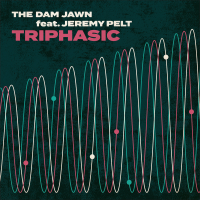
The answer is simple. The five musicians spent half a year living together in Philadelphia as students at the prestigious Temple University. That stay gave birth to a Philly connection that led them to form the band there and record their debut album, Master St. (Challenge Records, 2023), which featured a prominent member of the local scene who would become their mentor—Dick Oatts—and who returned for their second album as well, Forward! (Cellar Music Group, 2024), this one already recorded in Europe. These are albums steeped in deep respect for what is perhaps the last flourishing moment—at a popular level—of jazz: the heyday of hard bop. It is a style they give a carefully considered update, while bypassing its most frequently covered standards to focus almost entirely on their own elaborate original works.
The two Spanish members of the group appear to maintain the most prolific and visible activity—with several albums as leaders of various formations, plus a solid number of collaborations and side projects. Fort, in particular, emerges as an already firmly established voice, sustaining an intense schedule that combines concerts with his different combos (Joan Fort Quartet, Joan Fort Organ Trio) with the release of his 2026 album, Hangin' In (45Jazz), which he is presenting live with a new lineup, Joan Fort's New York Quintet. And although The Dam Jawn (TDJ, hereafter) bill themselves as a leaderless democracy, one senses a certain behind-the-scenes direction on Fort's part—both by virtue of the weight his compositions and arrangements carry within the group's corpus, and his more than presumed influence in giving it the iron stylistic coherence displayed across their first two albums. This notion is reinforced by his two leader albums to date—So Far, So Good (Fresh Sound Records, 2025) and the aforementioned Hangin' In—in which he deploys a repertoire and approach very much in keeping with those of the multinational outfit.
Triphasic breaks with the orthodoxy followed so far—without losing its deeply hard bop essence—and ventures boldly into a fusion as radically contemporary as it is indebted to the lessons of some very distinguished predecessors. Guitar being a fundamental element of that current, it is worth tracing the influences and evolution of the Tarragona native, as they are likely what sets the tone for this shift. Fort, who in TDJ's first two albums took us back to canonical figures such as Kenny Burrell, Jim Hall and Grant Green, here alternates that historical depth with sounds and approaches from much later on, freely inspired by early jazz-rock. Notably, in the unusual reading of "Send In The Clowns" included on Master St., the guitarist already showed he had listened closely to some champions of fusion guitar—in particular the John McLaughlin of Extrapolation (Marmalade, 1969).
Another key element of Triphasic is Jeremy Pelt—also a torchbearer for the legacy of that hugely influential jazz forged between the mid-'50s and the late '60s, and of its immediate continuation. When you hear him, Lee Morgan and Freddie Hubbard are the names that first come to mind, but there is also in his tone and articulation the elegant smoothness of Art Farmer, or subtle, glittering harmonic traces of Charles Tolliver and Woody Shaw—quiet giants who, through the '70s and '80s, cultivated that fertile legacy without distorting it. Pelt's pairing with TDJ is therefore as apt as it is natural—but also fortuitous: it began in 2024, at the North Sea Jazz Festival, when the trumpeter stepped in for the originally planned Oatts for a joint performance with the band. The connection was immediate, and one of its welcome consequences is this album, which benefits from that complicity that arises when a fascination with something transcendent is happily shared.
Among the tracks on TDJ's third album that venture into that contemporary fusion looking backward without inhibition—and, even more importantly, without mimetic intent—"Sooryaast" stands out, opening the album with a nervous burst that transports us, almost without our noticing, to the Miles Davis of We Want Miles (Bonus Track Version) (Columbia, 1982) and Star People (Columbia, 1983). Both Fort, who weaves seductive harmonies with a sound evoking the then-emerging John Scofield and Mike Stern, and Pelt, with his notes hurled into the ether, recreate the shadowy, charged atmosphere of those crucial records—as much for Davis as for his followers at the time. Parree's drums fill every available space, and thread a tense, vibrant dialogue with Díaz's alto sax, who delivers a fantastic solo of rough-hewn textures, infused with a steely, admirable purpose. "Checkin' In" also plunges into electronics, with Fort's apparently synthesized guitar alone managing a somehow familiar idea—this is, in reality, the intro to "Hotel 17," another of his compositions (which seems to develop a suggestive miniature by Enrico Rava called "Peace"), and whose silky voicings reposition us within the hard bop scene. During the trumpeter's exposition, the guitarist employs a classic tone, before shifting back to saturated sounds in his disruptive solo—one that displays a singular vocabulary seemingly drawing from sources as disparate as Robert Fripp and Allan Holdsworth: a magnificent demonstration of how to combine, without prejudice but with discernment, a vintage framework with judicious electronic touches.
Other pieces hew closer to orthodoxy, though without giving up measured moments of exploration. "Floatin,'" penned by Parree and introduced by him with fine spatial awareness, features evocative arrangements à la The Jazztet. Pelt opens the concise round of solos, masterfully developing multiple melodic ideas, while Groenendijk's tenor adds a touch of incisiveness to his notable reflections. The scene transforms via an unexpected closing vamp, with another highly charged electric solo from Fort. The captivating "Influx" digs deeper into the same vein, with an excellent line composed by Lewin. Pelt brings a delicious false hesitancy that lends the theme's exposition a deeply human airiness, and Díaz's alto bursts in with emotional forcefulness, evoking certain entrances of the early Henry Threadgill—the one who frequently unleashed his energetic alto sax. The trumpeter follows with his quavering mute, before launching into a festive exchange of ideas with the altoist; Lewin has his moment with a delicate interjection, and Parree closes with his urgent drumming. Throughout the number, the guitarist demonstrates his taste for a clean accompaniment—open, clear chords and a rhythmic looseness that leaves ample space for the soloists—a quality that, by contrast, can introduce a faint sense of repetition, especially toward its end.
Nor is there any shortage of cuts where electronic experimentation is set aside. Case in point: "I Got A Boogaloo," which showcases the quintet's most festive and straight-ahead side, with strong funk and soul jazz flavors comparable to such iconic titles as "The Sidewinder" by Morgan or "Alligator Bogaloo" by Lou Donaldson. Pelt makes clear once again that what interests him is not muscular virtuosity but telling a concise, well-crafted story—one unambiguously tied to the composition that houses it. In the same vein yet in sharp contrast to this calculated simplicity, "Tongue Twister" is a remarkable exercise in musical contortion—a fast, syncopated motif followed by spirited solos from both saxophonists, propelled by a careening rhythmic foundation. Pelt starts outside and chases after them, but his line stays under absolute control, ultimately resolving into a crisp dialogue with the rest of the horns.
We save for last the two tracks that are perhaps the album's most arresting, each emblematic of one side of a Janus-faced TDJ. The first, "Triphasic," is a work from Díaz's pen that he had already introduced in his outstanding El Goce (Fresh Sound New Talent, 2025), which builds its material around psychoanalytic concepts. Even so, the theme's title seems to refer more to the three sections into which it is structured than to any Lacanian concept—jouissance, the very idea encoded in Díaz's album title—nor, for that matter, to the popular name of a traditional Catalan drink made of coffee, liqueur, and milk, served with its three layers neatly separated. TDJ's reading opens with a simple, delicately harmonized melody delivered by the trumpeter in a plaintive mode, followed by a second, fascinating, altered-states-like passage—with resonances of Dave Douglas' "Strange Liberation," and therefore of early electric Davis—though filtered through Pelt's personal timbre and texture, who here works skillfully with silences, nuances and dynamics. Fort contributes dreamlike chords, and Parree excels in the background. The result is beautifully spectral, giving way to a third section in which the opening motif returns—now, by contrast, even more airy and luminous—with a velvety Pelt awakening echoes of Tom Harrell, yet another likely reference point. "Don't You Know I Care" is the other gem on this album—specifically on the CD, as it does not appear on the vinyl edition—graced by a wonderful Fort arrangement of the Duke Ellington standard. The trumpeter opens it again a cappella, and a pleasantly unsettling nostalgia immediately emerges through a reed section—like a miniature version of Woody Herman's "Four Brothers"—that sweeps him along as he sets out the line with his customary sensitivity. The guitarist, at his most Hall-like—that meditative gaze, intelligently managing pauses and silences—delivers a splendid statement, and the ensemble reappears at the bridge to take on the final exposition, which once again enables Pelt to close the piece with refinement.
Whether a moment of transition or a brief detour, Triphasic adds new shades and textures to the trajectory of a band that from its very first moment has fought to defend, champion, and refresh a legacy that remains far more alive than it might seem at a cursory look. With this, their exquisitely produced third album, TDJ reveals new possibilities and offers novel perspectives on that valuable inheritance—without subverting or reformulating it beyond recognition. So here's to the real damn thing—to the individual and collateral projects of its five members, and to their sharp musical alliances.
Track Listing
Sooryaast; Triphasic; Influx; Checkin' In; Hotel 17; Floatin'; I Got A Boogaloo; Don't You Know I Care; Tongue Twister.
Personnel
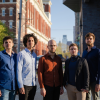
The Dam Jawn
band / ensemble / orchestra
Jeremy Pelt
trumpet
Joan Fort
guitar
Martin Diaz
saxophone, alto
Frank Groenendijk
saxophone, tenor
Philip Lewin
bass
Nitin Parree
drumsAlbum information
Title: Triphasic | Year Released: 2026 | Record Label: Dox Records
Tags
The Dam Jawn feat. Jeremy Pelt
Album Review
Artur Moral
Triphasic
Dox Records
Joan Fort
Martin Diaz
Philip Lewin
Nitin Parree
Frank Groenendijk
Philadelphia
Master St.
Dick Oatts
Forward!
Hangin' In
So Far, So Good
Kenny Burrell
Jim Hall
Grant Green
john mclaughlin
Extrapolation
Jeremy Pelt
lee morgan
Freddie Hubbard
Art Farmer
Charles Tolliver
Woody Shaw
north sea jazz festival
Miles Davis
We Want Miles
Star People
John Scofield
Mike Stern
Enrico Rava
Robert Fripp
Allan Holdsworth
Henry Threadgill
Lou Donaldson
El Goce
Dave Douglas
Tom Harrell
duke ellington
Woody Herman
Comments
About The Dam Jawn
Instrument: Band / ensemble / orchestra
Related Articles | Concerts | Albums | Photos | Similar ToPREVIOUS / NEXT
Support All About Jazz
 All About Jazz has been a pillar of jazz since 1995, championing it as an art form and, more importantly, supporting the musicians who make it. Our enduring commitment has made "AAJ" one of the most culturally important websites of its kind, read by hundreds of thousands of fans, musicians and industry figures every month.