Home » Jazz Articles » Album Review » Oscar Peterson Trio: The Oscar Peterson Trio at Baker's ...
Oscar Peterson Trio: The Oscar Peterson Trio at Baker's Keyboard Lounge

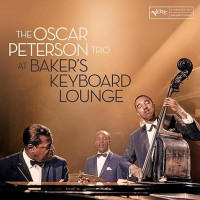
By the summer of 1960, Oscar Peterson had established himself as one of the leading pianists in modern jazz, yet what these performances reveal is that the celebrated "will to swing" often associated with him was never merely about speed, volume, or showmanship. It was discipline transformed into energy and energy transformed into joy. With Ray Brown on bass and Ed Thigpen on drums, Peterson leads a trio that does more than just support his virtuosity; it completes it. Together, they phrase with a remarkable unity that makes one forget the individual mechanics of performance. They breathe as one.
The standard edition of this release, available on CD and LP, provides a focused portrait of all five sets. However, the full edition with 36 tracks across 2 CDs, 3 LPs, and digital formats shows the true depth of this engagement. Wisely, the repeated titles are not true redundancies but rather part of the working repertoire of a great trio, one that refines, stretches, and reimagines familiar material night after night. That said, it is the unique performances that tell the most compelling story.
The opening three tracks showcase Peterson's versatility, flexibility, and musicianship, beginning with "Autumn Leaves," the English adaptation of the French ballad "Les Feuilles Mortes." The piece functions less as a routine standard and more as an exercise in balance, with lyricism anchored to pulse and sophistication rooted in song. The transition to "Django" finds Peterson approaching John Lewis's elegy with rare gravity, resisting sentimentality and opting for tensile lyricism. Brown's underpinning adds a dark glow to the piece, and Thigpen, always discreet, provides a frame rather than a commentary. Charlie Parker's "Confirmation" is a thrilling display of bebop fluency presented with remarkable clarity. Peterson's right hand shines brightly, but what endures is the ensemble's coherence. Brown's lines serve as melodic counterpoints, not mere accompaniment, and Thigpen's flashing brushes captivate. Another Parker bebop line is "Scrapple From The Apple," a contrafact based on the chord progression from "Honeysuckle Rose." These two Parker numbers demonstrate how thoroughly Peterson had internalized bop's demands without ever losing his own grand orchestral sense of the keyboard.
Two compositions by jazz great Benny Golson are delivered with affection and appreciation, beginning with "Whisper Not," which carries a sly rhythmic confidence, its bluesy undercurrent preserved even as the trio opens up the harmony. On "I Remember Clifford," written for the magnetic trumpeter Clifford Brown, is shaped with grave affection, Peterson balancing memorial tenderness with harmonic clarity. Despite the double-time section towards the end, he understands that a ballad can ache more deeply when it is not overplayed.
"Liza" and "S'posin" (which Peterson had not previously recorded) are classic Peterson showcases, but that description should not mislead. Yes, they dazzle. Yes, they crackle with fleet articulation and rhythmic daring. But what is most impressive is their structure. Peterson never floods the bar line with virtuosity for its own sake. He builds choruses architecturally, each flourish earned, each accent in dialogue with Brown's deep-centred pulse and Thigpen's unerring placement.
Peterson's maturity shapes the ballad performances throughout. "The Touch Of Your Lips" is played with exquisite restraint, with the trio caressing the song rather than over-embellishing it. Peterson's voicings flourish like chamber music, and the internal balance of the trio is outstanding. "Ill Wind" feels darker and more introspective, with Peterson allowing harmonic tensions to linger just enough to hint at unease without melodrama. "I Didn't Know What Time It Was" has a rueful sophistication, almost conversational in its pacing. "My Funny Valentine" is notable precisely because Peterson refuses to sentimentalize it. He gives it line, color, and poise. The result is more moving than any display of overt fragility could have been. Throughout this performance, Brown's foundational pulse underpins Peterson's interpretation, and his extended solo is a masterclass in the instrument.
Peterson's own composition "Blues For Big Scotia" is indispensable. Here, Peterson's rootedness in the blues tradition comes to the fore not as a gesture but as a home terrain. The groove is deep, the authority is absolute, and the trio's interplay has that rare quality of sounding relaxed and utterly exact.
What this release finally reveals is not just the range of the repertoire or the brilliance of the performance, but also the consistency of character. Across ballads, burners, blues, bop vehicles, and standards, The Oscar Peterson Trio shows confidence without complacency, virtuosity without arrogance, and swing without effort. This is not just unreleased material; it is recovered proof that three musicians could phrase with such unity that time itself seemed to bend in their favour.
Track Listing
Autumn Leaves; Django; Confirmation; Whisper Not; Billy Boy; The Touch Of Your Lips; Ill Wind; Chicago; I Love You; Blues For Big Scotia; Dancing On The Ceiling; Politics & Poker; Where Do I Go From Here?; I Didn't Know What Time It Was; Liza; Yesterdays; Softly As In A Morn ing Sunrise; S'posin; I Remember Clifford; Let There Be Love; Swamp Fire; Blues For Big Scotia; Satin Doll; Woody n' You; My Funny Valentine; Scrapple From The Apple; Billy Boy/When The Saints Go Marching In.
Personnel


Album information
Title: The Oscar Peterson Trio at Baker's Keyboard Lounge | Year Released: 2026 | Record Label: Verve Records
Tags
Comments
PREVIOUS / NEXT


Support All About Jazz
 All About Jazz has been a pillar of jazz since 1995, championing it as an art form and, more importantly, supporting the musicians who make it. Our enduring commitment has made "AAJ" one of the most culturally important websites of its kind, read by hundreds of thousands of fans, musicians and industry figures every month.