Home » Jazz Articles » Live Review » The Silkroad Ensemble at Zellerbach Hall
The Silkroad Ensemble at Zellerbach Hall
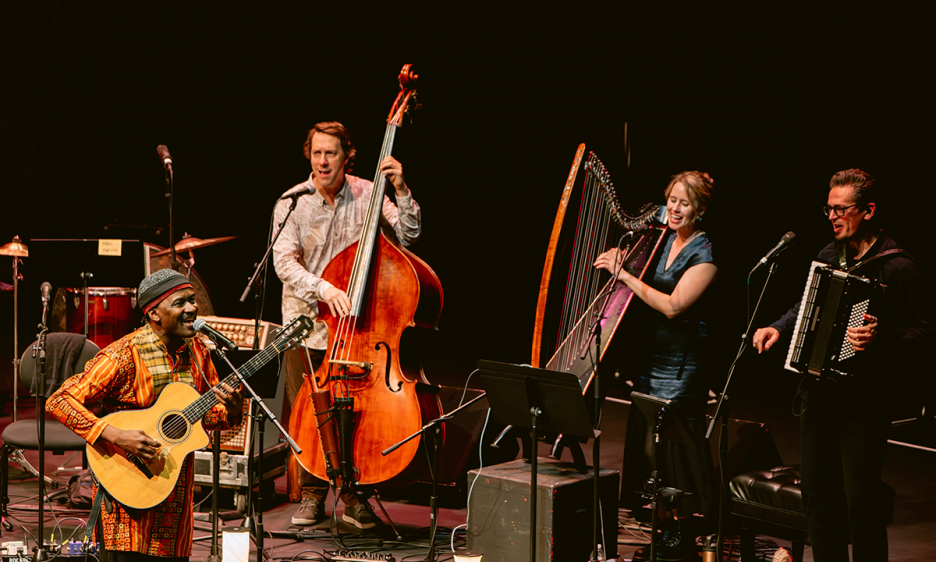
Courtesy Kristen Loken

Sanctuary: The Power of Resonance and Ritual
Berkeley, CA
March 27, 2026
Every sort of instrument was set out on the stage, which was bathed in red light. Everything had been readied for a very special event: a rare performance by the classical-ethnic fusion group The Silkroad Ensemble. At its commencement, members walked down the aisles en route to the stage chanting "Weh." Rhiannon Giddens, the ensemble's director, initiated a song, and then things took off propulsively onstage. Every manner of instrument soon joined in—from fiddle to acoustic bass to flute and percussion. While the percussionists had a battery of instruments, Giddens, naturally, brought her banjo, a replica of an 1858 model. Throughout the evening, the group would reconfigure—expanding and contracting, depending on the needs of the piece.
Near the beginning, Mauro Durante (tamburello, violin, and vocals) offered his contribution, one influenced by the pizzica, a traditional dance from Salento in the south of Italy. The tune was formerly connected with trance and healing rituals (and possibly related to the ancient Dionysus cult).A once-popular folk belief held that playing the rhythm might cure tarantula bites.
Haruka Fujii presented her composition based on the "Sunatoribushi," a folk song from Suzu-shi on the tip of Japan's Noto Peninsula. (The song's title literally means "Sand Hauling Warrior.") Percussionist Kaoru Watanabe used long sticks to play his traditional drum, which sat on the floor, while Fujii contributed flute. Tabla master and Guggenheim Fellow Sandeep Das presented a prayer to the goddess Saraswati as well as the Raga Bhairavi, on which Giddens provided vocal assistance.
Niwel Tsumbu's "Afrika Eh!" employed influences of Congolese Luba music, while the second was inspired by chant inspired by the Northern Congo's Baka tribe.
Giddens presented her version of an 18th-century Black Southern folk jig called "Pipi Danga." After learning the old tune she had found, to her surprise, there was a similar tune in Lingala (which tells the tale of a girl trapped into slavery). Tsumbu helped her with the translation, and instruments such as violin, vibraphone, and accordion added to the mix.
The progeny of a lineage of female Scottish harpists, Maeve Gilchrist explored the music of her Edinburgh childhood for her evocative piece. Likewise, cellist Karen Ouzanian, whose ancestors survived the Armenian genocide (1915—1917) in Anatolia and fled to Lebanon, produced "Songs of the Sap." While the first movement offered her lyrical take on the tamzara, the second focused on the curumca, a venerable Armenian rhythm.
A native of Taroudant, Morocco, Medhi Nassouli brought his Gnawa music to the mix, playing his guitar-like guembri (sintir) as he pranced around the stage. The versatile Francisco Turrisi employed his frame drum and accordion on "Colascione," named after the southern Italian lute.
Watanabe contributed "The Arch," titled after the St. Louis monument that "hovered over" his childhood. It was composed following "a period of loss and transformation." The melody was performed on a shihohue, a Japanese bamboo flute.
And so it went on for nearly two hours. Often, there was so much music and dance going onstage that it was difficult to follow it all. The repertoire was sometimes punctuated by audience participation—handclaps and call and response. At the end, Giddens sang out to the audience that "You need to keep it going" and "Build up love and unity."
After it all ended, some of the audience members flocked to the stage. One enthusiast told Durante that "This wasn't a concert. This was a happening!"
Tags
Live Review
Silkroad Ensemble
Harry S. Pariser
United States
California
san francisco
Silk Road Ensemble
Haruka Fujii
Kaoru Watanabe
Sandeep Das
Niwel Tsumbu
Maeve Gilchrist
Medhi Nassouli
Comments
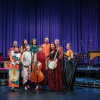
About Silkroad Ensemble
Instrument: Band / ensemble / orchestra
Related Articles | Concerts | Albums | Photos | Similar ToPREVIOUS / NEXT
Support All About Jazz
 All About Jazz has been a pillar of jazz since 1995, championing it as an art form and, more importantly, supporting the musicians who make it. Our enduring commitment has made "AAJ" one of the most culturally important websites of its kind, read by hundreds of thousands of fans, musicians and industry figures every month.