Home » Jazz Articles » Album Review » Andrés Coll: Ride to Heaven
Andrés Coll: Ride to Heaven

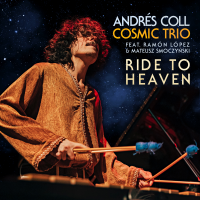
Coll has been immersed in sound since the age of seven, when he began with classical percussion lessons in a local orchestra, later soaking up Ibizan folk music—specifically the traditional Ball Pagès (which could be translated as "Farmer's Dance")—and gradually absorbing multiple influences, from jazz to classical, taking in a wide range of world music along the way. With all of these, and in a wholly organic, non-intellectualized way, he has shaped his own language. At 19, he crossed paths at a local jazz festival with an illustrious expat based in Eivissa: the German pianist Joachim Kuhn. Coll's flair leads him to directly ask the master—whom he barely knows at this point—that they play together. The two connect immediately, and it comes as no surprise: they share a passion for spontaneity over the preordained, feeling over rationalization, explosion over restraint. And a creative fire that defies limits, genres and conventions.
Coll's already-solid background and exploratory nature merge from that point on with the venerable pianist's artistry and life lessons. His subsequent evolution is dizzying. It is evident at first glance in his outward look, but also, of course, in his musical voice—which has tempered and reined in its earlier paroxysm while becoming enriched with a melodic inventiveness and chordal dimensions that were still only nascent at the time. Born of that pivotal encounter, Coll releases a collaborative album with Kühn, Natural Research (Self Produced, 2022), followed by his first self-led recording, Sunbird (Balaio Records, 2024), in which he displays connections between the folklore of his island and Gnawa music. His second project with Kühn, Joachim Kühn & Young Lions (ACT Music, 2026), and the album under review are the most recent giant steps in the career of a player whose trajectory promises to be multifaceted, and perhaps even media-friendly. The marimbist radiates charisma and a seductive innocence, and exudes a telluric force that reaches far beyond the usual jazz crowd—a presence that must be experienced live to fully grasp both the man and his art. His statements to the press—direct and down-to-earth—are equally compelling, revealing a young figure in constant evolution who has long possessed an extraordinary musical awareness, and creative criteria that are crystal clear.
Ride to Heaven also serves as the official recorded debut of the Andrés Coll Cosmic Trio—an ensemble that, as its name suggests, recognizes no boundaries. The leader is joined by two superlative performers—introduced to him by Kühn—with whom he has accumulated years of shared experience, whether in sweltering summer nights on village squares or in far more formal concert halls: the multi-award-winning Warsaw-born violinist Mateusz Smoczyński, and the drummer and percussionist from Alicante, Ramón López—a key figure in the avant-garde field and a member of the breathtaking Aurora Trio alongside fellow Balearic Agusti Fernandez and Barry Guy. To define his style, Coll uses the term "avant-groove"—a territory where the rhythmic groove of each of the three members' respective heritage combines with the improvisatory atmosphere inherent in free experimentation. The result is neither folk nor free jazz, but draws from both fields some of their roots, undercurrents and raw elemental impulses—though many of their compositions have a vernacular feel, their solos are imbued with an untamed jazz spirit.
In the artist's own words, "The song that gives the album its title refers to the human act of leaving fear behind and moving toward whatever fate has in store (...) it is a call to embrace life in its entirety—the good and the bad." Drawing on myths and other inspirations such as that of Orpheus and Eurydice, Homer's Odyssey and Stanley Kubrick's 2001: A Space Odyssey (1968), Coll conceives a sound project that is also an initiatory journey, in which each piece corresponds to "the experiences and prior steps that the 'ubiquitous' protagonist of this story takes in order to accept his fate and embrace it." Let us examine, then, the stages of that transformative voyage.
Final Preparations Before The Leaving
"Good Morning" jolts us with an abrupt awakening—by no means unpleasant, but rather suffused with a contagious positive energy. A country-folk ostinato dominates the track, though certain harmonic shifts quickly confirm that along the way we will veer toward terrain far beyond initial expectations. Coll bursts in, decisively establishing his idiom on the marimba—an oratory built on rapid-fire but clear phrasing, adventurous voicings and forceful accents. As for his style, the Ibizan acknowledges no specific influences from any illustrious predecessor, though he does point to Roy Ayers as a revelatory figure."Debussy Dances" sustains the urgency established by the previous number. The leader comes across as almost frantic, with cutting commentary that grows increasingly complex before stepping into a kind of approachable atonality, spurred by the percussionist's rhythmic onslaughts. The tension subsides during Smoczyński's fantastic statement, accompanied by a López who alternates between the drum kit and the tabla—the Valencian is also an authority on Indian music. Together, they transport us from old Europe—another of Coll's acknowledged sources—to spiced Hindustani settings, before returning to the lively main motif.
The Departure—And Its Counterparts
"The Docks" was composed by the Balearic artist while seated on the dock of a Galician town, in Northern Spain, letting himself be soaked in the sounds and cadences of the Atlantic Ocean. Here we find him at the piano—with undisguised traces of his German mentor—to more than satisfying effect. It is a restless, edgy ballad that conveys a nocturnal aura of ruminations before the solitary predawn setting out. Its verse is sharp and evocative, but the crucial action unfolds in its development section, where chord inflections give rise to galvanizing meditations from the soloists—especially Smoczyński, who excels in the lower range of his violin. Didier Lockwood would undoubtedly have made it his own."Acceptance Steps"—in addition to playing on iconic references in its evocative tag—reaffirms the importance Coll places on the path itself, above whatever significance might be ascribed to the final destination. After the hopeful candor of its initial motif, the expedition ventures into inhospitable, desert-like expanses. The march slows, and the trio offers striking heat-warped moments, with the marimbist absorbed in his own musings and Smoczyński exploring the upper register with an entranced enthusiasm, to which Coll responds with an apt tonal detour.
"Repicada" takes us to Eivissa through the use of its traditional castanyoles—related to flamenco castanets yet quite distinct from them. Coll reveals that he has found unexpected connections between certain rhythmic patterns grounded in them and those of the aforementioned Gnawa music, long established in various areas of southern Morocco. Wherever its location may lie, there is in this track a first-morning-of-the-festival feel, a Gypsy aroma, an infectious excitement that invites you to join in. López, with his percussion and shouts, constantly challenges Coll—who snaps castanyoles he and his father built—and Smoczyński joins the party with devastating momentum. The borders drawn in gray offices or gilded halls crack and dissolve, as ancestral wisdom and natural elements impose their irrefutable law—one that knows nothing of dikes, walls or electrified fences.
"Call of the Faun" seems to delve into the darkness of a dense forest as dusk settles. It is a crucial passage—one that demands a decision: push on into danger or stop short out of caution. Smoczyński takes center stage, skillfully punctuated by the leader's instrument and López's percussion. His is an ambiguous call—at once suggestive and mysterious—rising from the depths of his violin, urging the listener to venture ever further into the unknown, despite the anguished fear its perception provokes.
A Destination Now Close—But One That Demands Our Strength
The demanding process grants us a happy pause. "Fly Low, Fly High" opens with an exultant feel somewhere between the Quintet of the Hot Club of France and bebop before heading toward more abstract territory. The violinist opts for a straight-ahead attack here, with a splintery tone, and Coll's improvisation is propelled by the rest of the trio, which urges him to soar ever higher. López, however, settles us back down to the inevitable earthiness with a brief but remarkable turn."Keep the Hope" features Coll again at the piano, exemplifying the struggle against the quest's final difficulties, perhaps the hardest to face. Unfortunately, what is adverse—or outrageously abject—is of such colossal proportions that we can only overcome it through the will to redirect it within our limits of the acceptable. The composition alternates between ominous, aggressive and experimental moods—largely sustained by Coll, back in Kühn mode—and pools of melodic peace led by Smoczyński, though the marimbist also finds moments of release, while López emerges and recedes with subtle mastery. The trio broadens its stylistic palette here with an unclassifiable canvas that swings between the soothing and the deeply unsettling.
In its form and manner, "Ride to Heaven" circles back—after tracing such a long arc—to the initial point of departure. But beware: the trio's sound cartography is deceptive, and what seems like an ending may in fact conceal a new beginning. Their ultimate destination is no longer on Earth's surface—and this is not a gratuitous claim based solely on that title: the group's name and that of the album have traveled, courtesy of a 'boarding pass' provided by NASA, on a USB/SD drive aboard the spacecraft that the Artemis II mission carried to the farthest point in the cosmos ever visited by our species. Musically, the piece shows traces of John McLaughlin's Shakti with a driving melodic motif developed by Smoczyński, while Coll poses intriguing harmonic challenges. A brief freetime interlude gives way to a headlong race through the leader exhilarating solo, as López alternates between the tabla and the drum set. As a closer, the trio concludes with a second line, catchier than the one with which it opened.
Lessons from the Journey
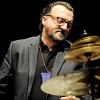
We insist: beyond listening, this trio must be witnessed. Their creative and personal communion is certainly perceptible in this sensational recording, but it reaches its peak live. Watching Coll rock while maintaining iron control over the double mallets is a spectacle in itself. Add López—a performer who seems on the verge of an imminent implosion when seen—and the magnificent Polish violinist, expressive in his own right, and the result is a superb ensemble whose internal dynamic gives it a life of its own: its members look at one another, smile, challenge, shout, and spur them on—and, crucially for the audience, they have fun. Protocol, pre-designed formality and strict contract fulfillment are off the table. Their seriousness and rigor lie not in outward forms but in their way of composing and performing music that, paradoxically, largely overflows with joy and a hunger to take on the world—in the best and least current sense of the phrase.Coll's creative drive, his imaginative impetus and that thirst for absorbing musical knowledge will most likely bring him a formidable future. Ride to Heaven is a key step in his career—and at the same time a tremendously motivating record that refuses to simply accept the stark, destructive reality surrounding us and instead proclaims a hopeful cry of encouragement.
Track Listing
Good Morning; Debussy Dances; The Docks; Acceptance Steps; Repicada; Call of the Faun; Fly Low, Fly High; Keep the Hope; Ride to Heaven.
Personnel


Additional Instrumentation
Andrés Coll: electric marimba, piano, castanets; Mateusz Smoczynski: violin, baritone violin; Ramón López: drums, tabla.
Album information
Title: Ride to Heaven | Year Released: 2026 | Record Label: XJAZZ! Music
Tags
Andrés Coll
Album Review
Artur Moral
Ride to Heaven
XJAZZ! Music
Dorothy Ashby
Julius Watkins
Garvin Bushell
Red Norvo
Bobby Hutcherson
Gary Burton
Stefon Harris
Joel Ross
Patricia Brennan
Andrés Coll
Balearic Islands
Joachim Kühn
Sunbird
Joachim Kühn & Young Lions
Warsaw
Mateusz Smoczyński
Ramón López
Agusti Fernandez
barry guy
Roy Ayers
Didier Lockwood
Hot Club of France Quintet
Shakti
Comments
PREVIOUS / NEXT


Support All About Jazz
 All About Jazz has been a pillar of jazz since 1995, championing it as an art form and, more importantly, supporting the musicians who make it. Our enduring commitment has made "AAJ" one of the most culturally important websites of its kind, read by hundreds of thousands of fans, musicians and industry figures every month.