Home » Jazz Articles » The Blue Note Portal » Reaper on the Bus
Reaper on the Bus
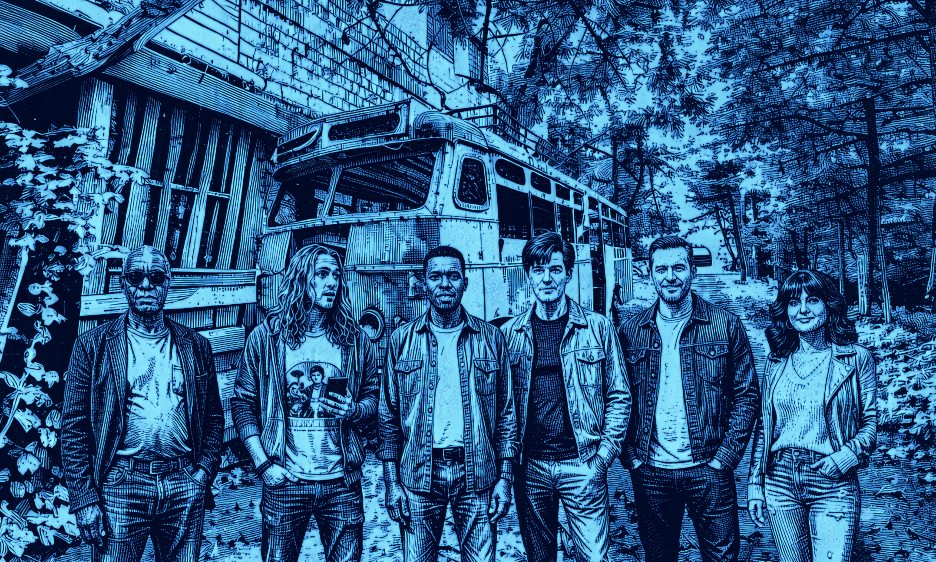
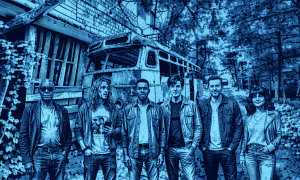
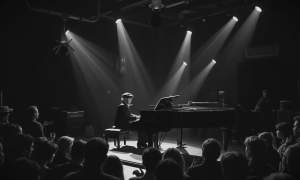
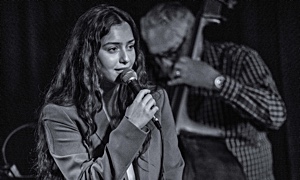
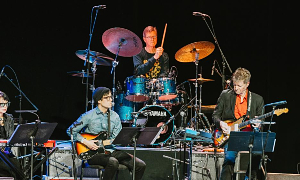
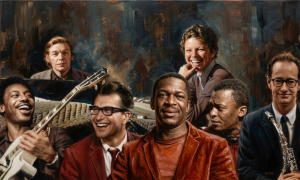
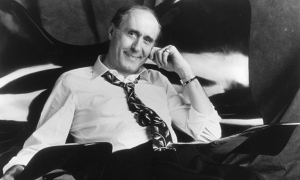
Courtesy AI with additional effects
Kyle glanced across at Upton. The two guitarists shared a quiet look. Kyle winked. Upton smiled—the small, satisfied kind that said he was already hearing tomorrow’s set in his head. One by one, the lights in the lounge clicked off.
Marcus "Mace" Reynolds, the saxophonist who'd been on the road since the Bush administration, had his feet up on the table. Elena Vargas, who plays flute and percussion, curled in the corner with her phone. Jamal "Keys" Thompson, the pianist, hunched over his iPad, half-listening. Leonid Kupfer, who plays electric bass, nursed a beer. Kyle Manning—the young cat on guitar and laptop, the one who always carried the newest toy—sat cross-legged on the floor with his phone propped on a crate. Across from him, Wade Upton, the guitarist who leaned toward Pat Metheny's lyrical, spacious approach, listened quietly.
They'd been arguing about "Artificial Intelligence" again—the same conversation that seemed to follow every tour lately.
"I'm telling you," Mace said, his voice gravelly from the gig, "when you get down to it, it's just a fancy sampler. It can ape the notes, but it ain't got no soul."
Elena snorted. "You said the same thing about synths in '98."
"Yeah, and I was right until I wasn't."
Kyle didn't jump in right away. He simply tapped his phone. A soft blue glow lit the lounge.
"Sid," he said quietly, "owner-only mode. Record mode. You hear the room, but you only take direction from me."
The AI—Sid, short for Sideman—answered in a calm, slightly raspy baritone that somehow sounded like it had sat in on a million after-hours sets.
"Got it, Kyle. Listening in owner-only mode."
Kyle grinned. "Alright, bull session rules. Sid only answers me, but he's hearing everything for context."
Leonid raised an eyebrow. "You're really gonna let the robot in the room?"
Kyle winked, "Let him listen."
Mace leaned forward. "Fine. Question for the group: What's a great rock song nobody in jazz has ever covered properly? I mean properly—not some smooth-jazz elevator version."
Jamal scrolled on his iPad. They tossed out songs by David Bowie, Pink Floyd, Talking Heads, The Police, and Steely Dan, but nothing popped, until Kyle dropped it.
"(Don't Fear) The Reaper."
The lounge went quiet for half a second. Mace let out a low whistle.
"Blue Öyster Cult. That cowbell, the driving guitar riff. Nobody's touched it, too on-the-nose for jazz."
"But the melody," Leonid said, eyes lighting up. "It's basically a minor blues with a killer hook. You could modal the hell out of it."
Elena sat up. "Keep the energy, though."
Kyle nodded toward the phone.
"Sid, you heard all that? Build me a jazz-fusion arrangement of '(Don't Fear) The Reaper.' Same drive, same drama, but nuanced. Think 1975 electric Miles Davis band energy—dark, modal, conversational. Guitar front and center, but with a killer rhythm section that breathes. Give me a thirty-second demo of the head and first solo section."
Sid didn't hesitate. "Understood. Generating now."
Thirty seconds later the Bluetooth rig came alive with that unmistakable cowbell tick—fatter and rounder, like it was played on a real drum kit. Then the guitar entered: searing, sustained notes with just enough bite to raise the hair on your arms. Underneath, the bass pulsed like Marcus Miller on a good night, the piano comped in tight stabbing clusters, and the drums were push-pull—loose on top, locked on the bottom.
The bus went dead silent except for the music. When the demo faded, Mace stared at the phone like it had grown horns. "Play that again."
Kyle relayed his request, and then opened "group mode." Now Elena leaned in. "Wait—those horn harmonies behind the guitar? That's Thad Jones big- band sneaky. I love it."
Leonid shook his head, grinning. "The bass is perfect. But I still say Tony Williams should be on drums. That first fill was a little too tidy. Williams would've attacked it."
Kyle didn't even have to repeat the instruction. "Sid, swap the drummer to Tony Williams style. Same arrangement, everything else. Replay from the top."
The cowbell returned. This time the drums hit like a controlled explosion—snare cracking on the off-beats, cymbals washing with restless energy. The whole thing felt alive. Dangerous. Jamal laughed out loud. "Damn!"
Mace leaned forward. "Alright, kid, you got our attention. What if we put Wayne Shorter on soprano instead of the guitar solo? Make the melody sing like a prayer before the storm."
"Sid—replace lead guitar solo with Wayne Shorter soprano, late-'60s intensity. Keep the rest."
The shift was instant. The soprano floated in, questioning and mournful, then leapt into those sideways angular lines Shorter loved. The groove never stopped pushing. They were all talking at once now.
"Add a conga layer, Airto Moreira style, just under the drums."
"Make the bass fretless for the bridge."
Each time Kyle spoke, Sid rebuilt the track in seconds, blending players and eras that had never actually recorded together—creating fresh conversations that felt both familiar and impossible. They argued dynamics, laughed when a version slid too far into smooth territory, and booed when another got too prog.
At one point Leonid looked at Kyle, half-amazed, half-wary. "This thing's just... listening? Learning the room?"
Kyle shrugged, eyes bright. "It's been trained on every solo, every live tape, every interview note we've got digitized. It knows how these cats reacted in real time. Pattern recognition off the charts. But it still needs us to tell it the story."
Mace sat back, rubbing his chin as the latest version—a slow-burn build with Shorter's soprano, Herbie Hancock's Rhodes, Jaco Pastorius' bass, and Williams' drums— faded out.
"Damn. I still don't know if it's got a soul. But it sure as hell knows how to ask the right questions."
Elena smiled, slow and satisfied. "And it lets us answer them at 2 a.m. on a bus."
Kyle tapped the phone. "Sid, save the last version as 'Reaper—Bus Session Take 1.'"
"Saved," Sid replied. "Ready for Take 2 whenever you are."
Jamal started laughing again, the kind that comes after you've seen the future and it swings. "Man... we're gonna be up all night."
Outside, the highway lights flickered like ride cymbals. Inside, the bull session had just gained a new permanent sideman. And for the first time in a long time, nobody was arguing about whether AI belonged in jazz. They were too busy playing.
The energy in the lounge had shifted from raw discovery to focused refinement. They had run through half a dozen more takes—some heavier on the fusion fire, others leaning deeper into modal mystery. The latest version still hung in the air: Shorter's soprano weaving through Hancock's Rhodes, Williams' restless drums pushing underneath, the whole thing pulsing with dangerous life.
Wade Upton had said almost nothing the entire night. He sat slightly apart, elbows on his knees, listening with the quiet intensity of someone who measured every note before opening his mouth. The others had grown used to it—Upton was the thinker, the one whose rare words carried extra gravity. When he finally spoke, the lounge quieted instantly.
"I like where this is going," Upton said slowly, his voice low and deliberate. Everyone turned toward him. "But the original has something we're missing. Start with a half-speed Miles Davis-inspired beginning—think "Time After Time" or "Mr. Pastorius," you know the atmospheric way Pastorius would let a ballad breathe. Spacious. Mysterious. Let it float, suspended, before the cowbell kicks in and the groove locks."
He paused, letting the idea settle. "And the vocal call-and-response in the original—that's not decoration. It's fundamental. That back-and-forth is what makes the hook stick in your chest. If we're going to keep the drama and the hook quality without actual singing, we need instruments that can talk to each other."
Elena leaned forward, intrigued. "What are you thinking?"
Upton continued, measured as ever. "Give the horn and your flute some effects—light delay, reverb, maybe a touch of harmonizer. Not to sound robotic, but to give them a vocal quality. Let the sax handle the main call, then have the flute answer it, echoing like a response. Make the horns trade the 'more cowbell' motif as if they're shouting back and forth. It keeps the singability of the hook while staying fully instrumental. The melody still feels like it's singing."
Kyle's eyes lit up. He glanced at his phone. "Sid, you catch all that? Start with a half-speed Miles Davis-inspired intro—slow, atmospheric, 'Time After Time' or 'Mr. Pastorius' ballad mode. Spacious harmonies, lots of air between the notes. Open with a dreamy sax-synth solo. Then transition into the main groove. Use the horn section and Elena's flute with vocal-like effects: delay, reverb, light harmonizer to replace the original call-and-response vocals. Let the sax handle the main calls, flute answering. Keep the core band we liked earlier—Hiram Bullock and Pat Metheny trading guitar lines, Marcus Miller on bass, Don Alias on percussion, Tony Williams energy on drums. Give me a forty-second demo from the top."
Sid's calm voice replied without hesitation. "Understood. Generating 'Reaper—Wade Vocalese Take.'"
The Bluetooth speakers filled the bus with something new. It began even slower than before—half-speed, almost suspended in time. A dreamy synth-sax solo floated the opening notes of the Reaper melody, hazy and distant, bathed in gentle reverb that made it feel like a voice whispering from far away. Space hung between every phrase. Then Elena's flute entered—processed with soft delay and light harmonizer—so it answered like a ghostly echo, human yet ethereal. The call-and-response felt alive: the sax calling with quiet urgency, the flute replying with a vocal-like lilt and shimmer. Underneath, faint percussion from Alias brushed lightly, hinting at the storm to come.
Gradually the tempo lifted. The cowbell ticked in, firmer now. Miller's bass slid underneath with slippery funk. Hiram Bullock's guitar brought the fire—gritty, chordal drive—while Metheny answered with those signature lyrical, bell-like lines, the two guitars conversing as naturally as the processed horns and flute had moments earlier. The call- and-response continued through the arrangement: horns shouting the hook in one section, flute weaving responses in another. The whole thing retained the original's dramatic tension and anthemic hook quality, but now it felt deeper—conversational, nuanced, and fully instrumental.
When the demo faded, the lounge stayed quiet for several heartbeats. Mace finally broke the silence, rubbing his face with both hands. "We didn't just have a bull session tonight. We had a whole damn rehearsal... without ever picking up our instruments."
Elena laughed softly, closing her notebook. "We listened. We argued. We refined. We built something that actually feels like us."
Leonid nodded, a slow grin spreading. "Let's sleep on it. Internalize it. Make it our own tomorrow—take what Sid gave us and bend it until it breathes like real cats in a room."
Kyle glanced across at Upton. The two guitarists shared a quiet look. Kyle winked. Upton smiled—the small, satisfied kind that said he was already hearing tomorrow's set in his head. One by one, the lights in the lounge clicked off. The bus rolled on into the deeper dark, carrying five musicians, one very attentive sideman, and the seeds of a new arrangement toward whatever came next.
How Plausible is the Above Scenario
In 2010, this might have been too implausible to publish, but no longer. Here is AI's own plausibility check:So far AI technology has moved faster than even optimistic forecasts predicted, making the core mechanics of the "Reaper on the Bus" scenario increasingly plausible rather than pure science fiction for the year 2031.
*Voice attunement and selective listening* is already well within reach. Modern AI music assistants support speaker recognition and wake-word systems ("Sid, owner- only mode") that let the device owner (Kyle) stay firmly in control. The AI can passively hear the full group conversation for rich context while only executing commands from the designated voice. Speaker diarization tools—which separate and identify who is speaking in real time—handle noisy, overlapping bus-lounge chatter reliably enough that a simple voice profile training session would make Sid obedient only to its user, preventing accidental triggers while still capturing the band's collective energy.
*Copyright considerations* have evolved into a more pragmatic landscape. Major 2024—2025 lawsuits against platforms like Suno and Udio largely resolved through licensing partnerships with labels (Warner and Universal settlements by late 2025, with ongoing talks and some active cases as of early 2026). Future tools like Sid would train on properly licensed catalogs, paying royalties upstream. Crucially, copyright law protects specific fixed expressions (exact solos or recordings), not styles, techniques, or probabilistic patterns. Pairing players and eras that never actually recorded together—Wayne Shorter soprano trading with Pat Metheny guitar lines, Tony Williams drums pushing a groove with Marcus Miller bass—creates inherently transformative output. This "never-recorded-together" approach acts as a natural creative safeguard: the AI isn't cloning any single protected work but synthesizing fresh, hypothetical conversations in the spirit of jazz itself.
By around 2031, we can realistically expect persistent, band-specific AI sidemen that combine strong voice filtering, low-latency iterative generation, and deep pattern recognition across licensed jazz archives. The result: late-night bus rehearsals where musicians brainstorm freely, refine arrangements in seconds, and explore impossible fusions— all while the human "why" (soul, risk, emotional judgment) remains the guiding force.
The story's tension still holds: AI excels at asking the right questions and delivering polished, nuanced demos. Whether it ever fully captures the lived danger and dialogue of real cats in a room is the deeper, ongoing conversation jazz will have to answer.
Where Music Makers Are Today
In 2026, AI has already transformed how musicians prototype and polish ideas—especially for mood music, background listening, and rapid demo creation—but it has not yet reached the seamless, conversational "Sid" experience of the bus rehearsal.The current leaders for full-song generation are Suno and Udio. Suno excels at quick, complete tracks with convincing vocals and structure from simple text prompts, making it popular for fast ideation. Udio offers more granular control through section-by-section editing, inpainting (regenerating only specific parts), and stem exports, which producers appreciate for further refinement in a DAW. Both handle genre blending well and can produce listenable results in under a minute.
For more structured or instrumental work, AIVA remains a strong choice. It specializes in cinematic, orchestral, and compositional depth, supports reference audio/MIDI uploads, and allows detailed customization of harmony, instrumentation, and emotion. It's frequently used for soundtrack-style pieces and has a library of over 250 styles, including jazz presets.
Hybrid workflows are the practical reality right now. A musician can start with a simple home recording (guitar chords, hummed melody, or voice memo), upload it to Suno or Udio, set a high audio-influence level, and add a detailed prompt describing desired production, instrumentation, or stylistic references. Iterative refinement is possible via "extend," "remix," or "inpaint" features. Stem separation tools (like LALAL.AI) and AI mastering options then help clean things up. Many creators already use this exact process to turn rough sketches into polished demos suitable for pitching or personal use.
Fusion and jazz-adjacent music benefits particularly from the "never-recorded-together" prompting approach we discussed. Tools can convincingly blend modal grooves, specific player-inspired phrasing (e.g., "Pat Metheny lyrical lines over Tony Williams energy"), and cultural elements. Channels like Persian Jazz Haven or Qajar Jazz on YouTube—many of which openly or evidently use AI—demonstrate how effective this is for atmospheric, hour-long mood mixes that feel professional and evocative. They excel as background or relaxation music but often lack the raw spontaneity, risk, or deep emotional interplay of live jazz improvisation.
Voice control and selective listening have advanced in general AI assistants, with speaker recognition and wake-word systems becoming more reliable. However, full integration into music generation tools (a true "owner-only mode" that listens to group chatter for context but only acts on one voice) is still emerging rather than seamless in mainstream platforms.
Legal and ownership realities remain in flux. Some platforms have secured licensing deals with certain major labels (e.g., Warner with Suno, Universal with Udio), granting safer commercial pathways for users on paid tiers. Others face ongoing negotiations or restrictions. On paid plans, creators often receive broad usage rights for distribution, but full ownership and royalty splits vary by platform and label agreements.
In practice, today's AI shines as a powerful sketchpad and arranger. It democratizes production quality, letting musicians present far more polished demos than a typical low-fi home recording, while freeing time for the human elements that matter most: songwriting, performance nuance, and live interaction. Jazz, with its emphasis on spontaneity and subtle ensemble conversation, remains one of the genres where AI feels most like a helpful collaborator rather than a full replacement.
The gap between today's impressive mood/fusion prototypes and the 2031 bus-session vision is narrowing—particularly in iterative control and stylistic blending—but the final "soul" judgment still belongs to the musicians in the room.
Tags
The Blue Note Portal
Hiram Bullock
Blue Note Portal
David Bowie
Pink Floyd
Talking Heads
The Police
steely dan
Blue Öyster Cult
Miles Davis
Marcus Miller
Thad Jones
Tony Williams
Wayne Shorter
Airto Moreira
Don Alias
Comments

PREVIOUS / NEXT

Support All About Jazz
 All About Jazz has been a pillar of jazz since 1995, championing it as an art form and, more importantly, supporting the musicians who make it. Our enduring commitment has made "AAJ" one of the most culturally important websites of its kind, read by hundreds of thousands of fans, musicians and industry figures every month.