Home » Jazz Articles » Album Review » Buster Williams: Pinnacle
Buster Williams: Pinnacle

But Williams has an exceptional discography of his own, if a bit overshadowed by his reputation as a versatile "musician's musician." Williams' leader catalog represents the diversity of his musical career, staying true to a recording's chosen style but always marrying thematic constancy with his own unique soul and spirituality.
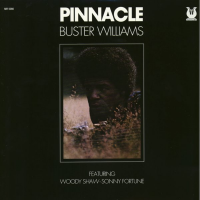
Williams recorded and released his debut album, Pinnacle (Atlantic Jazz), in 1975. The recording took place shortly after Williams, 33 years old at the time, came off his extended stint with Hancock's power fusion Mwandishi group. Pinnacle is informed by the fusion sound promulgated by Mwandishi. Still, Williams—naturally, for a bassist—imbues a groovy, funk-forward pivot from Mwandishi's more cosmic sound, resulting in a delightfully dank work that is one of the best examples of mid-1970s soul jazz.
Lost for decades, Pinnacle was remastered and repackaged by "Jazz Detective" Zev Feldman and his Time Traveler Records, and released for Record Store Day 2026. Feldman, who has made it his mission to unearth lost jazz classics and restore them to their original brilliance, has made perhaps his finest discovery to date. The album and its packaging look and sound fantastic, and new liner notes by jazz journalist Mike Flynn add insight and context.
Williams boasted a powerhouse group for the sessions. He was joined by fellow Mwandishi alum Billy Hart on drums, and he also recruited Earl Turbinton (soprano saxophone/bass clarinet), Sonny Fortune (soprano saxophone/flute/bass flute), Shaw (trumpet), Onaje Allan Gumbs (acoustic and electric piano, synths) and Guilherme Franco (percussion). Williams switches between electric and acoustic bass on the album, reflecting the trends of the era and Williams' overall career output in general.
The tight, cohesive band brings the funk on the opening track, "The Hump." A groovy, mid-tempo composition, Williams, Hart, and Gumbs (on electric piano) create a driving canvas that acts as a jumping-off point for the brass players. Williams and Gumbs create a sort of reverse-Mwandishi effect on the album, with Gumbs' keyboards filling in the spaces between Williams' bass notes (as opposed to the other way around with Williams and Hancock). But Gumbs is not merely doing a Hancock impersonation; indeed, Pinnacle finds him in his creative peak as well during this period (in addition to this work here, he appeared on Shaw's string of masterpieces during the decade). Gumbs' keyboards on the album are assured and assertive, and together with Williams give the music its backbone.
"Noble Ego" features the spirited, gospel-inflected vocals of Guilherme Franco and "Marcus" (i.e., Jon Lucien). The track is exhilarating, the rhythm section enthralling. Since Williams has been such a trusted sideman for so long, jazz circles may take his virtuosity for granted. One need only listen to this track, featuring Williams' extended bass solo, to be reminded of his legendary prowess.
Pinnacle concludes with the extended "Batuki," the only track on the album not a Williams original (it was written by Gumbs). The band engages in a beautifully affecting harmony before giving way to solos by Shaw, Turbinton, and Williams, and then a gorgeous duet between Williams and Gumbs.
Track Listing
The Hump; Noble Ego; Pinnacle; Tayamisha; Batuki
Personnel

Buster Williams
bass, acoustic
Woody Shaw
trumpetEarl Turbinton
saxophone
Sonny Fortune
saxophone, alto
Billy Hart
drumsGuilherme Franco
percussion
Onaje Allan Gumbs
pianoAdditional Instrumentation
Suzanne Klewan and "Marcus" (i.e., Jon Lucien)
Album information
Title: Pinnacle | Year Released: 2026 | Record Label: Time Traveler Records
Tags
Buster Williams
Album Review
Andrew Schinder
Braithwaite & Katz Communications
Pinnacle
Time Traveler Records
Kenny Barron
Woody Shaw
Herbie Hancock
Zev Feldman
Billy Hart
Earl Turbinton
Sonny Fortune
Onaje Allan Gumbs
Guilherme Franco
Suzanne Klewan
Jon Lucien
Comments
About Buster Williams
Instrument: Bass, acoustic
Related Articles | Concerts | Albums | Photos | Similar ToPREVIOUS / NEXT

Buster Williams Concerts

Support All About Jazz
 All About Jazz has been a pillar of jazz since 1995, championing it as an art form and, more importantly, supporting the musicians who make it. Our enduring commitment has made "AAJ" one of the most culturally important websites of its kind, read by hundreds of thousands of fans, musicians and industry figures every month.