Home » Jazz Articles » Live Review » Julia Keefe Indigenous Big Band at Zellerbach Playhouse
Julia Keefe Indigenous Big Band at Zellerbach Playhouse
Courtesy Kristen Loken

Zellerbach Playhouse
CalPerformances
Berkeley, CA
March 6. 2026
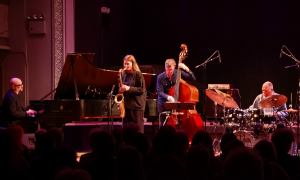
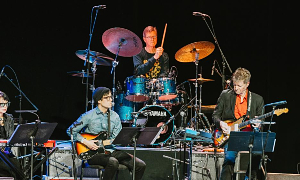
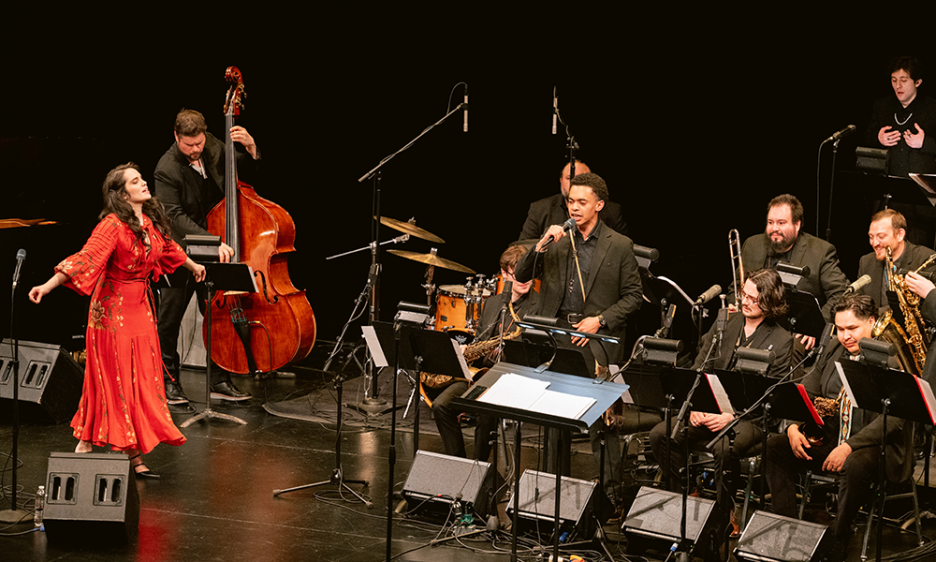
On a Friday night, pianist Grant Richards sat on the stage of the intimate UC Berkeley's Zellerbach Playhouse. To his right stood acoustic bassist Marcos Varela, with Edward Littlefield next to him manning the drum seat. The other members of the big band sat in rows of black chairs beside them. Five saxophonists sat in the front. Four trombonists were seated behind them. And the four trumpeters sat to the rear. A vocalist and conductor added to the mix. To all appearances this was your traditional big band.
However, this was not any ordinary big band, but the Julia Keefe Indigenous Big Band (JKIBB), a band created to promote Indigenous jazz music. As O'Keefe pointed out onstage, there is a long tradition of big bands in boarding schools, but it is rare to see an indigenous band onstage. So Keefe developed the concept in collaboration with trumpeter and composer Delbert Anderson.
Born on the Diné (Navajo) Nation in Shiprock, New Mexico, Anderson's first experiences with the trumpet was in the fourth grade. Trying out for his boarding school's jazz band, after he had failed to easily play the trombone he had picked up, the instrument that had first drawn his interest, he managed a few notes on the trumpet, and he was told, "You're a trumpet player." In addition to his work with the big band and his quartet, Anderson also fronts the Cherry-Pepper Project, which features original compositions inspired by the music of Don Cherry and Jim Pepper.
Anderson is also known as the founder of the DDAT Trio, whose name evolved from DAT after a rapper was added to the roster.
The band had its genesis when Anderson called Keefe about a suitable grant. The duo recruited other Indigenous musicians, both online and with in-person interviews, to bring together this unique group of Indigenous artists.
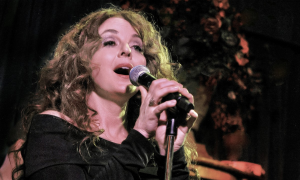
Following the first tune, Ojibway musician Chuck Copenace's "Creator," Keefe introduced Mildred Bailey's "Lover Come Back to Me" which, she said, is "one of my favorite songs to sing." Keefe has a special affection for Bailey, who was half Native American (Coeur d'Alene), who grew up on a reservation in Idaho, and who became the first female vocalist (in the early 1930s) to front a big band. Keefe is the director of the Mildred Bailey Project, which works to promote the legacy of a singer.
Keefe introduced the elegant, romantic, and melodic "Kuʻu Pua i Paoakalani" by relating the tale of Queen Liliʻuokalani, who composed the tune while being held under arrest for eight months at her palace. In it, the queen is said to liken her people to flowers in a garden.
Before beginning "Water," by the late great Indigenous saxophonist Pepper, Keefe related the struggles of Native Americans to openly practice their religion until the American Indian Religious Freedom Act of 1978 legalized all of their practices, including the use of peyote. Keefe sashayed and sang, and the band members rose to solo as the tune went on.
"Sonnet," Keefe's sole composition of the evening, was inspired by a Pablo Neruda poem. "Sonnet" was followed by DDAT Suite, Anderson's impressive and dynamic three-part suite. The charging and dynamic "Iron Horse Gallup," led by Lingít drummer Littlefield (Shaaḵindustoow), ended the suite. After its conclusion, Keefe related that "There's a lot of stigma around being a female vocalist... As a woman, you have to work twice as hard. They will say 'I'm just a chick singer.'"
Introducing Mali Obomsawin's brooding "Blood Quantum," Keefe maintained that "No one is illegal on stolen land." The tune itself is based on the complicated federal laws that determined who had the proper quotient of indigenous blood to be considered native and thus receive federal "benefits." "Blood Quantum" culminated with call-and-response chanting.
The concert concluded with a Hoagy Carmichael original, "Rocking Chair," a song also recorded by Mildred Bailey.
Something unusual happened following the concert: A panel discussion. Keefe and Anderson joined moderator Scott Saul, a UC Berkeley professor, and trombonist Quinn Carson, who produced the JKIBB's first album: Incarnadine (Outside In Music, 2026).
During the discussion—a wide-ranging conversation about jazz and the meaning of music, as well as "generational trauma"—Keefe related that she had called the band Indigenous as opposed to Native American because "Indigenous would be more encompassing."
One thing is certain: The JKIBB may still be just starting out, but they have a vibrant future in front of them.
Tags
Live Review
Julia Keefe
Harry S. Pariser
United States
California
san francisco
Marcos Varela
Edward Littlefield
Julia Keefe Indigenous Big Band
Delbert Anderson
Don Cherry
Jim Pepper
Chuck Copenace
MILDRED BAILEY
Comments

PREVIOUS / NEXT


Support All About Jazz
 All About Jazz has been a pillar of jazz since 1995, championing it as an art form and, more importantly, supporting the musicians who make it. Our enduring commitment has made "AAJ" one of the most culturally important websites of its kind, read by hundreds of thousands of fans, musicians and industry figures every month.