Home » Jazz Articles » Interview » Hugo Blouin: Jazz Sérieux, Jazz Fun
Hugo Blouin: Jazz Sérieux, Jazz Fun
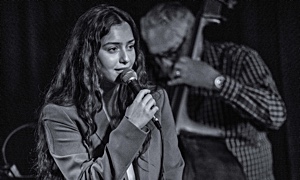
Courtesy Camille Gladu-Drouin

The meeting of very serious and very funny, and the total involvement of everybody, makes for a very powerful moment, and something I’m looking for in music, for sure.
—Hugo Blouin
Blouin's fascination with the musicality of speech is a through-line in his work. Rene Lussier and Hermeto Pascoal were important influences, both of whom have explored spoken language as a melodic resource. Blouin first followed Lussier (who, in turn, was influenced by Pascoal), listening to his early works and Le Trésor de la Langue (Ambiances Magnétiques, 1989). Blouin was struck by "both the complexity, or the depth, and the humor of the pieces," as well as "the political nature of the works." He asked Lussier to be the artistic producer of his first album, which Lussier declined "in a way that still led to further collaborations and friendship."
In conversation with All About Jazz, Blouin focused primarily on his 2025 release, Le buffet, on Ambiances Magnétiques records, the contemporary Montréal-based label founded by Lussier in 1983, touching on upcoming projects and previous works briefly toward the end. An edited transcript is below.
A serious place of music early on
All About Jazz: I just love Le Buffet. This is my first introduction to your music, which is fantastic, so I've been listening to a few different things and reading online. Thanks for sending the lyrics with translations. I couldn't find anything on your education.Hugo Blouin: It's minimal, that's why. I first went to university in another subject. I studied communications and worked there, became bored, and got back to music. So I went back to the University of Sherbrooke to do part of a first cycle—I'm not sure of the English equivalent—but a one-year university diploma in jazz performance. And then I started a second cycle, like a master's degree, but they offered a shorter program. So I tried that out, but I didn't stay around; so about two years of university back in Sherbrooke. It was a moment where I just wanted to go back to school and get the most playing and learning condensed into a short amount of time, and also to complement the auto-didact path that I was on. I was playing a lot and trying to write, trying to experiment with new stuff. That moment really helped just to get me on a track, and then I left the institution.
AAJ: I understand that, having stopped and started school a couple of times before going the full way. But did you study as a child?
HB: Yeah, I had a chance to be in a fulltime music program that was embedded in a regular school.
AAJ: Ah, good.
HB: So, yes, there was a serious place of music early on in my life. And that allowed me to—not go to school but—still get completely into music.
AAJ: So was bass your first instrument?
HB: No, piano was my first instrument. So I was really into piano, trying to get a hold of Schumann and Debussy. And I started bass as an auto-didact, traveling into the Yukon, where there was a lot of bluegrass music, and then back home in Québec, playing with singers and songwriters. Really, I started back with the bass in a really simple and jam-ful experience, and then got back to school, and then thinking, "Maybe I can write some jazz, too."
AAJ: I hear some of that in the stuff you did with Maz and also with the group Petite Maison. It's so beautiful.
HB: Oui. Marion Rampal, she's the project leader and singer on Petite Maison and has a really powerful voice, but also artistic incarnation and really leads this thing towards beautiful moments.
AAJ: And the YouTube of "Y'a une étoile pour vous" (There is a star for you) is so enchanting, with that lovely little girl dancing and everyone singing at the end...
HB: That's Marion's little girl.
AAJ: I can hear, now, some of your sensibility coming from that. It seems very strong. Did you grow up listening to that kind of music in Sherbrooke?
HB: I didn't listen to much music when I was young. I guess playing and learning it was enough. And I still see that in the moments where I'm playing, writing, involved in projects. I stop listening to stuff and suddenly the music I'm working on takes the full space. I suppose that the folk influences came from when I took the bass as an instrument and tried to play with other people and there was a lot of folk around me.
AAJ: What about your parents? Any musicians in your family?
HB: Not at all, but they are artists, too. They are both writers. So the major thing that I inherited from them was that it was normal to do art (laughs). So when I first had the idea of it, I didn't find it ridiculous. I just thought, "Oh, I know how to do that."
Hermeto Pascoal and Le Buffet
AAJ: Ok, great. Also, the melodies, the vocal melodies on Le Buffet really remind me of Hermeto Pascoal. He was an influence?HB: Of course.
AAJ: But you're taking a different approach. In his "som da aura" pieces, he would record someone speaking, extract the melody from that, then play both together, speech and instrumental melody. But you have that sound on Le Buffet once removed, because you substitute a singer for the original speaker, doubling her with another instrument. And your singer, Eugénie!
HB: Eugénie Jobin. She's great.
AAJ: Yes. She must have perfect pitch?
HB: She has magic powers.
AAJ: Haha. I think that might be one of her magic powers. The melodies are so tricky, and she does them really effortlessly.
HB: I'm not sure that this is conveyed in the English documentation, but—similarly to how Hermeto Pascoal, who is getting his melody—I worked with the melody of speech to find the melodies. So when Eugénie sings about "La Sauce," the Caesar salad dressing, it's the melody of my friend Jean-François telling it to us.
AAJ: Ah, you did! OK.
HB: It's all in there, not necessarily 100% faithful to the original, since I don't have to. But the inspiration comes from there, and often parts of the arrangement. In "La Sauce," the riff comes from a little part of Jean-François' speech, where he's telling us how great this sauce is.
AAJ: Oh, yeah. Two things happen when I listen to this record. One is that I want to go to Montréal, and the other is that I want to eat all this food!
HB: Haha. Yes!
AAJ: Except maybe for the popcorn. How did the popcorn get in there, in "La Patate au Sucre?"
HB: That's a cheap video trick. It's a challenge to create—my God, I was going to say "content" (makes a sour face)... It's a challenge to create a video to go along with a jazz piece because there is a big empty moment where we are just listening to the solo and, quite frankly, I don't want to steal the spotlight away from the solo. So, in the two clips for Le Buffet, I was looking for introspective visuals, something that would allow us to get into the solo, even though we are looking at funny images. So that's how the popcorn got in there. I thought maybe we could use the pan to start something else. And that's what happens in the solo.
AAJ: It's great. And also in "La Patate au Sucre," I love that you used the midi keyboard as a spatula. Were you playing those little lines on the keyboard?
HB: I was playing for the clip, but Marianne Trudel was playing them on the record for sure.
The Ensemble
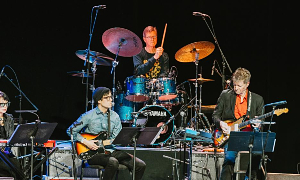
AAJ: Your band is incredible. The trumpeter, Émilie Fortin, with the balloon on "Du Jazz Sérieux"! I was trying to figure out what it was that she was playing, then I saw her. It was fabulous to see the live video performance, because you can watch the band. And it is truly serious, you know.HB: Laughs. Yes, she is doing a full-on solo, a serious solo. And I'm glad you like that part, because this juncture point between the different improvisational musics to me is something really obvious, but it's not obvious in real life with different players and different ways of thinking. So saying "let's play free" to the jazz band is very different than playing free with free players. I'm trying to find ways to be able to do both, which is hard and really serious stuff. And also to make the two play together. So Émilie's solo on the album and then live, which was even greater live, is an example of that.
There is also that on the previous album, the hockey one. I don't know if you saw that (Sport national, Multiple Chord Music, 2023). There are a couple of songs with Jean Derome, a great Québec flutist and saxophonist, also a great composer, and he's one to have studied the jazz tradition and is also very well-versed in the free-improv scene. He does this very inspired flute solo over a choir on "Sport National." It's just those little moments to try to make the people meet and make my different influences co-habit.
And that's one thing that's funny about Émilie Fortin's place on the album. When we recorded it, the take that we kept, everything went wrong. During the solo, I stepped on my earphone jack and stopped hearing everything. We had some problems with monitoring at the studio, and so I thought everything crashes... I'm looking everywhere, trying to fix it, and I see the band is still continuing so obviously they are hearing everything. So the sound engineer rushes to me and we figure a way and we play everything back. It's been maybe a minute or a minute and a half and they are just playing by themselves and kind of pedaling. But this urgency that's adding to the late stage of the solo kind of made it go back to life. Finally, we go on with the song and, by far, that was the best take that we could choose. So that's a fun story about that song in particular.
AAJ: Interesting! And, again, I've been kind of cramming in a non-systematic way, but I did listen to bits of individual people from the band do their own things. First of all, you have two singers, Eugénie Jobin and Marion Rampal, who sings on just one tune?
HB: Alors, Marion, she sings on the last one, "Un Camion Pizza."
AAJ: "Za za za," that's her? I love that.
HB: Yes, and the song is from her own story.
AAJ: That's such a tender story, about the the pizza truck and the family tradition. So, especially in the little bits I saw of Émilie and also Eugénie, I kept thinking that the situations you put them in make everything really come alive in ways that I wasn't really hearing in other bits. I'm sure they have brilliant tracks elsewhere, but here, in your ensemble, the whole seems greater than the sum of the parts.
HB: They are asked to go all in, also. Or they have no choice, either because of the complexity of what they're playing—although they are very skilled players; I'm not saying that my music is harder than anyone else's, but it's often not the context that they are used to playing in because of either the crazy melodies or different genres. Maybe it's even more true when we play live. They have to dive in. I talked with Eugénie after the last show and she was like, "Oh my God, I was doing gestures and trying to support the lyrics. I've never done that in my life. Now, I'm telling a story about recipes. I kind of need to make the recipe and forget about the intervals and just go for it." It's just an anecdote but, to me, it was her telling me how deep she was there, forgetting herself in front of the crowd to make the music happen.
AAJ: And I love the fact that one of your band members had on an apron and another had on a chef's hat. Very good. But the amount of practice, tell us a little bit about that. How did you prepare these things? How often did you rehearse?
Preparing to record and perform
HB: It is a jazz setting. So the performers are way too good for me, and so we haven't rehearsed much. This particular band, especially with John Hollenbeck and Marianne Trudel, they are very experienced and skilled players and composers in their own right, and so they arrived ready to make some noise. So there were maybe six rehearsals for the album. And for the show, we were fortunate enough to have two. I feel that we could have done it without it, but it's really helpful, as you know (laughs).It's my first time with these musicians. The previous albums were done with another band, with people more close to me, so the context was a bit different. We could rehearse more easily and more frequently. So there was a shift in the way to bring the music to life, finding the way to do it with less time, and maybe more freedom for the players.
AAJ: And what did you give them? What do your charts look like? Do you have anything you can show me?
HB: Sure. Any particular one in mind?
AAJ: Any of them. Maybe start with the first one, "Soupe Pragmatique?" That's one that you did transcribe the voice, pretty much, of your friend?
HB: Yes! And it begins with it; it begins with him. So you can hear a bit of him, and he's like (sings), "Alors, pour faire la bonne, bonne soupe." And it kind of spurs the riffs that will arrive later on. So, let's see. I have a score here I'll share.
AAJ: What do you use, Sibelius?
HB: I'm a Finale guy, still. I found a Finale that still works on a recent Mac OS, so it exists...
In the score, as you can see, the drum part is really sparse. I'm indicating a pulse. But most of the time he won't have a lot of indications; maybe shots. The parts are really crowded, often, for the melodic instruments. Marianne has all sorts of indications, harmonic indications and melodies to double. So I think the piano role in this band is especially tricky, because she is the harmony and melodic support, and sometimes doubling the bass as well. So she has the three-part brain.
AAJ: But on "Du Jazz Sérieux," the accompaniment was extremely unusual, I thought.
HB: Yes.
AAJ: Is that in the instructions you're giving her, the way she lays things underneath? It's not like typical comping in any way, but it's very supportive.
HB: You're right. That's interesting that you note it, because in the "Jazz Sérieux" there are moments where her instruction is "laugh with your instrument." It's the little solo moments she has with Émilie. And then, at some points she ignores the charts and comps how she sees fit. There was other stuff written. She inserts herself in support, but in an elusive way, but that's of her own devising. But then the solo is... they have no indications, so I'm just glad to see something develop with Marianne and John while we see Émilie get away with it. It's special because it's a strong piece, but it's the only one where Émilie plays on the record. So I guess I'll have to do other music with her.
AAJ: I hope so. And it's so wonderful to watch Marianne while Émilie put more air in the balloon, waiting to see, "Is she done yet?" So attentive. So much joy, particularly in that piece. It perfectly captures the kind of joy in seriousness that's involved in making something of this complexity. And also of this emotional depth. It's ridiculous, and yet...
HB: And yet—yes, I agree. The meeting of very serious and very funny, and the total involvement of everybody, makes for a very powerful moment, and something I'm looking for in music, for sure.
AAJ: I also was enthralled by your conducting, unconventional gestures, laying your body way back, then waiting and moving forward to indicate when it was time to play. And, at the end of "Jazz Sérieux," are they still counting—at the very end there—or are they just going by feel in those little pauses between hits?
HB: There's like two endings. First, a free drum solo over those little shots that are written to be missed. So we're kind of counting them, but—one by one—the players have stopped counting, including me. And then there is this outro that is written in time, so there are pauses that are intended then, finally, it's more of little cues. Initially, I wanted to make it more of a corny jazz ending; making fun of what serious jazz might be. But then it's beautiful. It doesn't feel corny at all.
AAJ: No, it doesn't. And that makes sense. The pauses feel more flexible, and yet they're right there, on the mark.
Beyond Le Buffet
AAJ: I want to hear more of your stuff! I see that we have some things of yours on All About Jazz, but no reviews.HB: No, I tried with the second album, but it's harder with the lyrics in French. It's a bit of an adventure to get the work known, to get people to listen to it outside of my bubble. But on every album, there are some new ears that discover it, either in Europe or in the States, that give some hope that we can play this music outside of here.
AAJ: Well, it's great to hear your new album, see the videos, and speak with you about it. And you are doing other things. What do you have coming up?
HB: With a collective led by a pianist friend, Jonathan Turgeon, who was playing on all my previous albums; a good friend and collaborator on many albums. So this collective is called l'Abîme, the abyss (l'Abîme, Multiple Chord Music, 2021). So it's the second album of this band. It's instrumental jazz, but really groovy rock-prog stuff. Even the saxophones are going through pedals, so everything is transformed. Very beautiful pieces by Jonathan, so that's a new album I have just collaborated with.
And then there is more Petite Maison stuff coming. I'm going to France in April for more shows. And hoping to write some new stuff this year for trios. So I've been writing a lot for five, six, and seven pieces; bands, bigger bands. But now I think it's a good time to write for smaller bands so we can tour them.
Sport National
AAJ: Can we talk for a second, just before we go, about Sport National?HB: Yes! That previous album was about hockey, something very important for Canadians. But when I started writing the pieces, I couldn't care less about the sport. I had played when I was a young kid. I wasn't good at it, so I put it away, never looked at it again. Even when the Canadiens, our Montréal team, were good—which they have not been for a while—I didn't follow any of it. So I thought, "This is a big cultural object, and it has links to recent history. It's part of the society, it's part of the ecosystem, so why not look at it through what transpires from the archives?" I was working from the archives, looking for any interviews, any parts of games; anything that could tell me something about me or about Québec. And so it became this kind of jazz documentary or a path to rediscover what this could be, this national sport, while writing songs from these archives. So it goes from "how did the Montréal Canadiens come to be created"—there were some documentaries or radio shows, so a song is composed from that.
There are some historical moments from Maurice Richard, a great player in the '50s, and who was also an icon for a lot of the folk here in Montréal and Québec. He was some kind of demi-god of the times. And at some point, his actions and his declarations were interacting with the society's evolution, and kind of predicted some of the evolution in society that would come later on. So there's a few moments like that in the album, with pieces. Also the Summit Series in '72, where Canada faced Russia, something that generated a lot of media attention, because it was still the Cold War. What interested me most about this episode is the vocabulary that was used was that of war. And we're just talking about hockey. But the games, and the fuss over it was very political.
AAJ: We're seeing that now.
HB: We're seeing that now, again. And the songs take a new value now, with what's happening. So everything becomes triple entendres, with a lot of layers of meaning. And so an interview after a game by the captain, where he's saying "this is war," magnifies—not necessarily what the sport is but—what people see in the sport, or what people see in themselves. So there is that on Sport National, that one on Phil Esposito's speech is called "This is War." It's one of the few English language songs on the album.
AAJ: And "Manon," the little girl.
HB: Yes, there is also a song about Manon Rhéaume. She's the only one to have played in an NHL game.
AAJ: She played with men?
HB: Yeah, but it was in a pre-season game. And she's really lucid about it. It was a marketing stunt for a new team, but she's been really outspoken about how this sport has treated her—so bad—and all the sexism she has had to face just to play her sport. The song is not just about her, but kind of laughs... I'm picking up some of the comments that she received and exposing them just to see how silly and ridiculous it can be. And, at the end, the song is funny. The lyrics of the chorus just go, "Yeah, sure, men and women aren't alike. Men, they have their appareils génitaux (genitals) more showing off. And it's from an interview with a scientist who says, "Well, you know, technically there is nothing wrong with women playing sports. If something is wrong, it should be with men because they are more at risk; their genitals are on top." So I'm trying to expose, also, the conservatist way of thinking that is often associated with sport, and with sport management, and with men in general. So I'm exposing it to not just celebrate hockey but also hoping it gets better.
AAJ: Thank you. And there was another album.
HB: Yeah, there were two previous albums, both on the same subject, but it's a really Québec-centric subject (Charbonneau ou les valeurs à' bonne place, vol 1., Self Produced, 2018; Charbonneau ou les valeurs à' bonne place, vol. 2, Multiple Chord Music, 2022). There was a political scandal where people found out that there was corruption with the awarding of public contracts for construction. So, after years of turmoil, they opened a political inquiry, and it went on for years, live on TV.
AAJ: So it became a reality show.
HB: It feels like a reality show, but it was a real audience with judges and a real jury.
AAJ: You have two volumes of this?
HB: Yeah, there are two volumes of this, because some songs couldn't fit on the first album because they had more complex vocal arrangements. So the second volume has vocal quartets playing with the band. So there are some great quotes to find in there. We should have another meeting. But since the Zoom is going to end by itself, I will send you the recording, and don't hesitate for any questions after that.
AAJ: Fair enough. Looking forward to it.
Tags
Interview
Hugo Blouin
Katchie Cartwright
Canada
René Lussier
Hermeto Pascoal
Frank Zappa
André Duchesne
Marion Rampal
Eugénie Jobin
Émilie Fortin
Jean Derome
John Hollenbeck
Marianne Trudell
Jonathan Turgeon
Montreal
Comments

About Hugo Blouin
Instrument: Bass, acoustic
Related Articles | Concerts | Albums | Photos | Similar ToPREVIOUS / NEXT

Support All About Jazz
 All About Jazz has been a pillar of jazz since 1995, championing it as an art form and, more importantly, supporting the musicians who make it. Our enduring commitment has made "AAJ" one of the most culturally important websites of its kind, read by hundreds of thousands of fans, musicians and industry figures every month.