Home » Jazz Articles » Groove Orbit » The !!!!Beat: The Rise And Fall Of The "Hippest Show On ...
The !!!!Beat: The Rise And Fall Of The "Hippest Show On Television"

Courtesy ChatGPT

This all changed when The !!!!Beat came on the scene (and yes, the exclamation marks are part of the title, but hey, this was the '60s). The !!!!Beat made its debut on 13 stations around the country on May 7, 1966, and it was one of the first shows to feature solely African-American performers. Unfortunately, it was syndicated for only 26 episodes. Although its initial shelf life was limited, it is now often considered "the hippest show on television," and its legacy endures, thanks in part to Willie Nelson (but more on that later).
The show's origins can be traced to Nashville, where the first all-black music variety program, Night Train, aired in syndication in 1964. Night Train's success ignited a creative spark in hipster Nashville DJ, William "Hoss" Allen, who decided to create his own show, but he wanted it to be even better. What he ended up with was what Marc Weingarten describes in his book, Station to Station (Pocket Books 2000), as "far away the quirkiest and coolest R&B-driven television show of the decade."
Hoss Allen was one of the "50,000-Watt Quartet" disc jockeys at Nashville radio station WLAC, along with Gene Nobles, "John R." Richbourg and Herman Grizzard. These were some of the first white disc jockeys from the South to introduce black music to a predominantly white audience. In his article, The 50,000-Watt Quartet, author David Henry explains that the station featured mainstream programming during the day but, in the evening, "all hell broke loose." Each of these guys loved the music, and they "gave 15 million listeners their first dose of Slim Harpo, Muddy Waters, Sister Rosetta Tharpe, Elmore James, Dorothy Love Coates, Howlin' Wolf, Memphis Minnie, and Lightnin' Hopkins."
Allen started playing jazz when he was growing up. He played in United Service Organization shows during World War II and later enrolled at Vanderbilt University as an English major. While at the university, he developed an interest in theater, but instead of becoming an actor, he decided to pursue a career in radio. One of his first gigs was hosting the Harlem Hop show. It was during this time that he was influenced by Gene Nobles and adopted his R&B and jazz routine. This proved successful enough for him to land a job at WLAC. Here, he developed his persona as "The Jivin' Hossman."
During the early sixties, Allen took some time away from radio, making a name for himself in record production, artist management and talent booking. According to an article on The !!!!Beat by Laurie Jasinski, Allen "helped launch the careers of Otis Redding and James Brown ." He also worked for Chess Records during the early '60s before returning to WLAC. He even started his own record label, Hermitage Records, and produced recordings for other labels. By the mid-'60s, he had plenty of connections within the music industry.
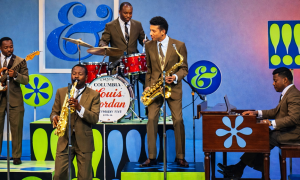
Following the success of Night Train, Allen created his own music variety show, The !!!!Beat. Although still based in Nashville, he decided to film the show at the Dallas station WFAA because it had the facilities to record in color. This turned out to be a smart move because the show's set exudes 1960s pop art, with its vibrant blue and green background and plenty of exclamation marks. Much of the effect would be lost if it had been shot in black and white.
Allen served as the host, and his larger-than-life persona gave the program a special edge. In spite of his somewhat corny dance moves and his hipster jive expressions like "Scooby Doo and how do you do?," he seems right in his element. While his presence might seem somewhat comical on the surface, he has a genuine appreciation for both the performers and the music that gives each episode a distinct charm.
Along with Allen, the house band, The Beat Boys, was outstanding. Initially led by Clarence Gatemouth Brown , who had recently recorded for Allen's Hermitage Records, the band benefited from Brown's inventive and tasty arrangements ranging from blues shuffles to jazzy instrumentals without missing a beat. David "Fathead" Newman anchored the horn section with muscular tone, and Billy Cox , a few years before his tenure with Jimi Hendrix , held down the low end with his driving bass. Even when the show occasionally dipped into lip-sync territory, there was no disguising the caliber of musicianship on that stage. Each program would open with Brown's catchy theme song and a cool stop-motion appearance of each band member, culminating in the show's dancers sliding into the picture.
The musicians were recruited from Chicago, New Orleans and Dallas for the most part. They would fly into Dallas's Love Field and spend an entire day at WFAA filming several episodes one after the other. Many of the performances were done live, but others were lip-synced. This alone gives The !!!!Beat a unique quality. Most of the time, there is some serious musicianship going on, but occasionally, you get a little smattering of cheesiness. In one performance, for example, the trumpet starts playing before the trumpet player has his horn to his mouth. Mistakes like this, although not common, make the show even more enjoyable to watch.
Overall, the shows were tightly packed. There wasn't a moment wasted in each show. After Hoss Allen delivered the intro, they immediately got down to business. And the musical guests read like a who's who of blues, r&b and even some jazz thrown in for good measure. Several episodes feature blues guitar legend Freddie King burning up the fretboard of his Gibson ES-345. Also, seeing him belt out "Tore Down" with a group of go-go dancers swinging it behind him is one of the hippest things you're likely to see.
While Freddie King delivers some serious firepower, he was not the only force to be reckoned with. The roster of performers over the course of those twenty-six episodes showcases some of the premier soul and r&b artists of the sixties, some well-known, others nearly forgotten. Famous or not, they all packed a punch. Otis Redding appeared, and so did Percy Sledge, Etta James , Barbara Lynn , Lou Rawls , Sam & Dave, Bobby Hebb, Joe Tex and Z.Z. Hill, to name but a few. Louis Jordan , although past his chart-topping prime, showed up and tore into "Saturday Night Fish Fry" with an alto sax solo so unhinged it nearly veered into free jazz territory. In another episode, Little Esther and Etta James swapped gospel-charged lines with devastating intensity.
There was also a strong New Orleans presence: Clarence "Frogman" Henry, Robert Parker, Gerri Hall and Bobby Powell all brought Gulf Coast groove to the Dallas soundstage. Wanda Rouzan delivered a totally cool mod-tinged version of "The Girl from Ipanema" that is about as soulful as it gets.
Texas was well represented, too. Barbara Lynn not only sang but also grabbed her Telecaster, showing she could hold her own as a guitarist. Watching her trade licks against that pop-art backdrop feels startlingly modern. Also, from Dallas, Little Gary Ferguson, whom Robert Wilonsky claimed "was Michael Jackson before Michael Jackson."
Despite the cool music and hip atmosphere, the show had its challenges. Production difficulties developed. Some artists arrived late; others appeared unannounced. Allen himself, never shy about his fondness for a drink, was at times noticeably inebriated. What might have sunk a lesser program, however, somehow became part of The !!!!Beat's loose charm. The atmosphere was raw, unpredictable and gloriously unvarnished. In many ways, this was practically the antithesis of the squeaky-clean choreography of American Bandstand.
Overall, though, the show maintained a special vibe that made it somewhat irresistible. However, midway through the series, behind-the-scenes changes altered the program's feel. Brown eventually departed, apparently because he could not read music well enough for the evolving format, so Nashville's Johnny Jones stepped in as bandleader. When Jones brought in his own horn section, it felt like a different program altogether, though the core energy of the show remained intact.
Still, being hip did not guarantee longevity. Though the show found pockets of enthusiastic viewership, most notably in Birmingham, Alabama, it also faced racial backlash. In another part of Alabama, a cross was burned on a television station's lawn after airing the program. Advertisers grew skittish. Affiliates accustomed to safer, more sanitized fare hesitated. The !!!!Beat was, in Marc Weingarten's words, "a little too grimy" for a nation of viewers who were only beginning to welcome black entertainers into the mainstream.
Before long, the show got canceled, and the final episode, taped in October 1966, has already passed into legend. Otis Redding, who had appeared as a guest earlier in the run, stepped in to host. Allen, reportedly distraught over the show's cancellation, was too intoxicated to host the final installment. It is a fittingly chaotic closing to a series that never quite conformed to expectations to begin with. The last show featured an extraordinary lineup: the Bar-Kays, Percy Sledge, Sam & Dave, Garnet Mimms, and Redding himself, who effectively commandeered the show with his magnetism.
And then it was gone.
For decades, The !!!!Beat drifted into obscurity. However, unlike many other sixties music programs whose tapes were routinely wiped or discarded, this one survived, but almost by accident. The footage had been shot on film rather than videotape, which meant it could not simply be erased. The reels survived, but where they ended up became a mystery. Many people who remembered, or at least had heard of, the show assumed any remaining copies had long been lost or destroyed.
This was far from the case; the physical copies were out there, just waiting to be rediscovered, and this all came about from an unlikely source: Willie Nelson. At some point, Nelson acquired the Show Biz Productions catalog, which included The !!!!Beat. When financial pressures forced him to liquidate portions of his holdings in the early 1990s, the existence of the tapes then resurfaced. What had long been thought lost among collectors and soul aficionados turned out to be real.
In 2005, Germany's Bear Family Records released the complete series on DVD, rescuing it from bootleg mythology and restoring it to its rightful place in music history. Watching those episodes now is like opening a time capsule. This is the '60s in all its glory, from the fashion and stage design to the music. It captures a moment when rhythm and blues pulsed at the center of American cultural change.
The !!!!Beat lasted only twenty-six episodes. But within those half-hours is a concentrated blast of mid-sixties soul at its prime. While the show is unfiltered and occasionally messy, it captures a moment when rhythm and blues stood at the center of American cultural change. This was a groundbreaking television show that gave African-American artists a broader audience. It was produced on a shoestring yet filmed in vibrant color. It was hosted by a white Southern DJ who, for all his theatrical jive and personal flaws, genuinely loved the music and the artists who made it.
Perhaps that is why the show still feels alive. It didn't last long enough to be polished into something safer. It was too real for that. And in the end, thanks to a country outlaw who happened to hold onto the reels, the hippest show on television is still reaching viewers.
Tags
groove orbit
Kyle Simpler
Willie Nelson
Slim Harpo
Muddy Waters
Sister Rosetta Tharpe
Elmore James
Howlin' Wolf
Memphis Minnie
Lightnin' Hopkins
Otis Redding
James Brown
Clarence Gatemouth Brown
David "Fathead" Newman
Billy Cox
Jimi Hendrix
Freddie King
Etta James
Barbara Lynn
Lou Rawls
Joe Tex
Louis Jordan
little Esther
Johnny Jones
Comments

PREVIOUS / NEXT

Support All About Jazz
 All About Jazz has been a pillar of jazz since 1995, championing it as an art form and, more importantly, supporting the musicians who make it. Our enduring commitment has made "AAJ" one of the most culturally important websites of its kind, read by hundreds of thousands of fans, musicians and industry figures every month.