Home » Jazz Articles » Interview » Raphaël Pannier & Khadim Niang: Sabar Jazz, An Historic Summit
Raphaël Pannier & Khadim Niang: Sabar Jazz, An Historic Summit
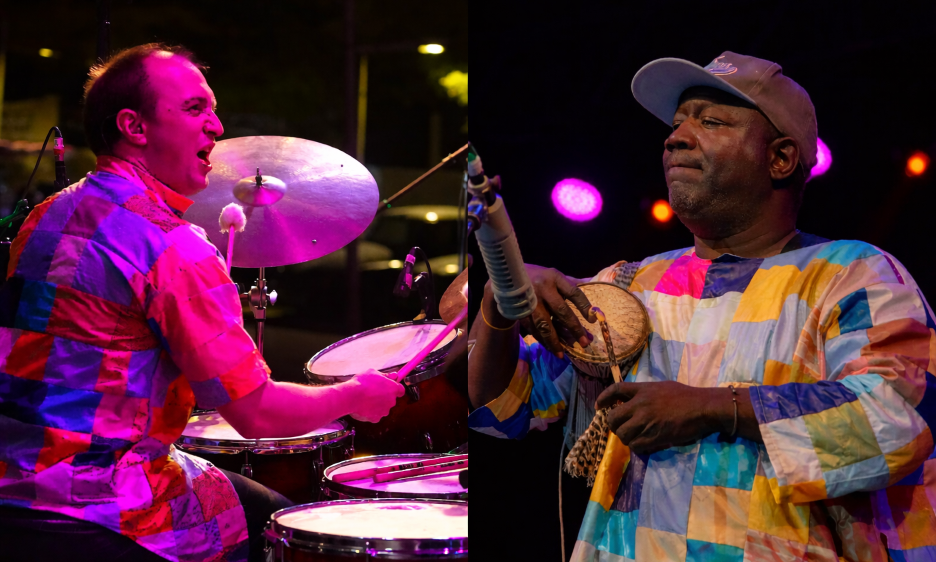
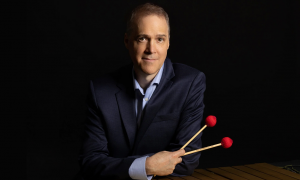
Courtesy Nicolas Henin

I've lived in New York where there were tons of amazing musicians, but to see these sabar guys that are playing all day every day, and praying, and healing, and dancing with these rhythms--I've never seen music at this level of intensity and with these layers of depth.
—Raphaël Pannier
Live In Saint Louis, Senegal, a collaboration between Raphaël Pannier Quartet and Khadim Niang & Sabar Group—not only ranks as one of the best jazz albums of 2025, but it also stands out as a groundbreaking recording in the history of jazz. Recorded live at the 2024 Saint Louis Jazz Festival and released on Miguel Zenon's Miel Music label, Live in Saint Louis, Senegal is certainly not the first meeting between jazz musicians and African musicians. Jazz has a fairly long history of such collaborations, dating back at least to the 1960s.
But collaborations where there is no hierarchy on the bandstand, and where the fusing of jazz rhythms and harmonies with African rhythms and concepts is seamless—such meetings are far less common. It could well be that the exhilarating concert given by Raphaël Pannier's quartet and Khadim Niang's eight-piece sabar percussion group on a warm May evening in Saint Louis, Senegal, holds a unique place in jazz history.
But let's not get ahead of ourselves. The story begins in Paris, three decades earlier, when a little boy dared to dream.
One Day, On A Small Island Off Senegal...
Raphaël Pannier was just three years old when, sitting at home in Paris, he watched a music video that would determine the course of his life. The video was Djabote. It featured 80 Senegalese sabar drummers and 50 singers performing on the island of Gorée, Senegal, in 1990.Leading the throng of musicians through the pulsating rhythmic orchestration was master drummer Doudou N'Diaye Rose—a sabar drumming legend. Rose could not have known that this event—captured for posterity on Peter Gabriel's Real World label—would inspire an historic meeting between French jazz musicians and Senegalese sabar drummers a quarter of a century later.
Over 30 years on, Pannier recalls the impact the music had on his three-year-old self. "It was extremely inspiring," he says via Zoom from his Paris home. "80 percussionists, 50 singers, all masters. The compositions were amazing and the sound was amazing. It was unbelievable. I knew this was what I wanted to do"
It is hard to disagree with Pannier's judgement that the performance is "a masterpiece of African percussion"—the power, the precision and the spectacle is almost overwhelming. What is surprising is that Pannier, at such a tender age, knew then that he wanted to be a drummer. "That is the whole mystery," Pannier says ruefully.
"My family were not musicians. My dad can't clap in time! But they were artists somehow. My mum is a psychologist, and my dad is an architect. They are super passionate about what they do. My father is always drawing and always imagining things, so they understood the love for a discipline. They trusted my instinct and they encouraged me, without understanding anything about drums, jazz or music really."
At the age of six Panier got his first snare drum. His first kit arrived when he was nine—both gifted by his parents (and the conspiring universe).
Pannier's youthful instinct and his parents' sage show of trust and confidence in their young son have both been proven right. For Pannier, a degree in classical percussion and jazz from Paris was followed by scholarships to Berklee and then the Manhattan School of Music. During the decade he spent in the States, Pannier honed his stage chops, playing with a host of top-class musicians. In 2019, he recorded his criticially acclaimed debut album as leader, Faune (French Paradox) with Miguel Zenón, Aaron Goldberg and Francois Moutin.
Returning to Europe in 2020, Pannier was immediately in demand, regularly collaborating with leaders such as Bireli Lagrene, Antonio Lizana and Baptiste Trotignon.
However, the spark that had ignited Pannier's passion for percussion and drumming in the first place, seeing Senegalese sabar master Doudou N'Diaye Rose lead an enormous orchestra of sabar drummers and singers, still exerted a strong pull on the Parisien.
Doudou N'Diaye Rose: Sabar Griot
Widely regarded as Senegal's premier sabar drummer, N'Diaye Rose (1920-2015) enjoyed a stellar career. In 1960, the year of Senegalese independence, Rose played with Josephine Baker, who in 1927 had become the first Black woman to star in a major motion picture. In April that same year, Rose became a nationally celebrated figure when he led 110 percussionists in an independence celebration presided over by President Senghor.Many other accolades followed, including his appointment as head drummer of the Senegalese National Ballet. Later, he would form Senegal's first percussion school in Dakar and led another first when he founded the country's first female drum orchestra.
But it was as the leader of his sabar groups that N'Diaye Rose arguably left the biggest imprint. At home, his sometimes-huge sabar groups nurtured numerous talents over decades. Abroad, Rose took smaller ensembles around the European festival circuit, occassionally appearing as a guest star with famous jazz musicians. In bringing his musical culture to the world, Rose did for sabar drumming what Nusrat Fateh Ali Khan did for Qawwali.
To collaborate with sabar master drummers was a long-held ambition of Pannier's. "It was my dream. "I wanted to realize it. I was telling everybody about it and I have this theory that if you talk about it somebody hears it and somehow the connection is made." And so it proved. Sound engineer Boubacar Tall mentioned the name of Khadim Niang—a griot sabar drummer. He put Pannier in contact with Biram Seck, the director of the Saint Louis Jazz Festival, in Senegal.
Senegal 2023: Nothing Ventured, Nothing Gained
The universe was still conspiring to make Pannier's dream a reality. In 2023, the time was right. Pannier took the decisive step of venturing to Senegal alone. He met with Biram Seck who told him he had to meet the main master in the area, Khadim Niang. Biram made the call and connected Pannier and Niang.Though his mind was set and the wheels were in motion, Pannier still had no clear concept of what might result from such a musical collaboration. "That was the big question. I had no idea until the end, actually," he laughs.
"I had no idea how flexible this guy would be, or how willing they would be to share their culture. Sabar is linked to spirituality, and it is difficult to share that or mix it with other cultures. I also didn't know if they would be willing to learn new rhythms and how much they could adapt."
Pannier need not have worried. Niang welcomed the French drummer with open arms. It seemed they had long shared the same dream.
Khadim Niang: Modern Sabar Master
Son of a griot, Khadim Niang has, in some ways followed in the footsteps of Doudou N'Diaye Rose, even playing in the legend's sabar group for three years in the late '90s. As is the griot way, Niang began playing the drums as a child. The sabar culture is there right from birth. Its rhythms are everywhere."The sabar culture is essential in Senegal," Niang says, in a Zoom call from Senegal, "because it is our national tradition. Everybody dances sabar. Everybody knows sabar. It's our national instrument."
The sabar tradition dates back over 500 years, and like most traditions it has changed to some extent. "Our tradition has evolved," Niang explains. "In the past, sabar was limited. It was used for communication, weddings, baptism and announcements. But now there are a lot of sabar percussionists doing great projects with international links."
The griot culture is hereditary. One inherits the rhythms and they are taught from day one. Griots can also be singers, dancers and storytellers, or "traditional communicators" as Niang calls the latter. "It is a community, an ethnic community," he explains. "When you go to Mali there are griots. When you go to Guinea there are griots. In Senegal there are griots."
The sabar rhythms, numbering in the hundreds, take many years to master. The same is true of the sabar drums, of which there are seven kinds. "Before you can come to a major drum you have to learn all the types of sabar drum—tungune, m'beng m'beng, talmbat, thiol, n'der, gorong, khine," Niang expands. "I also play tabala—we play it here on religious songs—and I play tama, dun dun and djembe. You have to master all the drums and know their origins." (note: tabala, tama, and djembe are not sabar drums)
With a cycle of four to five learning years to master each of the seven sabar drums, it can take a mind-boggling 30, or 35 years to become a drum master, or tambour major. Little wonder that sabar percussionists join groups while still children.
Khadim Niang's first sabar teacher was Cheikh Niang, his uncle. "Cheikh Niang was my master. He taught me everything when I was young." When he was around 20 years old, Niang began his three-year stint in the group of Doudou N'Diaye Rose. It was an invaluable experience.
"I learned a lot from him. He was someone with a lot of qualities," Niang relates. "I was very young. I was there with the youth group and I had other ideas. But he advised me. He talked to me about a lot of things. He integrated me into his group and showed me a lot of techniques. With him I was able to learn rhythms and to create rhythms, because he facilitated it. When we did rehearsals with him he showed us his secrets."
The musical secrets of sabar percussion that Niang speaks of are closely guarded. "He is not giving them up," says Pannier. "These secrets are mandatory to become a tambour major."
For Niang, meeting Pannier helped to fulfil a long-held ambition of his own. "I had thought a lot about doing something with jazz musicians, but I never had the possibility to bring it about," says the griot. "When you came here in Senegal, in Saint Louis, and told me about your dream, your project, I thought, 'it is not a coincidence' because it is the same dream as mine. God sent you here so that you would find me, because this is also my idea."
For years, Niang had dreamed of 'Senegalizing' Paul Desmond's "Take 5" with his Sabar Group. He had heard the song at the after-hours jam sessions in the clubs and bars after the Saint Louis Jazz Festival and was struck by its challenging rhythms. He had also played with the likes of Steve Coleman and Wallace Roney, but as a guest musician, not as an equal creative partner.
With Pannier it was obviously different from the start. They spent time together, cooking, eating and socializing. Niang took Pannier to a sabar ceremony and a dance lesson, immersing him in the local culture. "I watched them making the drums," says Pannier, "because that is an important part of their lives too." When they began to play together, Niang knew that musically it was a good match up.
Two weeks in Senegal, one in Saint Louis and another in Dakar, left a deep impression on Pannier.
"That was my first time being exposed to real sabar, so it was really important and emotional for me. To see this culture functioning, mostly around rhythm, was a revelation for me. Even the non-griots or the non-professionals—they know rhythms so well. You take the cab out of the airport and the guy puts on the radio and there is incredible music with incredible rhythms. And that's just the radio from the cab!
"All the kids hanging out on the streets are exposed all the time to all this music so of course their ears and their memory gets attuned to the logic of this great music. The level of the relationship to the music is different, and I was really amazed by that," Pannier enthuses.
"One thing that really shocked me was to realize that they played all day, every day. And if they don't play, they readjust the drums or they eat. But sometimes they keep playing while they eat because they practice songs."
Ancient Traditions, Modern Ways
After a couple of days of getting to know each other, musically and personally, Pannier returned to Paris. For the next year he and Niang exchanged files of their music via Whatsapp—ideas to dissect, experiment and build with. There were particular challenges for Pannier when transcribing Niang's sabar recordings."First of all, there is no concept of one. They see rhythms as a wheel. They start at 3pm, 6pm or 9pm, it's the same for them, so I had to make choices. It was really difficult: one; to understand the music, and two; to imagine how we could work together."
Gradually the musical pieces of the jigsaw started coming together, and with an invitation to the Saint Louis Jazz Festival in 2024, the greater dream shared by both Pannier and Niang came ever closer.
Woodshedding, Senegalese Style
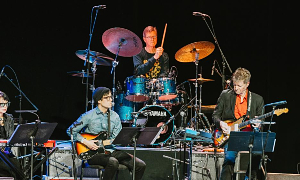
For the next step in the adventure Pannier turned to trusted compadres in bassist Francois Moutin, pianist Thomas Enhco and Cuban saxophonist Yosvany Terry. Upon arriving in Senegal in May 204, the French quartet and Niang's Sabar Group had a week of rehearsals to work on the repertoire for what would be the closing concert of the Saint Louis Jazz Festival.The first tune they rehearsed and 'Senegalized' was Ornette Coleman's "Lonely Woman." Niang added three separate rhythms. "He had this idea for baks. A bak is a musical break," Pannier explains. "Sabar functions around grooves and baks; at a given musical sign from the master, the whole band would play a certain bak. Some baks are a couple of beats long, some are two minutes long... it's an important part of the sabar culture. His guys memorized the baks and the grooves of ultra-complex rhythms. I had to write it down," recalls Pannier, laughing. "It was super powerful!"
The next day the musicians sank their teeth into "Take Five," with its unusual meters. "The first time I heard the melody it stayed in my head," Niang relates. "I liked the melody, the variation, but it was very complicated for me." The complication for Niang and his musicians with the tune made globally famous by Dave Brubeck was the 5/4 rhythm—in Senegal there are very few odd meters. Niang saw it as a challenge. "If things are complicated I want to do it. That's why I wanted to do it. I love 'Take 5.' It was my dream to do it, and Raphael helped me realize it."
The Concert: Dreams Become Reality
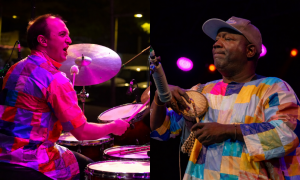
For Niang, born and raised in Saint Louis, the honor of headlining the festival was not assumed lightly. "Usually, I play as a guest artist on one song, but to be there on the main stage with my group, with Rapha, Thomas, Francois and Yosvany... we felt the pressure to succeed because everyone was waiting for us as the headliners. There was pressure on my percussionists because this was the first time like this."Additional pressure came with the presence of Senegal's national television cameras. Messing up was not an option. As is customary for prestigious celebrations, Niang and the members of his Sabar Group wore brightly colored patchwork Baye Fall shirts. A subgroup of Senegal's Mouride brotherhood—an order of Sufi Islam—Baye Fall's devotees express their faith through hard work, community work, whereby each task has spiritual significance—a form of devotion to God. "You see the face of the spiritual leader painted everywhere," says Pannier, "on all the shops, on all the walls in the city."
For the concert, in a gesture of respect accorded few westerners, Niang presented Pannier with a traditional Baye Fall shirt—a beautiful patchwork of bright colors reserved for a sabar master. "It was a huge honor," acknowledges Pannier. "Many of my Senegalese friends, when they saw me, they were 'wow! you're wearing this shirt!' It was a fitting symbol of all the work, faith and sacrifice that the Frenchman had invested in this unique project from day one.
In the end, the concert was a resounding success. Senegalized jazz compositions, Niang's originals and a Yoruba traditional composition ignited the 1,000-strong audience's passions. Pannier, who was giving the musical cues, was too swept up in the music to be fully aware of the audience's enthusiasm throughout. It wasn't until after the concert that he realized its impact on locals.
"That night and the day after when we walked in the city, everybody would recognize us and congratulate us and cheer us," recalls Pannier. "That was great. I think they were really touched that we had this real exchange. It was a big thing for them."
"I loved it," enthuses Niang of the concert. "A lot of people contacted me afterwards to congratulate me. They said it was the best concert of the festival. That gives me joy because I wanted this project to succeed. We did something new in the milieu of jazz. and it gives me the courage to continue my work."
Appropriately, the final track of the concert was "Djolokanete!," which as Niang explains, sums up the spirit of the project: "The idea came from my nephew, Babacar, because djolokanete in Wolof means 'giving,' in essence. I give Raphael something, Raphael gives it to Mouhamed, Mouhamed gives it to François... That's djolokanate."
Closing The Circle
Back in Paris, Pannier turned to the concert tapes. Recording a live album had been one of the project's primary goals, but there were many technical issues to contend with. For starters, there was more sub-bass than bass in the DI. Some of the stage mics on the night of the concert had malfunctioned. The mixing of up to 12 instruments engaged in intense interplay would be challenging to say the least.The task unfolded in the recording studio of Eric Serra, the veteran French film maker who had produced the Djabote, the concert film on Doudou N'Daye Rose that had so inspired the three-year Pannier. In another act of symmetry, Serra contacted Dominique Borde, the sound engineer from that concert thirty-five years before, who flew in from Portugal to mix the music.
After seven days, Borde's work was complete. The sound quality of Live in Saint Louis, Senegal is exceptional. With this extraordinary document Pannier, Khadim and their musicians have honored the legacy of Doudou N'Daye Rose while carrying the music forward into exciting new terrain.
Further Conspiracies?
The French musicians agree that this has been one of the most powerful music experiences of their lives. "It was very difficult for all of us to come back to our normal world after this. I think we all were really changed," says Pannier."I've lived in New York where there were tons of amazing musicians, but to see these sabar guys that are playing all day every day, and praying, and healing, and dancing with these rhythms—I've never seen music at this level of intensity and with these layers of depth. That was definitely the thing that changed me, and I'm still wondering how to get deeper in music."
Does the album mark a full stop in the story, or just the beginning of an ongoing adventure? For both Pannier and Niang, the answer is clear. Another go around, ideally at festivals around the world, would be the next dream. Niang sums up their mutual feelings succinctly: "I want everyone to discover sabar with jazz," says Niang. "Inshallah."
Tags
Interview
Raphaël Pannier
Ian Patterson
Live In Saint Louis, Senegal
Miguel Zenón
Miel Music
Faune
Aaron Goldberg
Francois Moutin
Birelli Lagrene
Antonio Lizana
Baptiste Trotignon
Paul Desmond
Steve Coleman
Wallace Roney
Thomas Enco
Yosvany Terry
Dave Brubeck
Khadim Niang
Khadim Niang & Sabar Group
Saint Louis Jazz Festival
Djabote
Doudou N'Daye Rose
Gore
Peter Gabriel
Miel Music
Nusrat Fateh Ali Khan
Biram Seck
Boubacar Tall
m'beng m'beng
tungune
talmbat
thiol
n'der
gorong
khine
Take Five
Lonely Woman
Xalat Bou Set
Naima
John Coltrane
Hommage To Doudou N'Diaye Rose
Sine Saloum
Djolokanete!
Ornette Coleman
Studio Sanar
Eric Serra
Dominique Borde
Beat Laden
Nicolas Henin
Assane Diakate
Daniel Monka
Isabelle Boiro-Gruet
The French Institute of Saint Louis, Senegal
Comments

PREVIOUS / NEXT

Support All About Jazz
 All About Jazz has been a pillar of jazz since 1995, championing it as an art form and, more importantly, supporting the musicians who make it. Our enduring commitment has made "AAJ" one of the most culturally important websites of its kind, read by hundreds of thousands of fans, musicians and industry figures every month.