Home » Jazz Articles » Film Review » Köln 75
Köln 75
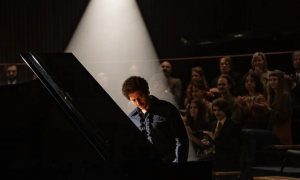
Courtesy Wolfgang Ennenbach / One Two Films

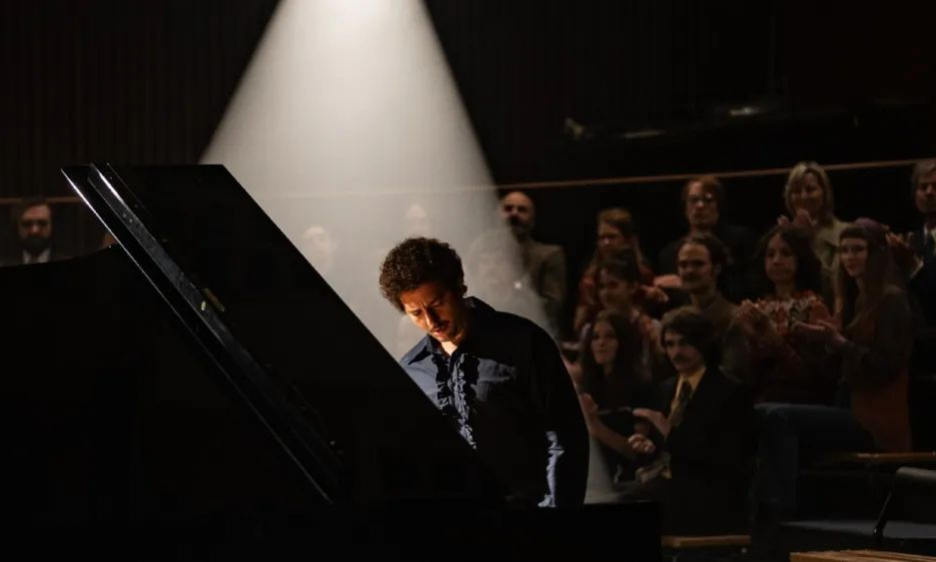
Having shot the film in a fashionable “tarnished Kodak” style of 1970s period pieces, with a slight syncopation to the editing rhythm, Fluk gave us an aesthetically pleasing ride, until the plot relaxes into the titular gig's culminating performance.
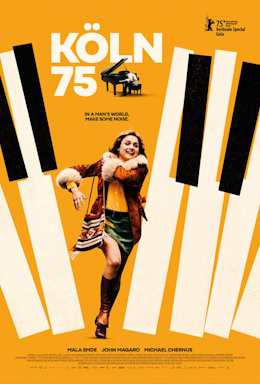 Köln 75
One Two Films / Extreme Emotions / Gretchenfilm / MMC Studios Köln GmbH
DIrector: Ido Fluk
2025
There is a scene mid-way through Ido Fluk's whimsical dramedy that plays like an European art-house tune. Three figures are traveling at night in a tiny Renault 4. Keith Jarrett (musician, played by John Magaro) is in the front seat, Manfred Eicher (label owner/producer—Alexander Scheer) at the wheel, and Michael Watts (with Michael Chernus embodying the universe's idea of a turtlenecked jazz critic) comments from the backseat. Without a day's rest, they cover the distance from Épalinges to Cologne. When the morning breaks over a pastoral Ruhr landscape, the critic leaves his seat to join Jarrett in a bird call reverie. They attune themselves to the natural soundscape. In contrast to the film's ocher hue, now we behold luminescence through raindrops in dewy cobalt blues. This could be an ECM Records cover moment in a film otherwise rubber-stamped with Impulse! Records dust-jacket close-ups. A breathing interval in a busy yet bemused performance.
Scheduled to coincide with the 50th anniversary of Jarrett's legendary concert on January 24, 1975, Köln 75 is not a story of a disaster that ended up in the National Recording Registry, but of the "scaffolding that made it possible." This preamble already signals a challenge typical documentaries and feature films about jazz milestones set. And the influence is undeniable. The Köln Concert helped establish a new model for solo piano performance, with Jarrett declining to play standards and challenging himself to "play from nothing" yet casting this Nothing into a strong catalog: Solo Concerts Bremen/Lausanne (RCA, 1973 )—a stepping stone for live solo gigs to come, Sun Bear Concerts, Dark Intervals (RCA, 1988), Rio (ECM Records, 2011).
Expecting a deep dive into the spiritual or technical sides of his process might leave us disappointed, though. Köln 75 focuses on the circumstances surrounding the date and the venue not its conceptual lineage. The protagonist enters the picture only after Vera Brandes' (Mala Emde) musical tastes have been given enough screen time to move from CAN's soundtracks to free jazz. Having shot the film in a fashionable "tarnished Kodak" style of 1970s period pieces—with a slight syncopation to the editing rhythm—Fluk gave us an aesthetically pleasing ride, until the plot relaxes into the titular gig's culminating performance. From then on, we go through the motions of a concert promoter's hell—the last minute realization that the Bösendorfer backstage instrument is not the requested 290 Imperial but a baby grand, the search for a replacement while the whole of West Germany is already away for the weekend, and the tuning of a broken-pedaled piano during a noisy performance of Berg's Lulu. Just the usual day at the office. Wrapping that up with an Oscar-ready prep talk about overcoming obstacles as a path to emotional growth that the 18- year-old Brandes delivers to the musician, was a bit too much. You almost hoped for the pesky critic to join this hyperventilating cutting contest and anchor the clichéd scene with a Charlie Haden bass line.
With the spotlight on the main character's struggles with adulthood, politics, sexuality, and traditional family models, underwritten by the growing passion for music that seems to take a back seat the closer we get to the date, there is little space for Jarrett's own soul-searching. Aside from the scaffold, and leaving out real life characters, it is the American jazz critic flown in to cover the tour—the proverbial "Lester Bangs in the car"—who is this film's most likable character. Much closer to Ted Gioia with untied shoelaces than to the notoriously militant Bangs. Michael Chernus's character repeatedly glances through the fourth wall. It has been a wait for those metanarrative disruptions providing nuts-and-bolt—albeit quite silly—explanations of basic jazz terms, while commenting on conflicts in the plot. Only there does Fluk's film seem to be hitting its diminished fifths.
As opposed to documentaries, dramatizations are a question of relinquishing control over one's image. That was not the case with Köln 75, which ends up not using Jarrett's music. Could that have translated into the slightly unfair treatment of its subject matter? A sobering disappointment settles in when Eicher tells the critic that Jarrett's physical expenditure and the cashing in of airplane tickets were a must to make his European tour possible, after the artist had been dropped by Columbia Records. At the time, however, Jarrett had already partnered with Impulse!, while working the momentum under the umbrella of ECM's fresh Northern sound. The decision to leave Miles Davis Group is also presented as an exile, even though it was Davis who encouraged Jarrett to improvise his way out of musical avenues, as documented in the 1970s The Cellar Door Sessions 1970 (Sony Music, 2005) concerts. Still, nothing lends itself better to screen fiction than a tormented Romantic going on a fist fight with the world—be it an established music label, Cologne's rainy weather, or a specifically German operatic inertia of Wagnerian proportions.
We were promised a story not about the Sistine Chapel but the scaffolding that made its painting possible. Upon confronting a wobbly construction, however, Michelangelo might have had second thoughts about the whole enterprise. As Wikipedia tells us, neither he nor Jarrett eventually ditched their respective "gigs." Taking Jarrett's reverend status for granted, the homage Köln 75 plays best as a collection of standards rather than an innovative two-hour-long solo. A flyer instead of a primer, for the jazz critic in all of us.
Tags
Film Review
Keith Jarrett
Maciej Stasiowski
Manfred Eicher
Luminessence
ECM Records
Impulse! Records
Keith Jarrett: The Köln Concert
Keith Jarrett: Solo-Concerts Bremen Lausanne
Ten Essential Keith Jarrett Solo Recordings
Keith Jarrett: Rio
Columbia Records
Miles Davis
Miles Davis: The Cellar Door Sessions 1970
Comments

PREVIOUS / NEXT

Support All About Jazz
 All About Jazz has been a pillar of jazz since 1995, championing it as an art form and, more importantly, supporting the musicians who make it. Our enduring commitment has made "AAJ" one of the most culturally important websites of its kind, read by hundreds of thousands of fans, musicians and industry figures every month.