Home » Jazz Articles » Interview » Jo-Yu Chen: For Taiwanese Pianist Classical Jazz is a Gas
Jo-Yu Chen: For Taiwanese Pianist Classical Jazz is a Gas

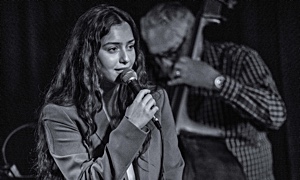
Courtesy Meng-Ling Hsieh

On the opposite end of the spectrum is Chen's solo rendition of the second movement of "Sonata No. 8," the "Pathétique," sounding spacious and hushed. She plays the tune as softly as you would step on someone's nouveau riche shag carpet. The unaccompanied turn spotlights the pianist's ability to delve deep into the emotional core of a piece of music, wringing profound feeling from the piece in a way that bridges the centuries since its writing and reframes it in a moving and captivating form.
When Chen moved from Taiwan to New York to study at Juilliard, she had every intention of continuing on the classical career path she had followed as a student of both piano and oboe. It was not long, however, before she detoured into the world of jazz, continuing her studies at the New School and falling under the influence of adventurous pianists like Jason Moran, Sam Yahel and Kevin Hays. Within a few years, Chen embarked on an ambitious series of collaborations, recording dazzling jazz albums with such modern greats as drummer Tyshawn Sorey (her debut, Obsession, 2012), guitarist Kurt Rosenwinkel (Stranger, 2014) and saxophonist Mark Turner (Savage Beauty, 2019)—all on Sony Music.
This new interest didn't deter her, however, from staying to true to her first love of classical music. "I disconnected from the classical world when I moved to New York, but the sound always stayed inside me," she explains. "I felt it was about time to integrate them."
Returning to her native Taiwan while the pandemic raged brought Chen full circle in other ways as well. She found herself reconnecting with fellow classical musicians, many of them also recently returned Juilliard alumni. But she had no intention of leaving her newfound passion for jazz behind. This involved incorporating a reverential attitude towards exploration, to truly be one with the music and travel inward as well as outward with the same focus, courage and determination. Bringing the two worlds together, however, would be as complex as trying to map a plexus of waterways in the Everglades.
The challenge came when Chen decided to explore the works of Russian composers. She chose an excerpt of "Swan Lake" from Tchaikovsky, and found herself to be exhausted and needing to take a break from all the rearranging and just focus on practicing piano. "I didn't know what to play and what to practice, so I asked myself if there is any repertoire I want to practice without purpose," she recalled. "I thought about the Prokofiev piano concerto. It is one of the most challenging in classical music. I heard a lot of tango rhythm, so I was bold and moved the second theme to my beginning part with tango and then got a little bit crazy."
In a sense, Chen was tossing the yarrow stalks to determine her direction with the concerto. When hearing the intoxicating score, the result verged on non-traditional eloquence, a kind of marvelous hybrid. She had inescapably crossed the line into the province of jazz as perhaps the masters would have played it centuries ago.
The album features reimagined works by five iconic composers, including pieces from three ballet masterpieces. As she has been on every one of her releases to date, Chen—who also produced the album—is joined by the outstanding New York-based rhythm section of bassist Chris Tordini and drummer Tommy Crane. Briskly-paced and skillfully played, that leans into—sometimes zooms into—the album's retro-futuristic content. It's entertaining even if it doesn't aim to return things to a familiar status quo. Some pieces take time to build like a volcano prior to pouring out lava; on others she softens them like a shaft of late-afternoon sunlight in a formal dining room. In the following Q&A, Chen outlines the dedication, if not the obsession, with turning classical water into jazz wine.
AAJ: Was New York something like a cultural shock for someone coming from Taiwan?
JYC: Coming from Taiwan and a strictly classical training environment, my world was quite contained at the time. Many of my friends were also fully immersed in classical music, so we rarely looked beyond that world. Arriving in New York was almost like a cultural shift. I became curious about r&b, hip-hop, and funk, but I didn't know where to start or who to turn to. Even if I wanted to go out and explore, none of my classical friends would join me—they had rehearsals or were tied up with practice. Then one day I heard Keith Jarrett, and that was probably the moment that pushed me toward jazz.
AAJ: What fascinated you about Jarrett's playing?
JYC: He played these very long introductions, and I was amazed by how someone could improvise Bach. I had practiced Bach my entire life, but I couldn't improvise at all. That made me question myself. If I had spent my whole life practicing this repertoire but couldn't improvise it, was I really a good musician? It was probably the first time I questioned everything I had done—all those years in the practice room and all my classical training.
AAJ: Was it a difficult path for you to transition from classical music to jazz?
JYC: Not at all. I started searching for everything about Keith Jarrett, wondering whether classical repertoire had ever been transformed into jazz or Broadway standards. At that time, I didn't even know what a Broadway standard was. Many musicians grow up with songs like "Summertime," but to me they simply felt like completely new pieces. As I became more familiar with jazz, I naturally gravitated toward writing my own music. My first four albums turned out to be entirely original. I never planned to record something like the EP Schubert and Mozart: Round Midnight (Sony Music, 2024). That only happened after I returned to Taiwan during the pandemic..
AAJ: Did you play this music at a concert hall in Taiwan?
JYC: Yes. I was invited to perform at the main concert hall in Taiwan. They had a rather unusual idea: a 24-hour marathon concert series to help people forget about the pandemic for a while. Each year focused on a different composer. The first year was Schubert, and it was a purely classical festival. I was the only jazz trio in the entire program. My concert was scheduled at one o'clock in the morning. I remember asking them, "Are you sure?" It's a 2,000-seat hall and I wasn't sure anyone would come at that hour. But many people came, and it became a very special moment. That was when I thought I should record the project and make it part of my discography. Originally, I had only seen it as a side project. They later invited me back again—the second year for Mozart and the third year for Beethoven.
AAJ: Did you study Schubert the man besides his music?
JYC: I didn't study Schubert in a very academic or biographical way. But while working on his music, I found myself becoming quite melancholic. There was a certain emotional space in his music that I seemed to enter naturally. Throughout my jazz career, I've experienced similar moments. It can be difficult, especially as a female instrumentalist, because sometimes you're not taken seriously. After my album Stranger, I went through a period where I felt quite lost. I think I had expected more at that time.
AAJ: That album had, some might say, dark titles like "Wolfman" and "The Art of Darkness."
JYC: At that time, I really wanted to make a strong statement about who I was and what the Jo-Yu Chen Trio sounded like. But I was also struggling. I didn't have a booking agent or a manager, so I constantly felt out of balance. I don't know if listeners can hear it in the music, but the sense of struggle was always there. Even with Beethoven (laughs), somehow it still ended up sounding like struggle.
AAJ: What has been the most challenging aspect of becoming a musician?
JYC: The business side. When I'm recording with my band or making a record, everything feels natural and I love every second of it. But once the record is finished and it's time to release it, the struggle begins. Promotion, marketing, social media—all those things. To continue as a musician you have to compromise many things, and that's not something that comes naturally to me.
AAJ: For Rendezvous: Jazz Meets Beethoven, Tchaikovsky & More, why did you choose that specific selection of composers and pieces?
JYC: After Schubert and Mozart, I thought the project was finished. I wanted to return to writing original compositions. But when the festival invited me again, this time to do Beethoven, I agreed. Once I started working on his music I felt deeply inspired by its power and emotional intensity. Beethoven was the composer who led the classical era into the romantic era, and that energy fascinated me.
AAJ: That makes sense. Schubert was in the romantic era; Mozart the classical era, and Beethoven the bridge between.
JYC: I felt that Beethoven was leading a kind of revolution. The more I studied his music, the more I connected with it—the intensity, the anger, and those very contradictory emotions. For some reason, I also felt a strong connection to my own journey as a musician. There was something in that sense of struggle that felt very familiar to me. I spent a lot of time with his music and felt deeply drawn to it. At the same time, I didn't want to approach it with a fixed idea of making an entire Beethoven album. I didn't want to be constrained by that kind of framework. Instead, I chose to focus only on the pieces I truly responded to and allowed the project to evolve more organically.
AAJ: How did Tchaikovsky fit into your plans?
JYC: Schubert, Mozart and Beethoven all belong to the German-Austrian tradition. I felt the need to escape that world a little. Tchaikovsky brought a different emotional language, and that inspired me to explore further.
AAJ: Next you turned to Prokofiev.
JYC: After working on those arrangements, I felt quite exhausted and decided to take a break and simply practice piano again. I asked myself if there was any piece I wanted to play purely for fun. The first thing that came to mind was a Sergei Prokofiev piano concerto. When I started playing the second theme, I suddenly heard a tango rhythm in it, and that became the opening of my arrangement. After that the music developed in a rather unexpected way before eventually returning to the original theme.
AAJ: You also reinterpreted "Romeo and Juliet."
JYC: Yes, I love "Romeo and Juliet," especially the orchestral recordings. In the middle section I wanted the bass to resonate like the brass section in a symphony orchestra. I tried to capture that orchestral power and bring it into an old-school, bluesy swing feel.
AAJ: This album was released on digital and vinyl, no CD. Do you think digital is the best way now with vinyl for the collectors?
JYC: For a long time, I had mixed feelings about streaming platforms like Spotify. Many musicians were skeptical about them. But eventually I realized that if digital platforms help more people discover the music, then that can be a good thing. When I saw that listeners were finding my albums through streaming, I actually felt very happy. When my label suggested vinyl, I said sure as long as there is something physical offered.
AAJ: On the Savage Beauty album, the cover has a very distinctive concept.
JYC: With Savage Beauty I was thinking about the idea of wildness—a kind of beauty that is not perfect. I think there was also a desire to push beyond my own boundaries. Some of the inspiration also came from childhood. I wrote one piece imagining my niece and nephew playing freely, and I was thinking I want my heart and inner self to be like a wild kid at the playground. Coming from an Asian background, there are certain cultural frameworks that can feel quite binding, even on a subconscious level. In a way, I think I was pushing myself to break away from that—to step outside those expectations and allow more freedom in how I express myself, both musically and personally.
AAJ: The album also had a very striking visual style.
JYC: Earlier in my career I sometimes felt that if I dressed too elegantly, people might not take me seriously as a jazz musician. So I tried to dress down, because at the time I believed that's what a "serious" jazz musician should look like. But eventually I realized I was hiding part of who I am. When I started working on this album, I almost wanted to push in the opposite direction—to exaggerate it, to challenge that idea, and to question why I felt the need to fit into that image at all. I've always been drawn to refined aesthetics—whether it's couture, architecture, or beautifully designed objects. I appreciate things where you can feel the care, the craft, and the intention behind them. Eventually I told myself that I should simply be honest about my own taste and sensibility.
AAJ: There was also a famous photo shoot with a sports car, though I've seen photos of you wearing the shirt of a rock band.
JYC: I actually love rock; I love Nirvana. But the photo shoot was part of the promotion concept with Sony Music Taiwan. The supercar was a metaphor for jazz—its unpredictability, speed, and sense of danger. We were fortunate to collaborate with McLaren Automotive, who even placed a car in front of the concert hall on the day of the performance.
AAJ: Which musicians have influenced you the most?
JYC: My teacher Sam Yahel gave me tremendous guidance. I was also very inspired by Jason Moran, especially the way he thinks as an artist not just a pianist. And I worked closely with Aaron Parks, who co-produced several of my albums. I learned a great deal from him.
AAJ: Do you have a preference—or maybe a better way to put it would be, do you find there is a difference between playing classical music in a symphony hall and playing in a jazz club?
JYC: Interestingly, I actually enjoy playing in concert halls more. In a concert hall I can't see everyone's face clearly, which gives me a certain sense of freedom to focus on the music. In a jazz club the audience is very close, and I notice every small sound. Sometimes that makes it harder for me to concentrate.
AAJ: Tell me about the Mozart concert with you wearing pajamas.
JYC: Yes, that was during the late-night Mozart concert. The poster showed Mozart wearing pajamas, which gave me the idea to perform in elegant pajamas and start the concert with "Twinkle, Twinkle Little Star." It created a very joyful atmosphere. I even brought a Mozart pillow on stage. For a moment it really felt as if Mozart was somehow present with us.
AAJ: When are you going to try wearing pajamas in a jazz club late at night?
JYC: (laughing) No, I can't do that. In a 2000-seat hall, I can be myself and I can joke and wear crazy stuff and that's fine. But when you are in the jazz club with people just staring at you very close, I am more anxious. Having some distance maybe is good for me to focus on my music.
AAJ: Would you play some of the pieces from classical composers in the same show with your other straight jazz numbers?
JYC: I don't think the Beethoven is so good for the jazz bar. I only had one drummer. I think the show may be a little weird, but definitely I would like to try it. But I don't think anyone in the States will hire me to do that.
AAJ: I've heard that doing a string quartet recording is in your plans for the future.
JYC: I would love that. I think the pandemic changed the perception of time for me. I always thought I had a lot of time to figure out things, but then I became unsure. I reconnected with a lot of Julliard alumni and we talked about doing something together, possibly a Julliard alumni album. I did write "Walking Through Fear" as a string quartet plus piano.
There was one classical critic in Taiwan who told me he thought it was Shostakovich. It's not that I wanted to sound like Shostakovich, but my next recording project will involve a string quartet and piano. I'm very interested in exploring the dialogue between classical chamber music and jazz improvisation.
AAJ: Not Shostakovich, though.
JYC: No, it will be my own composition. You'll see.
Tags
Interview
dean nardi
jason moran
Sam Yahel
Kevin Hays
Tyshawn Sorey
Kurt Rosenwinkel
Mark Turner
Chris Tordini
Tommy Crane
Comments

PREVIOUS / NEXT
Support All About Jazz
 All About Jazz has been a pillar of jazz since 1995, championing it as an art form and, more importantly, supporting the musicians who make it. Our enduring commitment has made "AAJ" one of the most culturally important websites of its kind, read by hundreds of thousands of fans, musicians and industry figures every month.