Home » Jazz Articles » In Pictures » A Musical Odyssey - Wandering The Streets of New Orleans
A Musical Odyssey - Wandering The Streets of New Orleans

Tourists throng through the French Quarter, the sidewalks filled with the sound of music and money. Pop-up flea markets crowd those sidewalks too, with tap dancers working hard in the heat and humidity for spare change while street vendors seek the disposable income that comes with the crowds. And on sale are perfectly functional musical instruments that have apparently been cast aside.
The marketplace bustles as, within a day or two, one collection disappears to be replaced with another group of older, collectible instruments. Presumably, there must be deals to be had.
During those two weekends of Jazz Fest, neighborhoods near the Fairgrounds are buzzing, crowded with people and, in the spirit of a city that finds any excuse to celebrate, nearby homes and even fences are appropriately adorned.
An estimated 475,000 people come to town, with a controlled but still chaotic scene within the spacious Fairgrounds. But those living close by enjoy the music emanating from the largest stage, separated by a fence and some foliage. On this small residential dead-end street adjacent to the western edge of the Fairgrounds, they sell seats and shade from the comfort of their porch. With chairs arranged on the blocked-off street and sidewalk, it is a cooler and quieter spot to enjoy the music... for a price, but not an unaffordable sum given the comfort of elbow room and shade.
But the music of New Orleans reveals itself not only on festival stages, but where it all began—on street corners and in bars. Jazz Fest, conceived to promote local Louisiana music, invites those performing only original material. Other talents, though, remain unknown, often encountered in small clubs or simply on the streets playing for tips. Wander far and long enough, and you will encounter unexpected sights and sounds. A bowl for tips, a horn with a worn and weathered case belonging to a relentless busker by the banks of the Mississippi River caught my attention.
The man could play—his repertoire including trad jazz classics as his frayed case lay bare the long journey he had taken. Intuitively understanding the value of the image, the purchase of a CD was accepted as adequate compensation, with thanks. Two years later, in the same spot by the river, the case had been upgraded even as he had noticeably aged in the interim.
The wandering continued, navigating uneven brick sidewalks through a downtown area and home to the Bohemian—now-landed-gentry in the Bywater, just east of the French Quarter. The changing landscape of the city's well-known, quaint, and scenic establishments continues, but not due to real estate transactions or a failed business model. Instead, the aging infrastructure disintegrates as all-too-common electrical fires destroy older, established businesses, seemingly more often on St. Claude Ave. than elsewhere.
Taken in 2016, Melvin's burned down a few years later, as did a favorite tire shop. Shown to Charmaine Neville to convince her to write a foreword for a planned photography book, she excitedly revealed she knew this fellow, and he was a horn player.
Who would have guessed? What seems like happenstance is an exercise in synchronicity—the wonders that New Orleans reveals to those aimlessly wandering, as improv is appropriately rewarded in the birthplace of jazz.
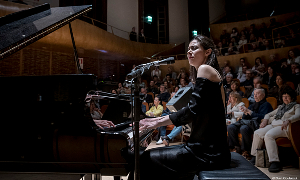
Stages at French Quarter Fest, a free event, are often sponsored by corporate entities like Shell and Chevron (Louisiana produces oil, and fuel prices are cheaper than elsewhere, even Texas). But the annual concert in Washington Square, an open grassy park immediately adjacent to Frenchmen St., is sponsored by a local park association. In 2017, Davell Crawford—a local pianist and Basin Street Records artist—played a much-heralded tribute to Ray Charles, complete with a recreated lineup of the Raylettes, Charles' backup singers.
Taking shots of musicians has been done to death in New Orleans and, while harboring no aspirations to compete, capturing unusual and different angles is more appealing. Asking for a closer vantage point past the security ropes, the following images were taken (scroll down)—one with Crawford dressed to kill and fully engaged at his piano.
And the other—one of the "Raelettes" approaching the stage, an alluring shot and the lead-in photo to a subsequent exhibition at the Jazz & Heritage Center in 2019 titled "Love at First Sight." Not knowing her name and wishing to give her a print, when shown the image and asked her name, renowned trumpet player Kermit Ruffins, without hesitation, declared, "That's Nayo Jones, no one in this town dresses like her!" And he's right!
Anyone who follows New Orleans music is familiar with Kermit. His arrival in Tremé, from where he was raised in the Lower 9th, was an epiphany—his life changed upon first hearing "When You're Smilin'" by Louis Armstrong drifting from an old jukebox in one corner of the bar while waiting for a po'boy sandwich. Since then, he's dedicated his life to playing like him. "But that's impossible, of course!" he immediately adds, without shame.
Eventually, he purchased Ernie K-Doe's Mother-in-Law Lounge, where he often sits at one end of the bar sipping a Budweiser in the relative anonymity of the cool, darkened interior. Little light enters other than through the only entryway—a glass door facing the busy North Claiborne Avenue, needlessly marked "EXIT," the only obvious one other than a back door through the kitchen.
Everyone knows what the bar looks like from the street—colorfully painted, it's impossible to miss. Oddly, fewer New Orleanians than you'd expect recognize this image taken from the less familiar vantage point inside the bar. To the left of the door hangs a poster paying homage to "Uncle" Lionel Bastiste of Tremé Brass Band fame.
Emerging onto N. Claiborne on a Sunday afternoon and expecting a swift journey to the next planned stop, the usual 2nd-line street procession hindered progress. Organized for any number of reasons aside from the celebrated New Orleans funeral processions, the colorful, often noisy and boisterous crowd marches on, oblivious to vehicular traffic or admonitions about disturbing the peace. But unlike elsewhere in the continental United States, procession-goers feel no obligation to conform.
Dancing, playing horns, and beating on drums of all sorts is the name of the game with these 2nd-line celebrations. In nearby Tremé, the fabled birthplace of jazz and present-day home to some of the city's most heralded musicians, including drummer Shannon Powell, the people revel in their history, taking every opportunity to remind themselves of how special their city really is.
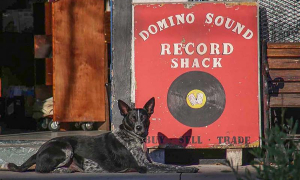
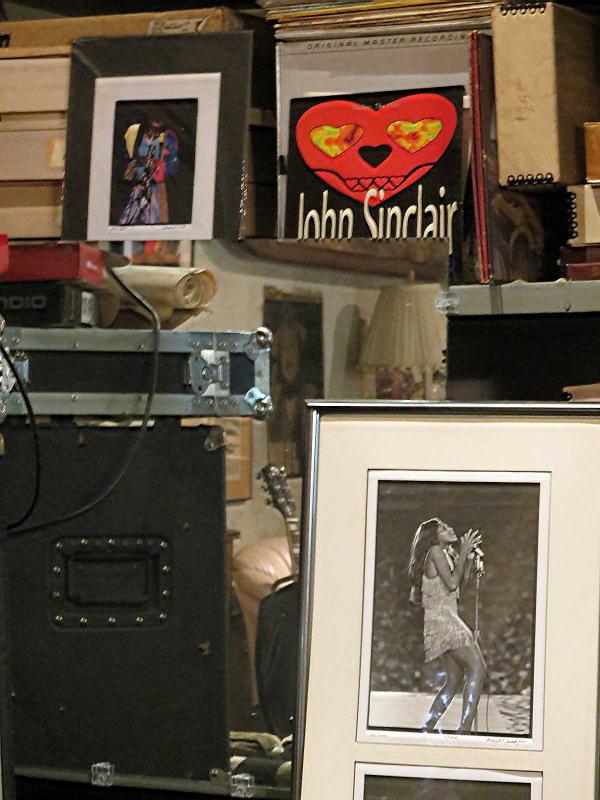
Of course, the arguable birthplace of American music traditions is also home to some record stores, though fewer than one might imagine. While CDs are commonly sold, old records are collectible relics of the city's musical past glory. Wandering, though never searching for anything or any image, rounding a nearby corner, I stopped, stunned by this scene—reminding me at once of the RCA dog gracing those Elvis 45s from my childhood.
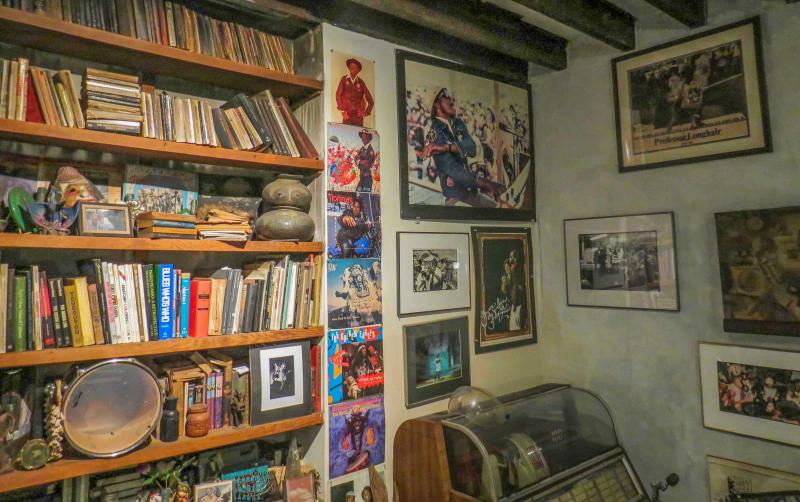
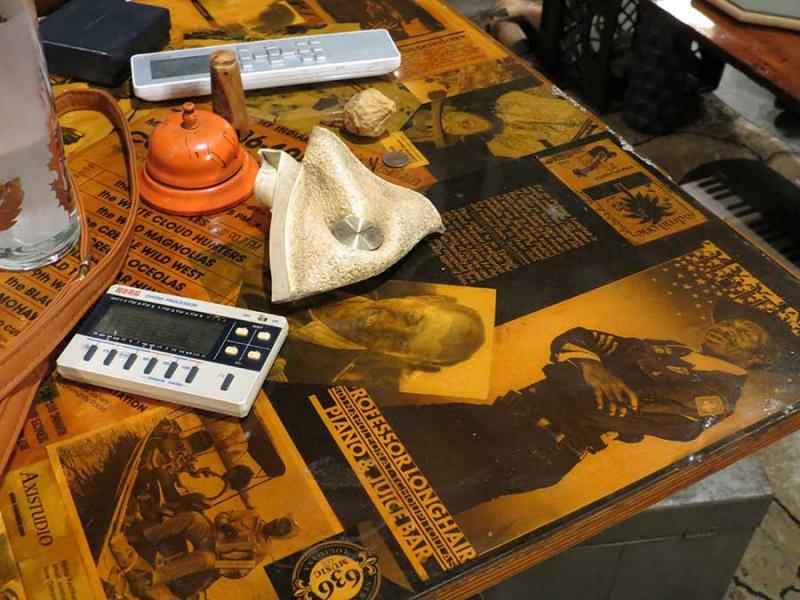
The Domino Sound Record Shack features racks of old records to page through, as does Euclid Records further downtown in the Bywater. The bulletin board outside that front door is wondrously eccentric—open to anyone wishing to tack up a flyer, in this case "Accordion Therapy" in addition to one promoting the annual tribute to Professor Longhair—Fess Up!—featuring, among others, Alfred Roberts, the conga player on the final album Fess recorded.
Everyone needs to make a living, and some musicians start on the streets. Doreen Ketchens, one of the most accomplished clarinetists one could ever hope to hear, continues to hold court, playing for tips on Royal Street in the French Quarter. But at one point, the municipal authorities thought it was a good idea to forbid busking under penalty of law.
Even as this duo entertained a meager crowd well after midnight at a distance from Frenchmen St. music venues, those clubs continuously buzz with activity. Often with no cover charge, the only unspoken obligation is to have a drink and, if the music is good, tip the band. In response to the now-defunct law, this performer reminds her audience in no uncertain terms—her tip box reading "Music Is Not A Crime."
But no journey to New Orleans would be complete without a trip to the hallowed hall itself—to enjoy the Preservation Hall Jazz Band in its time-honored home. A smaller, unpretentious building draped in wrought-iron lattice with ornate embellishments, it was transformed from one of the many struggling art galleries in the Quarter into a sanctuary for trad jazz players by current musical director Ben Jaffe's father, Allan, in the early '60s.
Steeped in history to which older members of the band resolutely cling, objections to an unabashedly updated sound simmer out of the earshot of an adoring public. As with a typical family squabble, hard feelings fall silent when the bright lights switch on.
Originally an early 20th-century American advertising slogan—a picture is worth a thousand words—to walk the city and see its musicians with broken-down instrument cases, or the peeling paint on sidewalk signboards and bug-eaten, fading-with-age calendars on darkened barroom walls, communicates the weight of history—a buoyant celebration of the past rather than signaling the end of an era. Wandering the city with eyes and ears wide open is more revealing, more colorful, and infinitely more enjoyable than researching online or at a public library.




Tags
In Pictures
Thomas Cole
United States
Davell Crawford
Ray Charles
Kermit Ruffins
Lionel Bastiste
Shannon Powell
Professor Longhair
Alfred “Uganda” Roberts
Comments

PREVIOUS / NEXT


Kermit Ruffins Concerts
Support All About Jazz
 All About Jazz has been a pillar of jazz since 1995, championing it as an art form and, more importantly, supporting the musicians who make it. Our enduring commitment has made "AAJ" one of the most culturally important websites of its kind, read by hundreds of thousands of fans, musicians and industry figures every month.