Home » Jazz Articles » The Great American Songbook » The 1920s: Jazz Becomes America's Soundtrack
The 1920s: Jazz Becomes America's Soundtrack
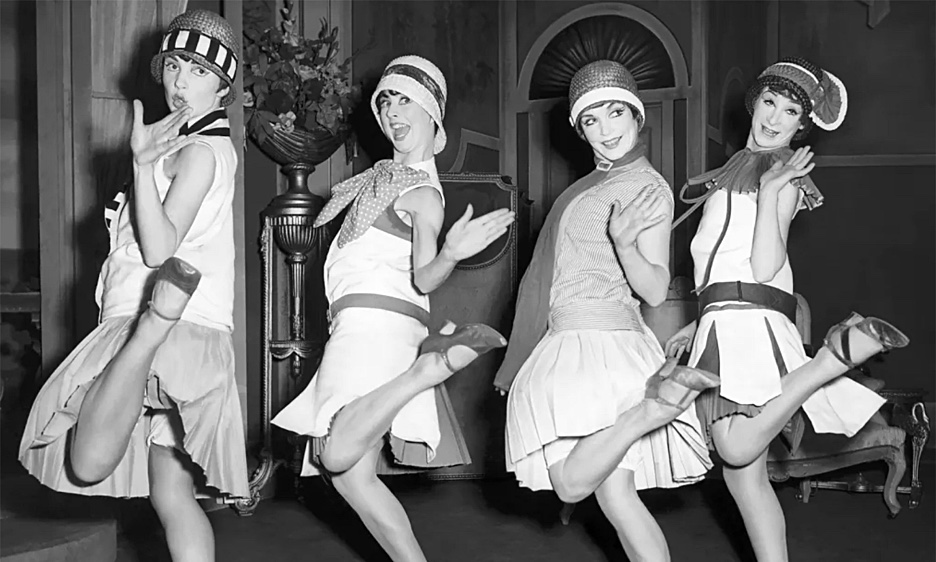

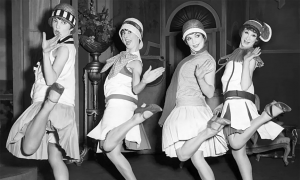
The Prohibition Era, from 1920 to 1933, gave rise to gangster bootleggers like Al Capone running speakeasies. Women got the vote with the 19th Amendment in 1920 and were inspired to rebel against Victorian-era restrictions of dress and behavior. These mostly young women were known as flappers and symbolized the Roaring Twenties with their bobbed hair and short skirts. They smoked, they drank, and they danced wildly to the Charleston.
Harlem became a vibrant community with the influx of nearly 200,000 African Americans moving north to escape the Jim Crow South. Harlem enjoyed a renaissance as writers and artists created works to celebrate their heritage. The development of jazz was part of this movement.
Electricity became more accessible for homes and that meant more radios and eventually record players. The country now had a national culture, and it all occurred to the soundtrack of a new musical form called jazz, the effect of which was so profound that the decade was named the Jazz Age.
Songs told the stories of what was happening, and as this popular song expressed, much of the mood was exuberant and optimistic.
The decade saw the growth of jazz as a music genre based on a swinging rhythm of 4/4 time. The widespread popularity of radio and records introduced jazz to the country, and made stars of jazz artists such as Fats Waller, Ethel Waters, Duke Ellington and Louis Armstrong, all of whom contributed to its inception and establishment as a legitimate art form. Jazz was the soundtrack of the 1920s.
Fats Waller
Waller was a significant figure in the Harlem Renaissance. He'd been born in Harlem and spent his early career playing piano or organ at churches, rent parties, and as the accompaniment for silent movies. He studied under the legendary James P. Johnson and eventually developed his own stride style. He composed the popular standards, "Ain't Misbehavin'" and "Honeysuckle Rose."Ethel Waters
Waters was a popular Broadway star and had her own style of jazz singing. In contrast to the blues of Ma Rainey and Bessie Smith, Waters' style was polished, with her impeccable enunciation and respect for lyrics. Some people consider her the first real jazz singer. She influenced all who followed, from Mahalia Jackson to Frank Sinatra, just to name a few. She was the "mother of us all," said Lena Horne.Waters' talent was so powerful that she broke barrier after barrier, integrating radio, Broadway and movies. And when television became prominent, she also helped to integrate that medium.
Duke Ellington
Ellington was a key figure of the Harlem Renaissance—a master pianist, bandleader and composer. He formed a band as a young man and stayed with it all his life.He is responsible for many compositions, both in song form and longer works. His orchestra was his composing medium with some songs attributed to a band member such as "Caravan," by Juan Tizol and "Take the A Train," by Ellington's long-time composing partner Billy Strayhorn.
Ellington's own works included "Satin Doll," "Mood Indigo," "Sophisticated Lady," "It Don't Mean a Thing If It Ain't Got That Swing," "Do Nothin' Till You Hear From Me," and many more.
In the 1920s, his orchestra played at various New York City jazz clubs such as the Hollywood Club and the Kentucky Club. His most famous venue was the Cotton Club, where his was the house band from 1927 to 1931. He is considered by many as America's greatest composer, although others would name George Gershwin.
And deservedly so. Ella Fitzgerald, who performed at his funeral in 1974, said, "It's so sad. A genius has passed."
Louis Armstrong
Armstrong is probably more responsible for the establishment of jazz as a mainstream musical genre than anyone else.He was born into a poor and unstable family in New Orleans and was "adopted" by a kind and supportive Jewish family for whom he worked. He attended a school for boys, which gave him a cornet to learn. And learn he did, so much so that he became the foremost jazz artist in the country and was enlisted to be America's cultural ambassador to the world.
He was mentored by the great jazz artist, Joe King Oliver, whom he followed as a young man to Chicago, and played in his band. His reputation as a virtuoso trumpet player reached New York and he was hired by Fletcher Henderson. Thus, he arrived in New York, just in time for the Harlem Renaissance. But he soon returned to Chicago and formed his own group, The Hot Five, which became The Hot Seven.
Armstrong's recording of "West End Blues" was influential in developing the jazz genre in that he emphasized solo performance rather than ensemble playing.
Furthermore, he helped to transition from ragtime to swing through his use of 4/4 time, and proved to be a superior vocalist. Though his voice is rough and gravelly, his phrasing and sense of swing are spot on. And he bantered with frequent performing partner, Bing Crosby with great humor. His duet albums with Fitzgerald are widely popular.
In 1964 his recording of "Hello Dolly" topped the Billboard chart ahead of the Beatles. And here he is with one of the popular songs of the 1920s, "Dinah."
Rhapsody in Blue
In 1924 in New York, Gershwin played piano at his "Rhapsody in Blue" concert with Paul Whiteman's Orchestra. It was a four-hour program and Gershwin was last. People got restless, but when they heard the opening clarinet solo, they perked up and when the piece ended, they were on their feet with thunderous applause. They had never heard anything like it, this blend of instrumental blues and jazz solos alternating with classical orchestrations.Whiteman subsequently performed Gershwin's masterpiece 80 times and the recording sold over one million copies. "Rhapsody in Blue" legitimized jazz and the piece took a place in the American canon of great works.
Here is a recording with Leonard Bernstein on piano.
Two Major Innovations in 1927
In 1927 two of the most influential productions occurred. One was the first motion picture with synchronized sound—The Jazz Singer—with Broadway star Al Jolson.People found it to be a sensation, magical. They had been so used to silent movies. The studio had recorded the sound on a separate disk and then played it in sync with the film projection. The results were far from perfect, but in a few years, recording the sound directly onto the film achieved near-perfect synchronization.
Realizing the musical was the best way to show off this new technology as well as color did, studios cranked out musicals as fast as they could, even enlisting their dramatic stars to sing and dance in a movie.
What ensued was the golden age of Hollywood musicals with MGM dominating the field.
Show Boat
Broadway's production of Show Boat was another pioneering effort. It was the first musical to integrate the story with the music; prior to Show Boat, songs were presented in a revue form or in vaudeville collections of different acts. In Show Boat, a story drawn from the best-selling Edna Ferber novel, the songs were part of the story, an innovation that became the standard.Its music was by Kern with lyrics by Oscar Hammerstein II. Partnering with Richard Rodgers, Hammerstein went on to create Oklahoma, The King and I, South Pacific, and others.
The Model T
When he began to manufacture the Model T in 1908, Henry Ford had one goal: to create a reliable but affordable car. He tinkered with the design until he got the one he wanted, reducing the number of parts and cutting the cost of labor. He calculated that it would cost consumers $850, which was the equivalent of $16,000 today.That was too expensive for most people, so he continued experimenting. He finally concluded that if he could make his own parts and assemble cars on a conveyor belt assembly line, he could cut his costs enough to charge $300 per car. He set his mass production line in motion and made 15 million Model Ts by 1927. One third of all the cars in the country were his product, which was nicknamed the Tin Lizzy.
He stopped production of the Model Ts, retooled, and started work on the Model A.
Ford has gone down in history as a manufacturing genius for his assembly line innovation. But his reputation has been tarnished by his antisemitism.
Conclusion
The events of the 1920s seem to be inspired by the quest for personal freedom. Young women shedding the yoke of Victorian Era restrictions, people ignoring the law and going to speakeasies to have a drink or two, African Americans working for freedom to be themselves and a music based on self-expression through improvisation and solos.Even the Model T represents freedom by allowing people a wider choice of where to live and where to go. For example, their Tin Lizzy could take them to a nearby city to hear jazz.
But on the flip side, freedom was also the country's undoing. Allowing people to buy stocks on credit led to bank failures and ultimately the stock market crash of 1929 which ushered in the Great Depression—one of the low points in American history.
In our next article, we will swing into the Swing Era of jazz. The 1930s began with the Great Depression and ended with the beginning of World War II, but in between there was a sense of hope with FDR's New Deal, the golden age of Hollywood musicals and the ever-present joy of jazz. See you then!
Let's end this review of the music of the 1920s with a recording by the Fletcher Henderson Band (see video below). The African American band introduced swing, which was the music of the 1930s big bands, like that of Benny Goodman, known as the "King of Swing."
Tags
Comments

PREVIOUS / NEXT

Support All About Jazz
 All About Jazz has been a pillar of jazz since 1995, championing it as an art form and, more importantly, supporting the musicians who make it. Our enduring commitment has made "AAJ" one of the most culturally important websites of its kind, read by hundreds of thousands of fans, musicians and industry figures every month.