Home » Jazz Articles » Live Review » Melissa Aldana Quartet At The Philharmonie
Melissa Aldana Quartet At The Philharmonie
Courtesy Matty Bannond

The Philharmonie
Cologne, Germany
March 21, 2026
In northwest Germany, the natural order slides out of whack in early Spring. Lazer-blue skies blacken in the flicker of an eyelid. Afternoon strolling requires sunglasses and waterproof footwear. Mosquito bites burn as you scratch frost off the car windscreen. It is a fitful, jumbled-up and unpredictable time. And it is possibly the optimal moment for locals to experience the aloof compositions and amorphous improvisations that characterize Chilean tenor saxophonist Melissa Aldana's work.
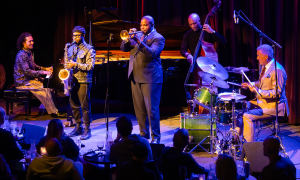
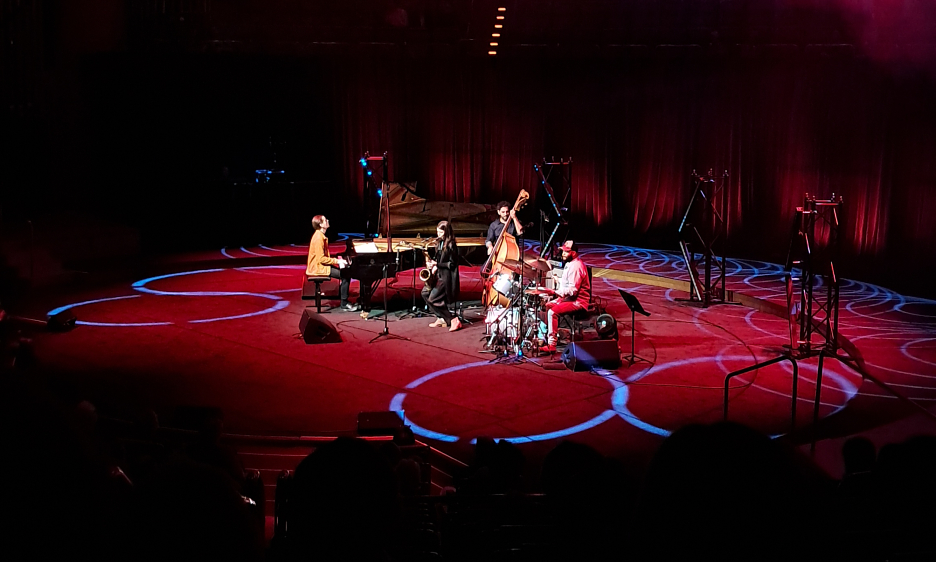
The evening's venue provided a suitably incongruous backdrop. It is a facility intended for classical music, with steep banks of plush-red seats and opulent solid-wood detailing. But jazz artists get invited to grace its spacious stage from time to time. On March 21, Aldana got the nod with her quartet of pianist Pablo Held, bassist Pablo Menares and drummer Kush Abadey. All three players team up with Aldana often and they deftly pushed, pulled and pursued her music together.
Aldana's bandmates kept quiet for the introduction to "Unconscious Whispers." The tune features on Echoes Of The Inner Prophet (2024), which marked her seventh release as leader and her second via the iconic Blue Note label. After a panpipe-ish opening passage, the group coalesced around the heavy-hearted melody. Aldana bent her knees, stretching up for the higher register and crouching for low tones. She also bent the pitch of her long notes. It was a typical example of the saxophonist's style with its unsettled blend of acceleration, hesitation, abandon and restraint.
"Little Church," composed by Brazilian multiinstrumentalist Hermeto Pascoal, appeared in the middle of the set. It also appears on Aldana's recent ballad-driven album, Filin (Blue Note, 2026). It was a free-ranging and loosely constructed piece, where blurry borders separated written material from the band leader's patient soloing. Aldana's improvisations have a conversational quality, with few repeated motifs and lots of empty space. That contrasted with Held's crowded contributions.
The vast stage blushed crimson during the initial bars of "Dime Si Eres Tú," which is also taken from Filin. Abadey employed the brushes here, while Held played an unusually loungey and languid solo. Aldana's saxophone had a strident voice and a foghorn low register on most songs, but the instrument crooned on this number, with fuzzy-edged phrases and yawning vibrato.
A posse of blazer-wearing patrons dribbled out of the auditorium's exits when the band popped backstage before returning for an encore. Quite possibly, these were classical listeners who chose to give Aldana's jazz quartet a whirl but then reversed their decision. That is OK. Volumes and velocities volte-face, rhythms backpedal and melodic patterns change direction in Aldana's work. It is music that refuses to make up its mind, like the early-Spring weather outside the Philharmonie. And like a day that requires sunglasses and waterproof footwear, it generated stirring and miraculous colors.
Tags
Live Review
Melissa Aldana
Matty Bannond
Germany
Cologne
Pablo Held
Pablo Menares
Kush Abadey
Echoes Of The Inner Prophet
Hermeto Pascoal
Comments

About Melissa Aldana
Instrument: Saxophone
Related Articles | Concerts | Albums | Photos | Similar ToPREVIOUS / NEXT

Melissa Aldana Concerts
Support All About Jazz
 All About Jazz has been a pillar of jazz since 1995, championing it as an art form and, more importantly, supporting the musicians who make it. Our enduring commitment has made "AAJ" one of the most culturally important websites of its kind, read by hundreds of thousands of fans, musicians and industry figures every month.