Home » Jazz Articles » Building a Jazz Library » Mal Waldron: His Journey Across 12 Albums
Mal Waldron: His Journey Across 12 Albums
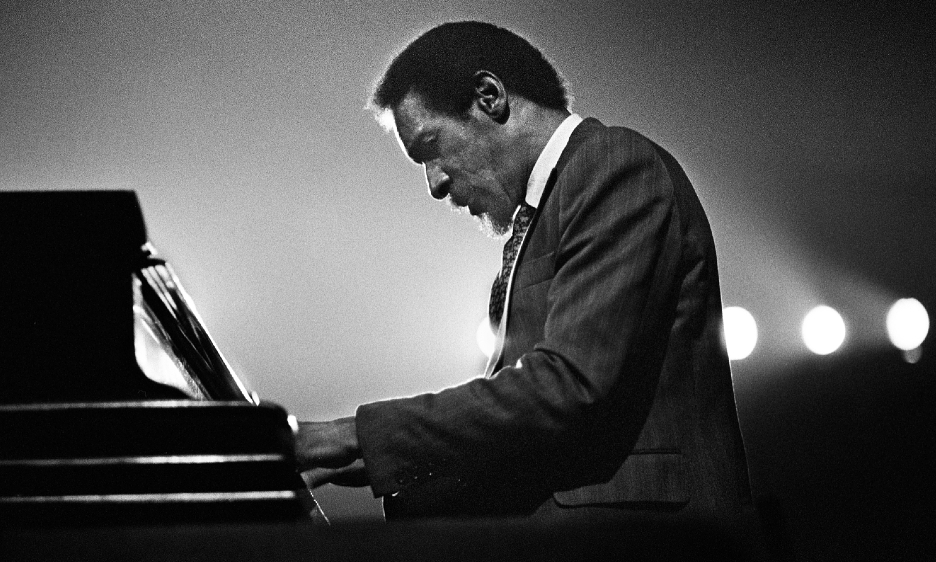
Courtesy Guy Fonck
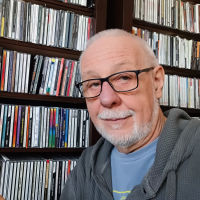
I like to look forward. I don’t like to look back too much. Because I feel if you look back too much, you trip when you take a step forward.
—Mal Waldron
Max Roach once singled him out, along with Thelonious Monk, Herbie Nichols, Hasaan Ibn Ali and Randy Weston, as uniquely original composer-pianists. Matthew Shipp later expanded this pantheon1, adding Cecil Taylor, Andrew Hill, Sun Ra, Horace Tapscott and Ran Blake for forging personal languages and idiosyncratic music from their experiences and imaginations.
Prominent in any discussion of Waldron are the dark vamping, heavy touch and exploratory riffing of his mature music. He wove together several diverse threads, refined by a near-death experience, into that simplified, albeit true, summary.
Classical piano was foundational and occupied his youth well into his teens. In the late 1940s, after his army service, he earned a degree in composition from Queen's College, studying under Karol Rathaus. Brahms, Ravel, Bartók, Berg and Schoenberg were favorites, as was Erik Satie, whose songs he recorded. He enjoyed playing sonatas and engaging the like-minded Randy Weston in friendly waltz competitions.
"Your classical background never left you, your sense of harmony and shading... And form and development, how to develop themes."2
Immersion in bebop defined the 1950s. Seduced by Coleman Hawkins and Charlie Parker in the mid-1940s to briefly pick up the sax, he subsequently returned to the piano bench where Bud Powell exerted a pull, closely followed by Horace Silver and Thelonious Monk. His performances with numerous heavyweights and his prominent work with the Charles Mingus Workshop led Prestige to bring Waldron in as its house pianist. There, he wrote an estimated 400 songs, composing at night and arranging and performing during the day. The decade concluded with Waldron accidentally becoming Billie Holiday's final accompanist, during which time they forged a deep and influential friendship.
As Waldron began a transition into the avant-garde, he suffered an overdose and a related breakdown. The 1963 crisis, understandably, deeply changed him, reducing and sharpening his playing. A permanent move to Europe in 1965 was rejuvenating, removing him from the triggers and racism in the States, in an ironic symmetry with his teacher, Rathaus, who fled Nazisim to New York in 1938.
"When I got to Europe, it was like the other side of the coin. In America if you were black and a musician at that time, it was two strikes against you. And in Europe, if you were black and a musician it was two strikes for you, so I decided to go for that."2
A self-proclaimed introvert, he felt at home behind the keyboard, listening keenly and dialoging empathetically with bandmates and soloists. He pared down and tightly focused his playing, with harder left-hand chords, repetitive notes and phrases and an iterative, rhythmic approach to improvisation, which Waldron himself described as minimalism. Elsewhere, by others, as "ruminative lyricism."
"But I never did recapture what I had before. My playing became more angular and solemn, where before it had been lyrical and fast. I played ballads slower, milking all the chords. That was the beginning of my ... minimalism. That's not so far-fetched, to use that term. Because I was always economical."3
Less frequently discussed is Waldron's love of Japan and its impact on him. He began making annual pilgrimages to the island nation in 1970, learned Japanese as his fourth language, met his second wife there in the early 1980s and performed and recorded dozens of albums, becoming something of a celebrity.
Atzko Kohashi4 suggested several aspects of Japanese culture that help explain the appeal of jazz there: the Zen concept that every moment is unique and ephemeral; the active use of space in art; the journey to master and then extend a discipline; the analogous art of sumi-e—intentional, expressive ink painting. These seem especially applicable to Waldron's music and are likely to have resonated with him in turn, influencing his thinking and playing.
"When you take our life span and measure it against eternity it is only a small dot," he wrote. "In this time we must realize, if possible, our fullest self potential." 5
"They think I'm here for the gigs, but I'm really here for the temples," he once told a friend.
Malcolm Earl Waldron wrote an estimated 2,000 compositions, extending beyond jazz performances to theater, ballet and movie scores. He appeared on at least 266 recordings, 133 of which he led. Of the 77 rated on Allmusic, 42 received a score of 4.0 or 4.5, making the choice of 12 something of a fool's errand. The selections herein feature him as the leader, span all decades of his career and showcase him in various configurations. Hopefully, these will encourage those unfamiliar with Waldron to spend time with this singular, enduring talent, whose unique musical legacy rewards a deep dive.
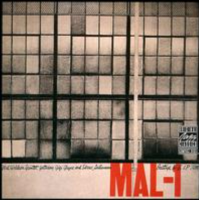 Mal-1
Mal-1Prestige Records
1957
Although Waldron's later work usually receives the most attention, his output in the 1950s was significant. He assiduously aspired to Bud Powell as he transitioned to bebop. After initially struggling to connect with Monk's music, he embraced and absorbed aspects of that language, especially its economy of notes and use of space.
In the 1950s, Waldron wrote and performed extensively with, among others, Teddy Charles, Gene Ammons, Donald Byrd and Jackie McLean. In 1954, Charles Mingus brought him into his Workshop, where he performed on the classic album Pithecanthropus Erectus (Atlantic, 1956). Waldron credits Mingus with pushing him to find his own voice and to employ a more percussive style, even using his elbow.
Prestige hired him in 1956, thanks in part to Jackie McLean, as its house pianist, allowing him to intensively hone his writing and arranging skills. He appeared on approximately 70 recordings by 1960 and wrote an estimated 400 songs, including "Soul Eyes," perhaps his best known, with John Coltrane in mind.
His hard work culminated in Mal-1, his first release under his own name. Joining him were Gigi Gryce (alto sax), Idrees Sulieman (trumpet), Julian Euell (bass) and Arthur Edgehill (drums). Sulieman's bright and brassy horn contrasts crisply with the mellow timbre of Gryce. Waldron's personality is apparent throughout, exemplified by his single-note riffing on the somber, moody version of "Yesterdays.
Benny Golson's "Stablemates" and the breezy "Transfiguration, by Lee Sears, both swing elegantly. Waldron's upbeat composition "Bud Study," not surprisingly, shows Bud Powell's influence. His other contribution, "Dee's Dilemma," swings at a moderate tempo in 4/4 time with delightful shifts in and out of 3/4 waltz time. Adding to the session's variety is Sulieman's bluesy "Shome," all solidly supported by Euell and Edgehill.
Waldron's second album, Mal / 2 (Prestige, 1957), a sextet featuring Coltrane, is also first-rate and equally deserving of the lead-off position on this list. But the less crowded nature of Mal-1 allows Waldron's piano to break through, revealing the roots of his later style.
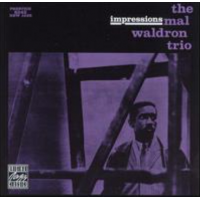 Impressions
 New Jazz
1959
At the age of 34, after a decade of performing and composing, Waldron released Mal / 4 (New Jazz, 1959), his eighth album as a leader and his first leading a trio. He waited, by his own account, to step out front because he felt he needed to develop his piano skills to match his composing and arranging abilities. He cited in the liner notes Billie Holiday's influence on developing his piano voice in the lead-up to this album. From 1957 until her death in 1959, Waldron was Holiday's accompanist, a relationship that had a substantial impact on him and his music.
Although that first trio album was a strong effort, his second, Impressions, a self-acknowledged favorite, exudes greater confidence and personality, with his influences more effectively integrated. Although he acknowledged his debt to Monk, Bud Powell is clearly evident here.
"Overseas Suite" was written after a European tour and consists of three movements, with the opener, "Les Champs Elysées," a likely nod to Bud Powell's "Parisian Thoroughfare." It kicks off with a three-note bass pattern followed by a steady cymbal ostinato. Then Waldron enters, with two chords dueling a single note before unfolding the song's playful theme. Deep, brooding chords launch "C'est Formidable," which quickly lightens up into an upbeat, swinging piece. (Although "C'est Formidable" is the second movement, it is inexplicably sequenced last). "Ciao" completes the suite in energetic, bluesy, fleet-fingered style.
Waldron's wife, Elaine Waldron, contributed "All About Us," a lovely ballad in waltz time deserving of broader coverage. Three standards, an energetic "With A Song In My Heart," a dancing "You Stepped Out of a Dream" and a bluesy "All the Way" complete the album, all thoroughly Waldron interpretations foreshadowing his post 1965 sound, with dynamic contributions from Addison Farmer (bass) and Albert Tootie Heath (drums).
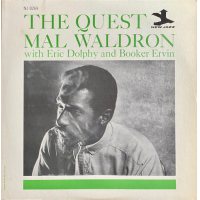 The Quest
Jazz Workshop
1962
By 1961, Waldron was leaning into the avant-garde, bridging his hard-bop work of the 1950s with the rapidly evolving new wave led by Ornette Coleman, Eric Dolphy and Cecil Taylor. The Quest summarizes Waldron's career to this point. His individuality was on full display, his compositional skills well-honed, his arrangements intelligent and his pianistic voice distinct.
The choice of personnel was inspired. The front line was composed of Dolphy and Booker Ervin. A true multi-instrumentalist (proficient on alto sax, flute, clarinet and bass clarinet), Dolphy employed only the alto except for one song on clarinet. The assertive, expressive Texas tenor titan Ervin is also a strong presence, a worthy match with Dolphy on the free-bop cuts. The album was noteworthy for Ron Carter's use of the cello (his first instrument). Joe Benjamin (bass) and Charlie Persip (drums) masterfully rounded out the band.
Waldron performed and recorded extensively with the utterly unique Dolphy throughout 1961, creating several classic albums and numerous memorable performances, including legendary shows at the Five Spot featuring the talented Booker Little on trumpet. Dolphy's presence on The Quest is palpable, but it was not his session, as has sometimes been erroneously claimed. Waldron organized the session and wrote and arranged all the songs.
Waldron, Dolphy and Carter all had serious classical music credentials and, if not for the deprivations of racism, might well have pursued classical or, perhaps, dual careers. For his part, Dolphy was active in the third stream movement as an outlet. That classicism is organically integrated with jazz here. The melodious "Warm Canto" has the feel of a chamber piece, with Dolphy's beautiful clarinet performance (apart from one squeaky misstep), Carter's lyrical pizzicato cello and Waldron's intelligent piano. This session also featured the premiere of Waldron's classic composition "Fire Waltz," a piece Dolphy often performed. Here, it is a bit more waltz than the fire Dolphy usually applied. "Thirteen" is a sly nod to the 12-tone serialism of Arnold Schoenberg, with one repeated note in the underlying tone-row.
Sadly, two years after this recording, Waldron experienced an overdose and emotional schism while working with Abbey Lincoln and Max Roach, both of whom aided him in his recovery. Shortly thereafter, Booker Little died at age 28, followed by Dolphy at age 35 in 1964, leaving us wistfully speculating on what could have been if all had survived.
Waldron's diverse and complex compositions, creative scoring, stellar bandmates and personal piano voice raise The Quest to classic status. Essential.
 Free At Last
ECM Records
1970
The 1960s were understandably lean recording years, as Waldron recovered from his horrific 1963 health crisis. Hospitalized for months, subjected to spinal taps and shock therapy, he emerged shaken and uncoordinated, having to relearn his own music. By 1965, he had sufficiently recovered to enthusiastically accept an offer to write the score for the Marcel Carné film "Three Bedrooms in Manhattan," relocating to Paris and permanently to the continent.
Waldron subsequently wrote the enjoyable score to Sweet Love, Bitter Love (Impulse, 1967), but Free At Last truly marks his reemergence, albeit in a percussive, reductionist style. It is also historic as the inaugural release by ECM Records. Bassist Isla Eckinger and drummer Clarence Becton comprise the Munich-born trio.
One of the reasons that "I feel it necessary to play freer is that I believe no one is ever exactly the same as he was a moment ago. The change from moment to moment can be and usually is very small, almost unmeasurable, but nevertheless it is there. And since I'm definitely not the same person I was five years ago, I cannot pretend that nothing has changed by playing the same old way."5
Free At Last is a bold, bracing declaration from the opening notes. It begins with a dark vamp and a repetitive right-hand, which expands into free-flowing explorations typical of the reborn Waldron. Overall, the songs are percussive and modal, focusing on rhythmic development rather than harmony. The one standard, "Willow Weep For Me," is bluesy, slowly evolving and atmospheric.
How should the title be interpreted? Free to be himself, following a narrow survival? Free from racism in the States? Free of expectations and constraints on his music? Free of comparisons with other artists? Harmonically liberated and rhythmically adventurous? Free to meditate, ruminate and explore? Or all of the above? Ultimately, Free At Last is a declaration of life and our essential need for music.
"A life without music is no life at all. It's like breathing -you have to breathe to live."5
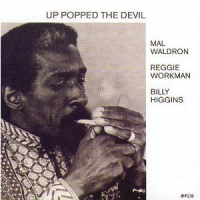 Up Popped The Devil
Philips
1974
The 1970s found Waldron truly resurgent, with a steady stream of outstanding releases that kicked off a thirty-year artistic spree and helped launch the Enja record label. All the Enja recordings are adventurous, avant-garde-leaning creations, some incorporating Manfred Schoof's trumpet flights of fancy alongside Steve Lacy's keening soprano saxophone. Ultimately, the contributions of the legendary Reggie Workman and Billy Higgins landed Up Popped The Devil in this collection. Their musicality, deep listening and dialoguing with Waldron elevated this session.
The title predicts diabolical times ahead. It is a mesmerizing, dark journey with an expansive sense of time beyond the standard 4/4 signature, a facet of Waldron's musicianship that Max Roach was instrumental in encouraging.
"I like to look forward. I don't like to look back too much. Because I feel if you look back too much, you trip when you take a step forward."2
The natures of the four songs, all composed by Waldron, are accurately reflected in their titles. "Up Popped The Devil" is foreboding. "Space Walk," with the addition of Carla Poole's flute, has a free-floating, spatial feel. The premiere of "Snake Out," a Waldron favorite, is based on long, sinuous ascending and descending runs over a resounding left-hand, and the theme of "Changachangachanga" sounds exactly as the name suggests. His hard-bop background, vaunted kinship with Monk, avant-garde leanings, compositional skills, minimalist tendencies, life experiences and his renowned wit are all thoroughly alchemized into these performances.
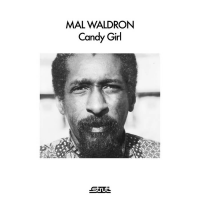 Candy Girl
Strut Records
2025
Choosing funky, electric jams to listen to naturally brings to mind Herbie Hancock's Headhunters, electric Miles Davis, Lonnie Liston Smith or George Duke. But Mal Waldron? Oh yeah. After the two previous heavy avant-garde albums, Candy Girl is quite a change-up. Funky bass grooves, flowing soul-jazz, electric clavinet riffs and driving Afrobeats reveal an unexpected side.
Candy Girl, recorded in 1975, is a collaboration between Waldron and the Lafayette Afro Rock Band, whose members had also relocated from the States to Paris, and whose subsequent work has served as a rich source of samples for hip-hop producers. A collector's holy grail recording, first issued in small numbers on the Calumet label, it was remastered and released in 2025 by Strut Records and, as of this writing, is available on vinyl and as a digital download. The new release contains alternate versions of four of the five original compositions, all by Waldron. Backing Waldron on piano were bassist Lafayette Hudson, drummer Donny Donable and keyboardist Frank Abel on clavinet and Moog.
There has been some debate over the years as to who played what instrument and if Waldron even performed at all, but Francis Gooding clarified in the liner notes "that Able played Rhodes and clavinet and Waldron played electric Wurlitzer piano as well as Rhodes; it was only the second time in his career he had done so: the first was on 1971's The Call."
The repetitive electric bass lines and right-hand jams scream Waldron, but with a brighter, more upbeat, funky sound. "Home Again," "Red Match Box" and "Bits And Things" all have deep grooves, while the title cut is a slower, lyrical piece with shimmering cymbals replacing driving percussion. The distinctly different "Dedication To Brahms" is an electric jazz waltz based on Brahms' "Piano Concerto No. 2."
Candy Girl highlights Waldron's mal-ability, if you will, in working with disparate artists. A controversial inclusion, perhaps, given the wealth of excellent albums from which to choose, but it is also a surprising and exciting excavation from Waldron's archives, in stark contrast to the rest of his discography. Moreover, it is simply pure fun.
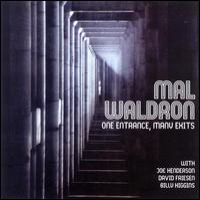 One Entrance, Many Exits
Palo Alto
1983
In 1975, after a decade of recording and performing in Europe and Japan, Waldron began making occasional hops over the pond to the States, in part for "good cornbread or New York-style potato salad," and most importantly to visit family. But he always kept his return ticket at hand. He funded the trips by performing in New York and sometimes beyond, including a 1978 enthralling solo performance in a Philadelphia art gallery and another in Vancouver, Canada (captured as Solo Piano Concert, 1980, Condition West Recordings, 2017).
One Entrance, Many Exits was recorded in Menlo Park, CA, not long after a performance at San Francisco's Keystone Korner. Waldron gathered together Joe Henderson (saxophone), Billy Higgins (drums) and David Friesen (bass) to record a set of five originals plus "How Deep Is The Ocean." All were in excellent form.
Waldron was adept at writing music tailored to individuals. The opener, "Golden Golson," is imbued with the spirit of the great Benny Golson and played by Henderson in an appropriately warmer tone. "Chazz Jazz" is an unaccompanied solo of gratitude for Mingus' substantial influences on his development as both a performer and a composer. Likewise, the free-bop "Herbal Syndrome" was written with Henderson in mind. Waldron's titles often captured the nature of his songs, with "Blues In 4 by 3" a case in point.
"How Deep Is The Ocean" opens with Waldron and Friedman in a languorous, romantic duet, with Henderson adding an upbeat interpretation of the melody. The title cut is a duet with Friesen that would expand afterwards into three excellent full-length recordings together. They clearly got each other, creating a dialog that ebbs and flows, with shifting dynamics and tempos.
The music on One Entrance, Many Exits glances back to hard-bop roots and is a natural fit with Joe Henderson, another saxophone titan with whom Waldron meshed wonderfully.
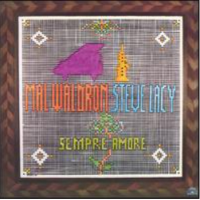 Sempre Amore
 Steve Lacy & Mal Waldron
Soul Note
1987
Waldron and Steve Lacy were a dream team. Over half of this list could easily consist of their shared performances. They first recorded together on Lacy's second album, Reflections: Steve Lacy Plays Thelonious Monk (Original Jazz Classics, 1958), the first-ever all-Monk album recorded by someone other than Monk. It is absent from this list only because it was Lacy's session. Sempre Amore is a superb example of Waldron's and Lacy's mutual deep listening, intertwined playing and exploratory natures and is distinguished by its entirely Duke Ellington-Billy Strayhorn repertoire. Despite admiring their music, Waldron released only one other collection of Ellingtonia, 1959's Sing Or Play The Music Of Duke Ellington (Music Minus One) with Addison Farmer and Ed Shaughnessy.
These interpretations, including, among others, the classics "Johnny Come Lately," "Prelude To A Kiss" and "A Flower Is A Lovesome Thing," are personal, intimate and respectful of the melodies. Lacy's higher-pitched soprano always made a beautiful contrast to Waldron's deep sound. They shared a drive to approach each performance anew, to reel off fresh and surprising ideas. There is a warmth and affection in Waldon's playing here that contrasts nicely with his freer, heavier tone elsewhere. Remaining, however, are the occasional dark chord and solid note, but in service to an overall more gentle lyricism. Lacy's tone is deceptively pure and true on a notoriously unforgiving instrument. The record also highlights Waldron's adept, sympathetic accompaniment of Lacy as soloist.
"Well, music is a language, and as long as you have a large enough vocabulary, you can communicate with anybody else. And if the vocabulary is the same, then you can communicate even better. Steve and I had pretty much the same vocabulary."2
Sempre Amore is included here for its grace, beauty, empathetic playing and distinctive playlist.
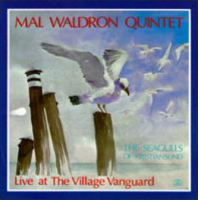 The Seagulls of Kristiansund
 Soul Note
1987
This live Village Vanguard recording documented one of Waldron's most memorable returns to the States. Joining Waldron in the Seventh Avenue basement was an all-star band consisting of Ed Blackwell (drums), Reggie Workman (bass) and, in a rare performance with Waldron, Woody Shaw on trumpet and Charlie Rouse on tenor sax. All are brilliant, stretching out on three Waldron originals. It opens with another creative take on "Snake Out," enhanced by the horns. The second number, "Judy," is an upbeat hard-bop leaning workout. Shaw and Rouse sound great as a team, with classic Waldron sympathetic backing.
True to its name, the title cut is an evocative, easy-flowing modal song that emerged from Waldron's morning meditations on gulls in the Norwegian island city of Kristiansund. While visiting in the early 1970s, he would "watch the seagulls perform a ballet."5 The gorgeous composition takes its time, drifting and floating along much like its namesake avians. Rouse and Shaw sing the tune as a gentle ballad. Blackwell puts on a master class in making music primarily with cymbals. Workman begins the song with an arco drone, switches to pizzicato, and produces an ever-changing series of supportive ideas, including gull-like squawks. Rouse likewise adds bird calls with his mouthpiece. Sixteen minutes into the performance, Waldron takes over the tune for an unhurried rumination. Compared with earlier recordings, especially the original on One-Upmanship (Enja, 1977), this performance is a warmer and more ethereal rendition that one can easily get lost in for 26 dreamy minutes.
For the concert captured on Travellin' in Soul-Time: Live From Tokyo, Nagasaki and Kobuchizawa (Haast Records, 1995), Waldron added these lyrics, sung by Jeanne Lee:
"They're wond'rously free
They live happily.
They know from the past,
a life cannot last,
So they live for today
for tomorrow they may not
Be able to dive from the sky."5
The companion album from that night, Git Go: Live At The Village Vanguard (Soul Note, 1986), contains two additional Waldron compositions, "Status Seeking," originally on The Quest, and "The Git Go." A superb quintet captured in a classic venue.
 The Mighty Warriors
Elemental Music
2024
Waldron was highly respected in Europe, revered in Japan. The occasion of his 70th birthday was celebrated with multiple concerts, including this one in Antwerp, Belgium, on September 30, 1995. A duet performance with his old friend and collaborator Max Roach, Explorations...To the Mth Degree (Slam Productions, 1995), during which everyone sings "Happy Birthday," preceded this concert by 10 days. Further acknowledging his artistry, Belgian TV commissioned the documentary "A Portrait Of Mal Waldron," produced by Tom Van Overberghe, which included interviews and footage of Waldron and his bandmates for this concert (see video below).
Accolades go to Waldron's wife, Hiromi Waldron, and producer Zev Feldman for excavating this live performance by an all-star band of Waldron, Steve Lacy, Reggie Workman and Andrew Cyrille. All four were stellar, melding their individual languages and listening and communicating brilliantly. Buried for years, the recording finally saw the light of day in 2024. The concert consists of three compositions by Waldron, two by Monk and one each by Lacy and Workman. The recording quality, especially live, is exceptionally clear, rich and detailed, with no distractions.
"What It Is," from the 1981 album by the same name, opens the show, and there is no mistaking Waldron, with that heavy, repetitive left-hand chord and right-hand riffing. Two Monk compositions, "Epistrophy" and "Monk's Dream," sandwich Lacy's simple, Monk-ish "Longing." Lacy and Waldron were masters of interpreting Monk, and do not disappoint here.
Workman and Cyrille elevate all the performances, drawing on deep wells of experience, masterful techniques, implied and overt swing and a love for the music. Both perform inventive improvisations, with whispers of themes wafting through, including Cyrille tapping out recognizable patterns and pitches amid his free-flowing solos.
"Variations On III," by Workman, is the most abstract, free piece of the concert, requiring depth and range from each musician. After a droning arco bass introduction, the musicians exchange ideas in shifting combinations and in unaccompanied passages. It is an impressive, albeit at times challenging, group exploration.
The concert concludes with "Medley: Snake Out / Variations On A Theme By Cecil Taylor." The often-performed "Snake Out" serves as both the introduction and the conclusion of an extended foray into "Variations On A Theme By Cecil Taylor," recorded previously only on Update (Soul Note, 1986). Midway is an introspective, memorable Waldron solo. Mighty Warriors captures four masters, fully engaged in a remarkable performance.
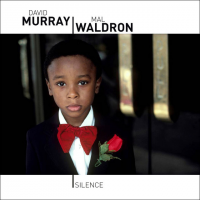 Silence
Justin Time Records
2009
For fans of both David Murray and Mal Waldron, Silence, recorded in 2001, a year before Waldron's death, is essential. Waldron was perpetually open to new collaborations and explorations. So the exuberant Murray and the introspective Waldron seamlessly united, matching wits and ideas, on this superlative late-career duet.
"I think sparks fly with David Murray and I, because he's adventurous, he likes to take risks, and I'm adventurous, I like to take risks—so we go up on that point together." 2
The program includes three classic compositions by Waldron, including what is perhaps his best-known song, "Soul Eyes," written for John Coltrane. "Free For C.T." and "Hurray For Herbie" are also included. Murray contributed the adventurous title cut, with three standards rounding out the album.
Murray brings all his skills to the meeting. Free-ranging avant-garde explorations, flights of circular breathing, post-bop excursions, blues and Webster-esque balladry are all here. In a poetic symmetry, like Eric Dolphy, Murray is also proficient on bass clarinet, used to great effect on "Free For C.T." and "Soul Eyes." Waldron responds with ideas aplenty, rising to the challenge of dancing with the firebrand as they listen and respond, give and take, first note to last.
Waldron kicks off "Free For C.T." at a moderate tempo with a classical-leaning prelude. Murray takes the melodic lead on bass clarinet and explores the theme through his repertoire of intonations, vocalizations and timbres, underpinned by Waldron's harmonic and rhythmic explorations. "Silence" pulls Waldron into Murray's free jazz orbit, where the dialoguing is rich. "Hurray For Herbie" dates back to 1974 and is a classic example of Waldron's minimalist approach to developing a theme, with Murray's tenor a perfect foil.
"I Should Care" is taken at an unhurried, romantic pace for over 12 minutes, with Waldon creatively supporting Murray's expressive tenor. Both are ingenious and totally in synch, endlessly and patiently unspooling fresh ideas. Miles Davis' "Jean-Pierre" is playful, and "All Too Soon" by Ellington is tender. The album concludes with "Soul Eyes," lovingly and, well, soulfully sung by Murray on bass clarinet. They sustain the performance without lagging for 14 lyrical minutes. Silence is an inspired meeting of two unique talents.
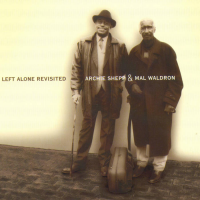 Left Alone Revisited
Archie Shepp
Soul Note
2002
Waldron paid homage to Billie Holiday many times during his career, but cites this recording as his favorite. They became very close during their two years performing together around the world, from 1957 until her death in 1959. He came to think of her as the big sister he never had. Waldron can be heard backing Holiday at the 1957 Newport Jazz Festival, Ella Fitzgerald & Billie Holiday at Newport (PolyGram, 1958) and for her last concert recording at the 1958 Monterey Jazz Festival, Billie Holiday at Monterey (Black Hawk Records, 1958).
The already attuned and sensitive Waldron refined his playing with Holiday's guidance. Per Waldron's daughter, Mala Waldron (an artist in her own right and to whom Holiday was godmother):
"My dad was always a great accompanist who loved working with singers and knew how to listen. And Billie loved that. She taught him to pay attention to the lyrics, how to approach them when you're playing the song, and be more [present] in what's happening with a song on a given day. Not just chords or melodies, but the actual story." 4
Archie Shepp, a Holiday devotee, delivered a heartfelt performance, his bluesy, rough-hewn timbre on tenor and warmer sound on soprano expressively counterbalancing Waldron's emotive, pure sound. All of the songs are associated with Holiday, except "Blues For 52nd Street," written by Shepp.
The song "Left Alone" was written with, not just for, Billie Holiday. They wrote it together on a transcontinental (prop) flight, with him creating the melody and her the lyrics, touching down in California with a classic. It is performed twice here, first as an instrumental duet and then, poignantly, as the final cut on Mal Waldron's final album in 2002, in which he recites the lyrics she penned on their flight together.
References
1. Shipp, Matthew. "Black Mystery School Pianists" New Music USA. Dec 18, 2020.2. Panken, Ted. Two Interviews With Mal Waldron Transcript of WKCR radio interview. August 15, 2011.
3. Whitehead, Kevin. Mal Waldron: My Minimalism Originally published in the Dutch daily de Volkskrant. 1997.
4. Kohashi, Atzko. Why Is Japan a Jazz Paradise—or—Why the Japanese Feel at Home in Jazz? All About Jazz. July 26, 2025.
5. Shatz, Adam. Mal Waldron's Ecstatic Minimalism The Nation. August 14-21, 2017.
Tags
Building a Jazz Library
Mal Waldron
Carl Medsker
Max Roach
Thelonious Monk
Herbie Nichols
Hasaan Ibn Ali
Randy Weston
Matthew Shipp
Cecil Taylor
Andrew Hill
Sun Ra
Horace Tapscott
Ran Blake
Coleman Hawkins
Charlie Parker
Bud Powell
Horace Silver
Charles Mingus
Billie Holiday
Why Is Japan a Jazz Paradise—or—Why the Japanese Feel at Home in Jazz?
Mal-1
Teddy Charles
Gene Ammons
Donald Byrd
Jackie McLean
John Coltrane
Gigi Gryce
Idrees Sulieman
Julian Euell
Arthur Edgehill
benny golson
Impressions
Addison Farmer
Albert Tootie Heath
The Quest
Ornette Coleman
Eric Dolphy
Booker Ervin
Ron Carter
Joe Benjamin
Charlie Persip
Booker Little
Abbey Lincoln
free at last
Isla Eckinger
Clarence Becton
Up Popped The Devil
Manfred Schoof
Steve Lacy
Reggie Workman
Billy Higgins
Candy Girl
Herbie Hancock
Miles Davis
Lonnie Liston Smith
George Duke
Lafayette Hudson
Donny Donable
Frank Abel
One Entrance, Many Exits
Joe Henderson
David Friesen
Sempre Amore
duke ellington
Billy Strayhorn
Ed Shaughnessy
The Seagulls Of Kristiansund
Ed Blackwell
Woody Shaw
Charlie Rouse
Jeanne Lee
The Mighty Warriors
Andrew Cyrille
Silence
David Murray
Left Alone Revisited
Ella Fitzgerald
Mala Waldron
archie shepp
Comments
PREVIOUS / NEXT
Support All About Jazz
 All About Jazz has been a pillar of jazz since 1995, championing it as an art form and, more importantly, supporting the musicians who make it. Our enduring commitment has made "AAJ" one of the most culturally important websites of its kind, read by hundreds of thousands of fans, musicians and industry figures every month.