Home » Jazz Articles » Live Review » Joanna Wang's Hotel La Rut at (Le) Poisson Rouge
Joanna Wang's Hotel La Rut at (Le) Poisson Rouge
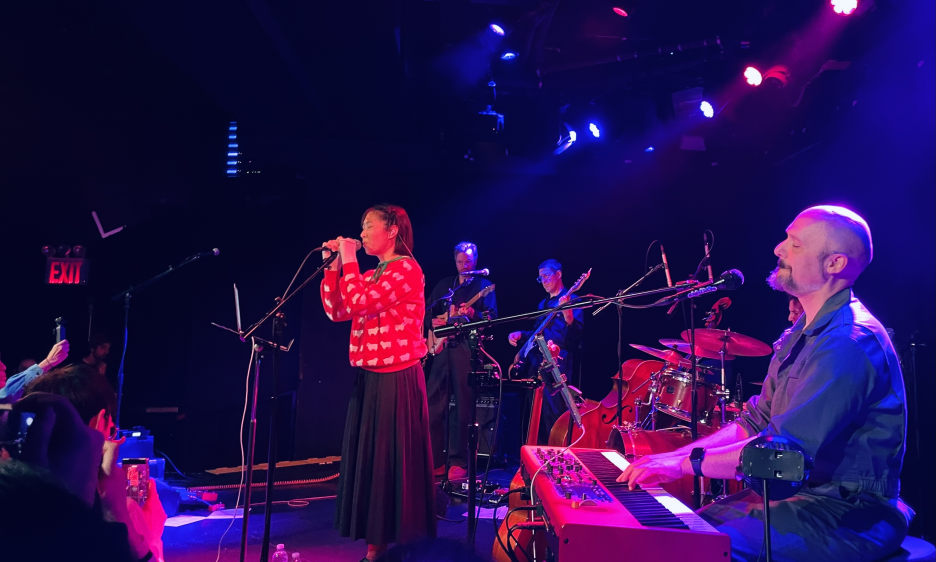
Courtesy Tamara Yadao

(Le) Poisson Rouge
New York, NY
March 20, 2026
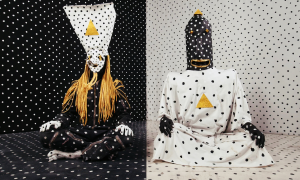
Hotel La Rut was the cohesive centerpiece of the first set from Joanna Wang and the Hotel La Rut Band at Le Poisson Rouge in NYC's West Village on March 20. This hyper referential, eclectic, genre defying concept album—Wang is no stranger to worldbuilding—folds together rock styles, punk, art pop, jazz pop, '60s folk, swing, and more. Its dense architecture of sound mirrored the packed intensity of LPR's sold-out room on a Friday night.
Viewed through the jazz lens of a two-set evening, the structure became a lively, cartooned, character-driven array of 23 ostensible rooms, each rendered by Wang and her band in one-or-two minute songs that underscored Hotel La Rut's dearth of space. Wang's songs sketch various characters—sometimes as quick doodles, sometimes as fully rendered portraits with real wit. These restless vignettes seemed to portray the residents, or perhaps the past occupants, of rooms at Hotel La Rut. This conceptual approach—rendering each cramped room and its occupant as a brief vignette—reiterated itself in her stage presentation, with Wang announcing each wildly imaginative yet deliberately outlandish song title before beginning. And even though the album's staged presentation came with a self-conscious "Get it? Get it?" attitude as she and the band performed it in full, Wang's songwriting and the band's playing proved far more compelling than her theatrical conceit.
The Hotel La Rut Band dove headfirst into Wang's arrangements, whose jazz-rooted harmonic language shaped much of the ensemble's performance. The keyboardist was a particular standout: his virtuosic playing fused modal jazz improvisation with synthetic textures, opening unexpected pockets of space defined by an electronic sheen that invoked '60s sci-fi B movies.
Their performance echoed the nonlinear, genre-collaging, jump-cut song forms of The Fiery Furnaces and the playful, Tin Pan Alley—tinged absurdism of They Might Be Giants. There were also flickers of Sparks' conceptual pop playfulness, not in the sense of the Mael brothers' elaborate constructions, but as part of the eclectic art pop atmosphere Wang grew up in—alongside the influence of her father.
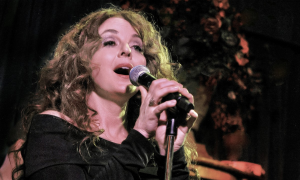
Born in Taipei, the daughter of renowned Taiwanese Mandopop producer Bing Wang but raised in LA, Joanna grew up listening to a diverse musical world. Her bi-cultural upbringing surely encouraged her engagement with jazz further clarifying an eclectic style—a lineage that revealed itself in the dulcet, refined tones of her voice during the second set. Her vibrato was so sumptuous it seemed to draw out the very souls of her listeners as she lulled the room into a sensual stupor.
One of the evening's most affecting moments came in her interpretation of Don McLean's 1971 folk ballad "Vincent," performed in intimate tandem with her guitarist. As Wang sang—warm, unhurried, emotionally unguarded—the guitarist responded with sculpted swells through his volume pedal. Their two voices, one human and one electric, moved in interweaving lines: hers expressing the ache of the misunderstood artist, his rising and falling like a small pendulum clock marking the long wait for recognition—a quiet irony, given that she was singing it to a sold-out room of 700 on both nights.
The second highlight featured a jazz-lounge rendering of "Qin Mi Ai Ren" (親密愛人), a Cantopop torch ballad by '90s Hong Kong singer Anita Mui. Lending itself well to jazz phrasing, Wang's interpretation touched upon her heritage through a possible childhood dream of engaging an audience like Mui. The moment carried a tender warmth, as if she were honoring both a musical ancestor and a younger version of herself.
The final highlight—and arguably the most striking—was a fresh experiment delivered without a hint of conceit: setting the melody of Burt Bacharach's "I'll Never Fall in Love Again" against the iconic harmonic progression of John Coltrane's "Giant Steps." The pairing was surprising, even a little audacious in a vocal setting, yet wholly successful, evoking the conceptual language of jazz improvisation through playful recombination. That playfulness emerged most clearly in the way Wang's rhythmic phrasing intertwined with the keyboardist's rendering of Coltrane's changes, her delivery tightening as she navigated the quick-cycling harmony. His firm, rhythmically charged foundation allowed Wang to explore the nuanced contours of Dionne Warwick's phrasing, recalling her clarity while gaining a new edge shaped by the harmonic undercurrent supporting the tense yet fluid overlay of the two lines.
Tags
Live Review
Joanna Wang
Tamara Yadao
United States
New York
New York City
Le Poisson Rouge
Sparks
Don McLean
Burt Bacharach
John Coltrane
Dionne Warwick
Comments

About Joanna Wang
Instrument: Composer / conductor
Related Articles | Concerts | Albums | Photos | Similar ToPREVIOUS / NEXT

Support All About Jazz
 All About Jazz has been a pillar of jazz since 1995, championing it as an art form and, more importantly, supporting the musicians who make it. Our enduring commitment has made "AAJ" one of the most culturally important websites of its kind, read by hundreds of thousands of fans, musicians and industry figures every month.