Home » Jazz Articles » Interview » Dida Pelled: Sultry Swing, Blissful Blues
Dida Pelled: Sultry Swing, Blissful Blues
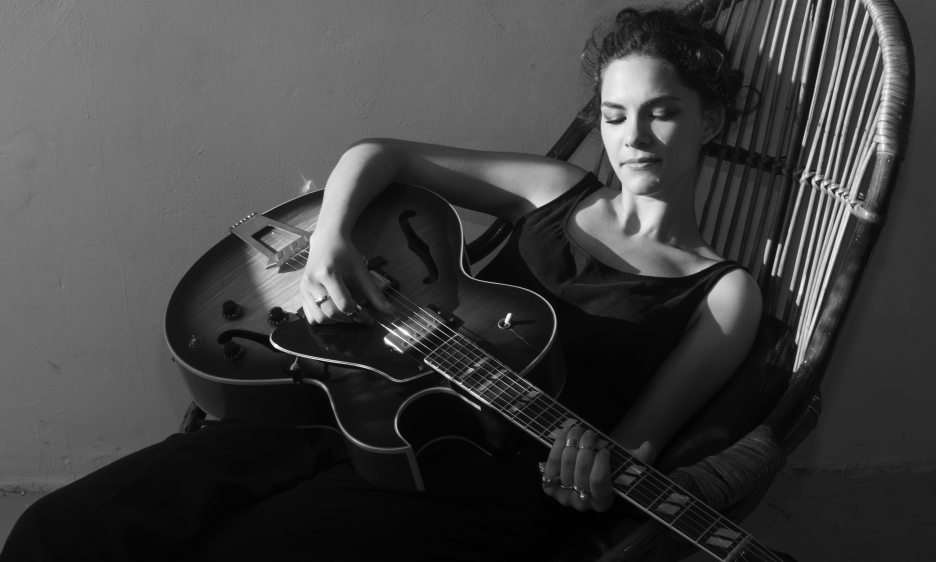
Jazz and blues is my bread and butter. That's where I'm coming from.
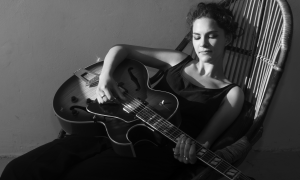
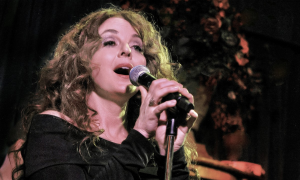
An artist with her own compelling style exists in Brooklyn in the person of Dida Pelled, a guitarist, songwriter, and educator whose breezy but sophisticated playing and singing began enrapturing fans in the Big Apple and continues to capture devotees all over the world.
Her fifth and newest recording, I Wish You Would (La Reserve Records), is a collection that comes mostly from her blues roots but doesn't abandon her innate jazz trappings. Like everything she does, in a studio or live, it's captivating. Her compelling voice and clever phrasing owe more to Billie Holiday or Shirley Horn than, say, Sarah Vaughan or Betty Carter. There are no vocal gymnastics.
On guitar, the lines are smooth, precise, and ethereal. Her expression is more about storytelling, with emotional twists and turns that spin off engaging discoveries. Again, no pyrotechnics like Joe Pass or John McLaughlin. The package that is Dida is expressive in a softer way, but no less effective. It's a summer day with a breeze, not the heat that brings along thunderstorms.
"Jazz and blues are my bread and butter. That's where I'm coming from," she says. In high school, in Tel Aviv, where she is from, "I obsessed over bebop, and I was always on the bluesy side. But I'm coming from jazz and blues. Also, when I was a teenager, and until today, I love songs ... There's a lot of great songs. There's an indie rock, folky element to my music."
She says among her favorite singers are Holiday, Nina Simone, Frank Sinatra, Nat King Cole, and Dinah Washington. "I don't sing like her," says Pelled of the latter, "but I love her vibe and repertoire. In spirit, I do think about her with all the blues. And Shirley Horn, for sure."
As for the blues, she admires many of the classic artists but doesn't want her voice to emulate them. Rather, it is "the spirit of the recordings and the songs" that grabs her, "like Lou Reed and the way he will sing a song. Or Bob Dylan. So to me, all of these are my influences, because it's basically people that tell a story more than sing. That's why I feel like I love the jazz singers, and they're amazing for what they do, but it's not really something that I have in my voice. I don't like to sing like that. I sing more like a storyteller. I love songs."
Pelled was heavily into music in her native Tel Aviv, and that's where her jazz roots started. When she moved to New York at age 20, she became more engaged with it. She also began to feel things beyond jazz were worth exploring and perhaps incorporating into her style. "I found these amazing musicians that were jazz musicians, but they were playing other things. They were playing at the Living Room (a New York City club) a lot. It used to be in the East Village. It's like the jazz dropout scene. It's like jazz musicians that play folky stuff. For example, the musicians on my record, (bassist) Tony Scherr and (drummer) Kenny Wollesen, are musicians that play with Bill Frisell and Norah Jones."
"I started listening to what they were doing at shows, and I loved it so much. It kind of changed what I wanted to do. I wanted to start playing bluesy, folky jazz ... more songy, funky stuff. The blues and all that. It's kind of where everything I feel meets."
The new recording also features the renowned Sullivan Fortner on piano.
The music expresses different feelings and goes in different melodic directions. The chestnut "Hesitation Blues" owes more to Morton than Hot Tuna and Jorma Kaukonen. Her blues singing owes more to Lady Day than Koko Taylor. "Dimples" swings gently behind a compelling blues lyric. Her guitar floats in, dances, even teases. Its elements in total make it memorable. Fortner's piano is also sparse but grabs onto and enhances the vibe. "Since I Fell for You," covered by all kinds of singers including Bonnie Raitt, is an exhibit of Dida's personal stamp: thoughtful and heartfelt. As singer and guitarist, she squeezes the right amount of pathos out of "Blues in the Night" without being a blues shouter.
She says her bandmates knew the tunes and there was little preparation in order to bring on a fresh creativity. "Me and Kenny and Tony had played together already. I wrote some notes for them to look at, but they didn't need a rehearsal. Sullivan wouldn't need a rehearsal. It's hard to find a song that he wouldn't know. There's nothing he can play badly. I don't know that I can ever make an album without him as the pianist now; he's so good. We didn't want to have the magic wasted on a rehearsal."
"One day before the recording, Sullivan and I met together for an hour to go over the tunes. But we wanted the first time that we were playing together to be recorded. And I'm very happy with how that turned out. Some of the songs on the record, the first take is the one that we chose."
That approach is not uncommon in jazz. Some of the best recordings over the decades have used that approach as part of the blueprint.
As a teenager learning guitar, jazz was not on Dida's radar. A teacher got her playing tunes like "Take Five." But when she went to Thelma Yellin, an arts high school, she encountered a teacher, Amit Golan, who made a difference. "He was amazing, not just by what he taught us to play, but also he made us love this music. I remember I didn't know anything about jazz. And three months in, I was obsessed with Grant Green, Thelonious Monk, Wes Montgomery, Kenny Burrell. Every time my dad would go abroad, I would ask him to bring me albums of Peter Bernstein. That's when I started being obsessed with that. And that's what made me learn this music."
At the time, she considered drums as a possibility but stayed with guitar. As she got a bit older, she "secretly wanted to sing," she says. "I was very shy about it. It was like a secret."
She started taking vocal lessons surreptitiously for about two years. "I didn't tell anyone ... I was already playing gigs, like at cafes and clubs, and I couldn't tell my friends that I was playing with all the time, 'Listen, I'm going to sing the next song,' or 'I want to sing.' I could not tell people that this is my passion."
Upon moving to New York, she attended the New School pursuing a music degree and landed a Sunday gig at a wine bar in the West Village. It was a duo gig with a bassist, and there she unveiled her new passion. "I told them, 'I'm Dida. I play guitar and sing.' And that's it. You're more open when you're not around people that know you for so many years and expect something from you. I felt freer to just do whatever. I started singing ... I didn't have a huge repertoire. I played mostly instrumental and had a song here and there that I sang. Because it was really my biggest passion, I quickly started singing more and more."
Around that time, at a friend's house, they played Blossom Dearie. "And I was shocked," she says with glee. "I thought it's the coolest thing I've ever heard. So I learned a lot from the tunes that she was doing. I was very inspired by her, and sadly, sounded a little too similar to her in the very beginning. But I think now it's just an influence. That was the beginning of singing. I'm influenced by a lot of other singers as well."
A significant event in advancing her career occurred when she was a freshman at the New School. At her weekly wine bar gig, she met Italian trumpeter Fabio Morgera. He took her up on an invitation to sit in. After a few weeks, Morgera mentioned he had a connection at the Italian jazz label Red Records. He wanted her to record. She recalls, "He said to me that night, 'I think you're going to go in many directions, but you should do a straight-ahead jazz record now, because you sound so good doing it, and you should capture that.'"
She was focused on performances and hadn't yet considered a recording. But she went ahead, the result being Plays And Sings (Red Records, 2011). As that was moving forward, she sat in with Roy Hargrove at the Jazz Gallery and had the nerve to ask if he would be a guest on her project. He ended up playing on three tracks. Trumpeter/producer Morgera played on two, and drummer Gregory Hutchinson played the session as well.
"I was very lucky. That kind of opened a lot of doors in the jazz world for me."
The album received good reviews. It helped get jobs at festivals in Europe. "When one door opens, more open. So that was the big thing," she says. "And I was just 21 at the New School. I didn't even think about being a bandleader. I learned a lot from that, and it changed my perspective, a lot of what I want to do. And then I wanted to do songs, and then I was starting to work on the album Modern Love Songs (self-produced, 2015). That was when I was really wanting to make something that is more songwriting and folky," she says. The song "Jack Nice" made some noise on the scene. "That song and video really did well. That even made me tour more in Europe and also in the States. And in Russia and Ukraine, like crazy stuff."
A Missing Shade of Blue (Red Records, 2016) is mostly instrumental, basically an organ trio record with Luke Carlos O'Reilly on keyboards.
Love Of The Tiger (Self Produced, 2022) took a bit of a different direction. The songs are all original, delivered in the same heartfelt manner, less jazzy and more indie, with hip-hop elements in places, yet impressive.
Love of the Tiger "took years to make. The writing of the songs took time, and figuring out how to record it took me through a lot of versions. I was spending years just getting that band sound right and then the right songs. That opened my world to a different kind of scene, like the musicians from more indie world," she says.
"I think the community you're in really influences what you're making and how you're making it. So I feel like, even if now I'm back to a jazzier thing, I do it kind of in a different way, in a different perspective, not totally an insider in jazz. Even though I also am one. But I have something else from the indie rock or pop world, if that makes any sense."
She adds, "That's why I'm so happy with the musicians on this record. Because when I first met them and the community around them, I totally shifted what I think and what I want to play. So I think I'm very lucky to come back to jazz with this new approach. And then have Tony play on it and Kenny, because they really make it sound good. And of course, Sullivan."
Pelled is very interested in the visual aspects. Videos are important to her, as well as album covers, and she takes an active role in how those come out. "It is another goal of mine, to release albums and also have a strong, cohesive vision visually around them. I find it satisfying."
Another aspect she enjoys is radio, hosting The Dida Show on Radio Free Brooklyn, an independent freeform radio platform broadcasting from that New York City borough. On it, she does hour-long interviews with musicians. The shows are relaxed, open-ended conversations and include playing songs. "It's more like an open conversation than a full-on interview. Depends on the guest a little. It's been really fun."
Pelled loves New York City, and as she grows as a musician, "I want to keep making albums, and I want to tour a lot, maybe more than I do now. I do love my life and that I do a lot of different things."
"I would love to have the records reach as many people as they can. And I think by touring and bringing this music to different cities and audiences, it's the best way to make it work. I want to keep making different albums."
There are other albums in the works, at least two nearly ready for release, she says.
"I want to keep making beautiful albums and writing good songs, and hopefully it will get to a lot of people. My goal is to get better at music. It's a lot of work even to maintain what you have. I have to have time to keep working on the music, because that's the most important thing."
Tags
Interview
Dida Pelled
R.J. DeLuke
Fully Altered Media
Billie Holiday
Shirley Horn
Sarah Vaughan
Betty Carter
Joe Pass
john mclaughlin
Nina Simone
Nat King Cole
Dinah Washington
Kenny Wollesen,
Bill Frisell
Sullivan Fortner
Grant Green
Thelonious Monk
Wes Montgomery
Kenny Burrell
Peter Bernstein
Blossom Dearie
Fabio Morgera
Plays And Sings
Roy Hargrove
Gregory Hutchinson
A Missing Shade of Blue
Love Of The Tiger
Tony Scherr
Norah Jones
frank sinatra
Comments

PREVIOUS / NEXT
Support All About Jazz
 All About Jazz has been a pillar of jazz since 1995, championing it as an art form and, more importantly, supporting the musicians who make it. Our enduring commitment has made "AAJ" one of the most culturally important websites of its kind, read by hundreds of thousands of fans, musicians and industry figures every month.