Home » Jazz Articles » Album Review » Duke Ellington, Brian Wilson and Friends: Shimmering Pro...
Duke Ellington, Brian Wilson and Friends: Shimmering Prologue: The Lost Sandbox Sessions
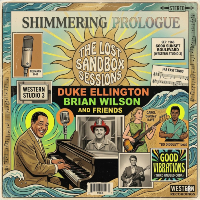
Mired in an un-stately creative slump, Duke Ellington finds himself being ushered into 6000 Sunset Boulevard (Western Studio 3 for all you folklorists out there) where Beach Boy Brian Wilson (a man who believed his every whim was a twenty-four track master) is going all fan boy with a helmet on his head.
"Thank you, my boy, thank you. "Caroline, No" is a beauty to be proud of." Duke fan boys back.
The air is palpable with praise. Duke takes a seat behind the piano. The ten-piece orchestra subtly tunes. Bassist Carol Kaye burbles. Hal Blaine, his sticks always at the ready, uncorks a steady "Bo Diddley." Glen Campbell's guitar sways like an island breeze with a vodka sting. "Far East Tango" is born.
Ellington's smile ignites the room. "Yeah, that almost came too easy," we hear Blaine enthuse on "Random Chatter (pastiche 1)."
"Oh man! That was beautiful, everybody!" Wilson calls from the control room. His zest is infectious.
"What have you got on tape?" Duke answers back. Even at the tail end of the song's recording sessions, Brian still has questions about the finished structure of "Good Vibrations." He eagerly directs tape op Chuck Britz to play the reel.
Kaye mimics her imitable bass line. Duke, in town a couple weeks early to prep for the orchestra's Greek Theatre gigs in late September, hears a melodic fragment and begins to guide the chamber players through a call and response that Campbell slashes Chuck Berry-like up against.
"Whoa! Do that again and keep doing it! Let us get it down on tape!" the young maestro insists to his elder.
"What if I want to use it for something I have in mind?" Ellington playfully inquires. "Man, you can have it just let me use it!" Wilson returns.
They run the tape again. Ellington conducts a sweeping cinema. Keyboardist Leon Russellsupplies the Delta gospel. The listener can only imagine the look on Wilson's face: blissed, blitzed, and blessed. Blaine shuffles bluesy. Campbell kicks back.
Wilson didn't use the nine miraculous minutes of "Good Vibes (Third Unused Coda)" on the finished single, released not long after this session, on the tenth of October. We can only imagine where we might be today (perhaps free of demented authoritarian impulses) and singing a different tune if he had. Coincidentally, it would be December in New York when Ellington, along with Billy Strayhorn, Johnny Hodges, and Paul Gonsalves, recorded Far East Suite (Bluebird/RCA, 1967).
"Billy's Stray Harp Blues (F# major/minor to B major)" starts as a jam, but Russell quickly reins it in, tightens the beat, and shouts for a Duke solo. Ellington then calls upon his admiration for the irascible joie de vivre of fellow pianist Oscar Peterson—striding and swinging, singing to the stars—and this track could be the highlight of the whole Shimmering Prologue: The Lost Sandbox Sessions if it didn't face such stiff competition from the previously highlighted titles and the ones still to manifest.
"Satin Doll/Cotton Tail Medley" then manifests. How and why nobody knows. Maybe the spirits of Bud Powell, George Gershwin, and Buddy Holly were smiling down on Western Studio 3 that special day. It would certainly appear so, especially for Powell, who rocks the house through Ellington on the barreling "Caravan." "Caroline Changed Her Mind" finds Wilson behind the mic, melancholy, singing "How could she do this to me?" as Duke and Kaye lean into a lush pop duet.
Still standing behind the Neumann U 47, Wilson begins a child-like, acid-infused chant that quickly evolves into "Come and Sing This Song with Us." Blaine hosts a loose martial beat that Kaye and Russell swerve into. Duke mimics Wilson's play with the violins in the lead. It is a heady four-plus minutes that serves as a casual intro to the mystical "Far East Expressions." An improvised mix of musique concrete, Wilson's doo-wop chorality, and Ellington's love of harmonic overtones, "Far East Expressions" closes Shimmering Prologue: The Lost Sandbox Sessions with a feral tone poem for the ages.
Track Listing
Far East Tango; Random Chatter (pastiche 1); Good Vibes (Third Unused Coda); Billy’s Stray Harp Blues (F# major/minor to B major); Random Chatter (pastiche 2); Satin Doll/Cotton Tail Medley; Smile 7; Caravan; Caroline Changed Her Mind; Come and Sing This Song with Us; Random Chatter (final pastiche); Far East Expressions.
Personnel
Brian Wilson
vocals
Duke Ellington
piano
Hal Blaine
drums
Carol Kaye
bass, electric
Glen Campbell
guitar
Leon Russell
pianoAdditional Instrumentation
Brian Wilson: piano, organ.
Album information
Title: Shimmering Prologue: The Lost Sandbox Sessions | Year Released: 2026 | Record Label: April First Records

Tags
Album Review
Mike Jurkovic
Shimmering Prologue: The Lost Sandbox Sessions
April First Records
Brian Wilson
duke ellington
Carol Kaye
Hal Blaine
Glen Campbell
Chuck Berry
Leon Russell
Billy Strayhorn
Johnny Hodges
Paul Gonsalves
oscar peterson
Bud Powell
George Gershwin
Buddy Holly
PREVIOUS / NEXT


Support All About Jazz
 All About Jazz has been a pillar of jazz since 1995, championing it as an art form and, more importantly, supporting the musicians who make it. Our enduring commitment has made "AAJ" one of the most culturally important websites of its kind, read by hundreds of thousands of fans, musicians and industry figures every month.