Home » Jazz Musicians » Ahmad Jamal
Ahmad Jamal

In 1951, Mr. Jamal first recorded 'Ahmad's Blues' on Okeh Records. His arrangement of the folk tune 'Billy Boy', and 'Poinciana' (not his original composition), also stem from this period. In 1955, he recorded his first Argo (Chess) Records album that included 'New Rhumba', 'Excerpts From The Blues', 'Medley' (actually 'I Don't Want To Be Kissed'), and 'It Ain't Necessarily So' —all later utilized by Miles Davis and Gil Evans on the albums "Miles Ahead" and "Porgy and Bess." In his autobiography, Mr. Davis praises Mr. Jamal's special artistic qualities and cites his influence. In fact, the mid-to-late 1950's Miles Davis Quintet recordings notably feature material previously recorded by Mr. Jamal: 'Squeeze Me', 'It Could Happen To You', 'But Not For Me', 'Surrey With The Fringe On Top', 'Ahmad's Blues', 'On Green Dolphin Street' and 'Billy Boy'.
In 1956, Mr. Jamal, who had already been joined by bassist Israel Crosby in 1955, replaced guitarist Ray Crawford with a drummer. Working as the "house trio" at Chicago's Pershing Hotel drummer Vernell Fournier joined this trio in 1958 and Mr. Jamal made a live album for Argo Records entitled "But Not For Me". The resulting hit single and album, that also included 'Poinciana' — his rendition could be considered his "signature". This album remained on the Ten Best-selling charts for 108 weeks — unprecedented then for a jazz album. This financial success enabled Mr. Jamal to realize a dream, and he opened a restaurant/club, The Alhambra, in Chicago. Here the Trio was able to perform while limiting their touring schedule and Mr. Jamal was able to do record production and community work.
Mr. Jamal was born on July 2, 1930, in Pittsburgh, Pennsylvania. A child prodigy who began to play the piano at the age of 3, he began formal studies at age 7. While in high school, he completed the equivalent of college master classes under the noted African-American concert singer and teacher Mary Caldwell Dawson and pianist James Miller. He joined the musicians union at the age of 14, and he began touring upon graduation from Westinghouse High School at the age of 17, drawing critical acclaim for his solos. In 1950, he formed his first trio, The Three Strings. Performing at New York's The Embers club, Record Producer John Hammond "discovered" The Three Strings and signed them to Okeh Records (a division of Columbia, now Sony Records).
Mr. Jamal has continued to record his outstanding original arrangements of such standards as 'I Love You', 'A Time For Love', 'On Green Dolphin Street' (well before Miles Davis!), 'End of a Love Affair', to cite a few. Mr. Jamal's own classic compositions begin with 'Ahmad's Blues' (first recorded on October 25, 1951!), 'New Rhumba', 'Manhattan Reflections', 'Tranquility', 'Extensions', 'The Awakening', 'Night Mist Blues' and most recently 'If I Find You Again', among many others..
Read moreTags
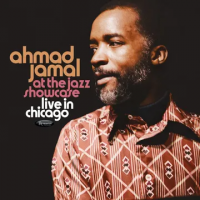
Ahmad Jamal: At The Jazz Showcase: Live In Chicago
by Mike Jurkovic
There was something Buddha yet cool-as-all-hell about Ahmad Jamal. Who else would give the whole story away with the set-opening, barn-raising ingenuity of “Ahmad's Song"--a CV of everything Jamal--his musings on time and space; his insatiable swing-- and dares you to keep up on At The Jazz Showcase: Live in Chicago. A gig to remember, no matter what side of history it happened on, Jamal, bassist John Heard, and drummer Frank Gant take a chill, take-no- prisoners attitude at ...
Continue ReadingAhmad Jamal: At The Jazz Showcase: Live In Chicago
by Dan McClenaghan
Ahmad Jamal (1930 -2023) began his recording career in 1951, laying down the tracks to the 1959-released album The Piano Scene of Ahmad Jamal (Epic Records). It was a trio affair, with Jamal at the keyboard, Ray Crawford on guitar, along with bassists (separately) Ray Calhoun and Israel Crosby. But before those earlier sessions saw the light of day, Jamal's At The Pershing: But Not For Me (Argo Records, 1958) hit the record racks. Jamal had switched out the guitar ...
Continue ReadingHow Ahmad Jamal Got His Groove Back

by Chuck Lenatti
Part 1 | Part 2 | Part 3 | Part 4 Though he was well-versed in the musical vernacular of blues, big bands, bebop and hard bop, piano trios and singers, as well as European classical music, pianist Ahmad Jamal seemed out of step as jazz fused with rock and R&B in the 1970s. Doubling on the Fender Rhodes and frequently backed by singers and strings, Jamal's covers of contemporary hits like Stevie Wonder's “Superstition," Marvin ...
Continue ReadingAhmad Jamal: Emerald City Nights: Live at the Penthouse, 1966-1968

by Stefano Merighi
Il terzo volume della serie “Emerald City Nights" del trio di Ahmad Jamal documenta alcune serate al Penthouse di Seattle nel triennio 1966-68. L'edizione è assai curata e firmata da Zev Feldman per il suo marchio Jazz Detective. Jamal, pianista stimatissimo da molti maestri del jazz fin dai suoi esordi, confermava in queste esibizioni di guardare obliquamente la storia del jazz moderno, dal bebop fino al modale, da una posizione del tutto originale, magari con un atteggiamento eclettico ...
Continue ReadingAhmad Jamal Plugs In: Funk, Fusion and the Fender Rhodes

by Chuck Lenatti
Part 1 | Part 2 | Part 3 | Part 4 During the politically and culturally turbulent late 1960s and '70s, many jazz musicians attempted to appeal to a younger and more diverse audience that grew up listening to artists such as James Brown, Jimi Hendrix and Sly Stone rather than Louis Armstrong, Duke Ellington or Charlie Parker. Miles Davis was the catalyst. Released in 1969, Miles Davis' seminal album Bitches Brew (Columbia GP ...
Continue ReadingAhmad Jamal: After Poinciana

by Chuck Lenatti
Part 1 | Part 2 | Part 3 | Part 4 On Location and at the Penthouse In an apparent effort to capitalize on the new-found popularity from his 1958 record, At the Pershing, But Not for Me (Argo LP628), Ahmad Jamal released a flurry of albums between 1958 and 1970, many of them recorded on location. Musically, it was a very productive period for Jamal, and these 20-plus albums do nothing to tarnish Jamal and his ensembles' ...
Continue ReadingAhmad Jamal: An American Classic

by Chuck Lenatti
Part 1 | Part 2 | Part 3 | Part 4 1930-1958: From Pittsburgh to The Pershing Frederick Russell Jones was born on July 2, 1930, to a working-class family in jny: Pittsburgh. His friends called him Fritz. As a boy, he delivered newspapers to Billy Strayhorn's family. He converted to Islam around 1950 and took the name Ahmad Jamal. His family identified him as a child prodigy at the tender age of three after his ...
Continue ReadingJazz Musician of the Day: Ahmad Jamal

Source:
Michael Ricci
All About Jazz is celebrating Ahmad Jamal's birthday today!
In 1951, Mr. Jamal first recorded 'Ahmad's Blues' on Okeh Records. His arrangement of the folk tune 'Billy Boy', and 'Poinciana' (not his original composition), also stem from this period. In 1955, he recorded his first Argo (Chess) Records album that included 'New Rhumba', 'Excerpts From The Blues', 'Medley' (actually 'I Don't Want To Be Kissed'), and 'It Ain't Necessarily So' —all later utilized by Miles Davis and Gil Evans on ...
read more
Ahmad Jamal: 1930-2023
Source:
JazzWax by Marc Myers
Ahmad Jamal, whose spare but highly melodic piano style on trio recordings beginning in 1951 transformed the sound of the jazz piano and deeply influenced Miles Davis and Red Garland, died on April 16. He was 92. At the dawn of the 1950s, Jamal's gleeful and relaxed style was a radical departure from other piano approaches at the time, when thick chords and a strong left hand held sway on the jazz piano. While critics would scoff at Jamal's recordings ...
read more
Ahmad Jamal: Complete Okeh, Parrot & Epic

Source:
JazzWax by Marc Myers
There's always plenty of talk about musicians who had an enormous impact on jazz's direction. From Coleman Hawkins and Lester Young to Charlie Parker, Kenny Clarke, Miles Davis, Horace Silver, Lennie Tristano, Shorty Rogers, Sonny Rollins, Clifford Brown, Bill Evans, John Coltrane and beyond. Always skipped over, for some reason, is Ahmad Jamal. Now Fresh Sound has released an extraordinary two-CD box that is sure to get you to reconsider: Ahmad Jamal's Three Strings: The Complete Okeh, Parrot & Epic ...
read more
Jazz Musician of the Day: Ahmad Jamal
Source:
Michael Ricci
All About Jazz is celebrating Ahmad Jamal's birthday today!
In 1951, Mr. Jamal first recorded 'Ahmad's Blues' on Okeh Records. His arrangement of the folk tune 'Billy Boy', and 'Poinciana' (not his original composition), also stem from this period. In 1955, he recorded his first Argo (Chess) Records album that included 'New Rhumba', 'Excerpts From The Blues', 'Medley' (actually 'I Don't Want To Be Kissed'), and 'It Ain't Necessarily So' —all later utilized by Miles Davis and Gil Evans on ...
read more
Jazz Musician of the Day: Ahmad Jamal
Source:
Michael Ricci
All About Jazz is celebrating Ahmad Jamal's birthday today!
In 1951, Mr. Jamal first recorded 'Ahmad's Blues' on Okeh Records. His arrangement of the folk tune 'Billy Boy', and 'Poinciana' (not his original composition), also stem from this period. In 1955, he recorded his first Argo (Chess) Records album that included 'New Rhumba', 'Excerpts From The Blues', 'Medley' (actually 'I Don't Want To Be Kissed'), and 'It Ain't Necessarily So' —all later utilized by Miles Davis and Gil Evans on ...
read more
Jazz Musician of the Day: Ahmad Jamal
Source:
Michael Ricci
All About Jazz is celebrating Ahmad Jamal's birthday today!
In 1951, Mr. Jamal first recorded 'Ahmad's Blues' on Okeh Records. His arrangement of the folk tune 'Billy Boy', and 'Poinciana' (not his original composition), also stem from this period. In 1955, he recorded his first Argo (Chess) Records album that included 'New Rhumba', 'Excerpts From The Blues', 'Medley' (actually 'I Don't Want To Be Kissed'), and 'It Ain't Necessarily So' —all later utilized by Miles Davis and Gil Evans on ...
read more
StLJN Saturday Video Showcase: Spotlight on Ahmad Jamal
Source:
St. Louis Jazz Notes by Dean Minderman
This week, let's check out some videos featuring pianist Ahmad Jamal, who will be performing Saturday, March 30 at the annual benefit gala for the Sheldon Concert Hall and Art Galleries. Jamal, who's now 88 years old and plays only a select number of dates per year, is a native of Pittsburgh who began his musical career in the late 1940s, reaching international stardom a decade later with the release of his album Live at the Pershing. Recorded at a ...
read more
Ahmad Jamal and Fender Rhodes

Source:
JazzWax by Marc Myers
We tend to think of Ahamd Jamal as a pioneer of the elegant jazz trio, a style he perfected in the 1950s by making ample use of space, swing and the upper register of the piano keyboard. Or we think of Ahmad's more recent abstract recordings that are bold and percussive. In between, there was a brief period when Ahmad recorded on the Fender Rhodes electric piano. He released only three studio albums on which he recorded extensively on the ...
read more



Darryl Alexander Sr.
drums
Hal Galper
piano
Mark Kramer
piano
Reuel Lubag
piano
Richie Pratt
drums
Wajdi Cherif
piano
Gwen Sampé
vocals
Larry Davis
bass
Steve Rudolph
piano
Dawn Clement
piano
Mariah Parker
piano
Mboya Nicholson
piano
Ryan Burns
piano
Andy Wasserman
piano
James Weidman
piano
Joe Alterman
piano
Franz von Chossy
piano
David Udolf
piano
Tobias Gebb
drums
Bennett Paster
piano
Lefteris Kordis
piano
Joshua Bowlus
piano
Lauren Henderson
vocals
Ben Bilello
drums
Jesse Fischer
keyboards
Dimitri Nassar
piano
Keith Brown
piano
Alex Chadsey
piano
Darrell Lavigne
piano
Matthew Whitaker
organ, Hammond B3
Bill Laurance
piano
Chris McCarthy
piano
Eran Har Even
guitar
Andrea Garibaldi
piano
Ben Wilcock
piano
Anton DeFade
bass
Tom Kalnes
piano
Brian Ward
piano
Keith L. Brown
piano
Borys Janczarski
saxophone
Inbar Paz
bass, acoustic
Carlos Barba
piano
Noa Levy
vocals
Tom Hensley
piano
Ben Tweedt
piano
Tal Klein
piano
Cody Steinmann
guitar
Eivind Austad
piano
James Edward Hill
piano
Marco Cremaschini
piano
Jazz Interlude
band / ensemble / orchestra
DeWitt Fleming Jr
percussion
Louise Denson
piano
Guy Mintus Trio
band / ensemble / orchestraTissa Khosla
saxophone
Spencer Zweifel
piano
Hannah Barstow
piano
Gabriel Judet-Weinshel
composer / conductor
Ken Powe
piano
Zachary McDonald
bass, electric
Or Shovaly
guitar
Alfred Yun
piano
Jacob Hurlock
piano
Randolph Noel
piano
Matt Peterson
piano
Geoffrey Dean
piano
Katia Toobool
piano
Giacinto Piracci
guitar
Anirudh Chakravarthy
saxophone, tenor
Cody McCafferty
saxophone, tenor
Brian D Ward
piano
Sara Magnúsdóttir
organ, Hammond B3
Silva & Steini
band / ensemble / orchestra
Jonah David
drums
Eli Leder
bass, acoustic
Joe Gold
composer / conductor
Edwin Corne
guitar
The Commercialists
band / ensemble / orchestraPhotos
Music


Videos
Similar

Keith Jarrett
piano
Miles Davis
trumpet
Thelonious Monk
piano
Bill Evans
piano
Herbie Hancock
piano
Chick Corea
piano
Freddie Hubbard
trumpet
Cannonball Adderley
saxophone
McCoy Tyner
piano
Red Garland
piano
Bud Powell
piano
Wynton Kelly
piano
Erroll Garner
piano
Ramsey Lewis
piano