Home » Jazz Articles » Album Review » Rahul Mukerji: Mridhangit
Rahul Mukerji: Mridhangit

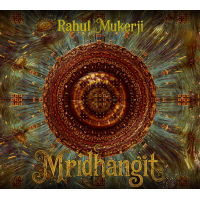
The compositions are concise, introducing their melodic core with little delay before unfolding into densely layered arrangements. Yet Mridhangit is most persuasive when it is given room to breathe. This is especially evident in the more relaxed, atmospheric pieces ("Twelve Ganeshas," "Enjoymaddi") and the funk-inflected grooves of "Kalli Penn" and "Funky Pakora"; to an extent, even tracks driven by more angular guitar heroics, such as "Rahu Ketu," benefit from this spaciousness. A sense of unrestrained velocity and exuberance courses through the album, with relentless soloing woven around the mridangam and tabla patterns.
The album's fusion vocabulary evokes less the jazz-rock spiritualism of John McLaughlin's Mahavishnu Orchestra or Ralph Towner's Oregon, and more often recalls Steve Hackett's multifaceted engagements with Middle Eastern and Far Eastern melodic traditions. "Funky Pakora," guided by clarinet lines and buoyed by clear, driving melodies, establishes an expansive atmosphere, while elsewhere the music acquires an elastic buoyancy through its guttural bass work—almost as though it were situated across the street from Jonas Hellborg's mansion of funky ragas. At any moment, this fluidity can erupt into distorted, quasi-orchestral guitar detonations, as in "Dushtan." Most tracks function as dialogues or trios, yet it is in the latter format that the music truly catches fire, at times approaching the combustible interplay of the Bozzio-Levin-Stevens (Terry Bozzio-Tony Levin-Steve Stevens) records.
Fortunately, Mridhangit is balanced rather than relentless, closing with two contemplative statements. "Four Seas" allows space and emotional resonance to take precedence; its understated beauty leaves the listener lingering over its brevity. "Mutabor," meanwhile, eases the album toward its conclusion through yearning duduk melodies and shimmering tabla rhythms underpinning a circular guitar motif. Even at 50 minutes, the record retains a sense of momentum, deftly guiding the listener through a broad emotional spectrum—from a tandavam dawn to an abhoga dusk. One can only hope that Mukerji will eventually devote an entire record to the more subdued incarnations of his otherwise intensely kinetic music.
Track Listing
Mr. Sinister; Bheja Fry; Twelve Ganeshas; Enjoymaddi; Mridhangit; Kalli Penn; Funky Pakora; Dushtan; Rahu Ketu; Four Seas; Mutabor.
Personnel

Rahul Mukerji
guitarLeo Margarit
drumsRubén Rubio
bassRafael Freitas
bassPraveen Sparsh
percussionRahul Krishnan
fluteAlejo Perezcuba
percussionDylan
clarinetEmi Romero
keyboardsThisara Bandara
violinAdditional Instrumentation
Rahul Mukerji: keyboards, tabla programming, handpan, percussion programming; Rubén Rubio: fretless bass; Praveen Sparsh: mridangam, konnakol (spoken rhythms); Maciej S: upright bass; Chaplin: piano, keyboards; Rahul Krishnan: tablas; Erkan Erginci: duduk (double-reed aerophone).
Album information
Title: Mridhangit | Year Released: 2026 | Record Label: Self Produced
Tags
Rahul Mukerji
Album Review
Maciej Stasiowski
Mridhangit
Self Produced
Ma De Re Sha
Mahavishnu Orchestra
Oregon
Jonas Hellborg
PREVIOUS / NEXT


Support All About Jazz
 All About Jazz has been a pillar of jazz since 1995, championing it as an art form and, more importantly, supporting the musicians who make it. Our enduring commitment has made "AAJ" one of the most culturally important websites of its kind, read by hundreds of thousands of fans, musicians and industry figures every month.